


The powerful earthquake that struck Taiwan yesterday morning killed nine people and left 17 buildings askew in Hualien County, including two that had partially collapsed, government officials said.
Mudslides and rockfalls also damaged multiple tunnels and were responsible for almost all loss of life in the county, which was closest to the earthquake’s epicenter.
Tien Wang Hsing Building (天王星大樓), an eight-story mixed-use tower, partially collapsed after developing a 60° slant, the Hualien County Fire Department said.
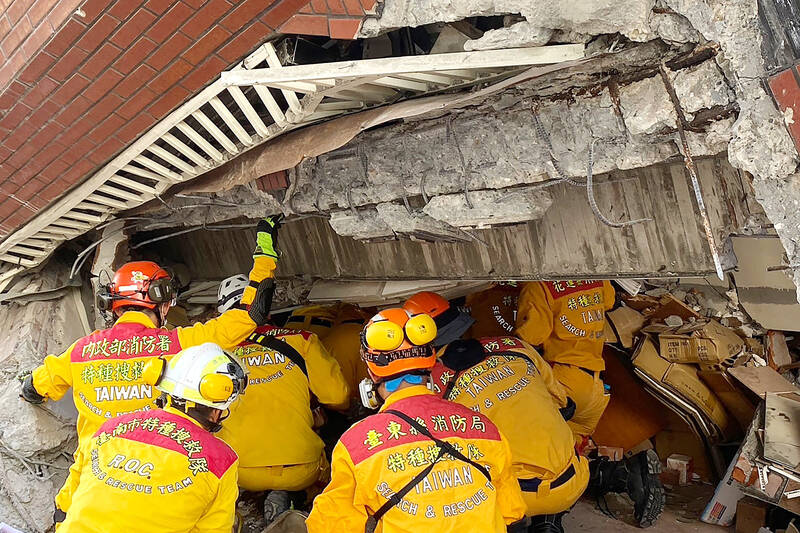
Photo: AFP / National Fire Agency
One woman was found dead trapped beneath the rubble and 23 were rescued from the site, it said, adding that efforts to extricate the dead from the debris were ongoing.
A four-story residential building on Beibin Street partially collapsed, crushing the first floor, but caused no loss of life, the department said.
Four women were reportedly killed by falling rocks in Taroko National Park, including three hikers on the Dekalun Trail (得卡倫步道) and an engineer accompanying her husband doing roadwork on Provincial Highway No. 8.
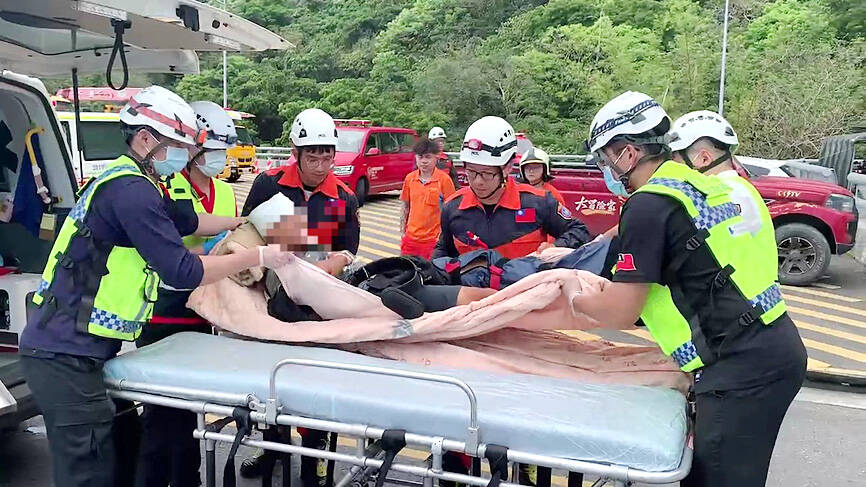
Photo courtesy of the Yilan County Fire Bureau
Another unidentified body of a man was found along a section of the highway outside the park who appeared to be a slope maintenance worker.
A truck driver was reportedly killed by a fallen boulder along the Suhua Highway (part of Provincial Highway No. 9), while another motorist was hit by falling debris in the Dacingshuei Tunnel (大清水隧道).
A man was struck dead by rocks at a parking lot near the Hueide Tunnel (匯德隧道).
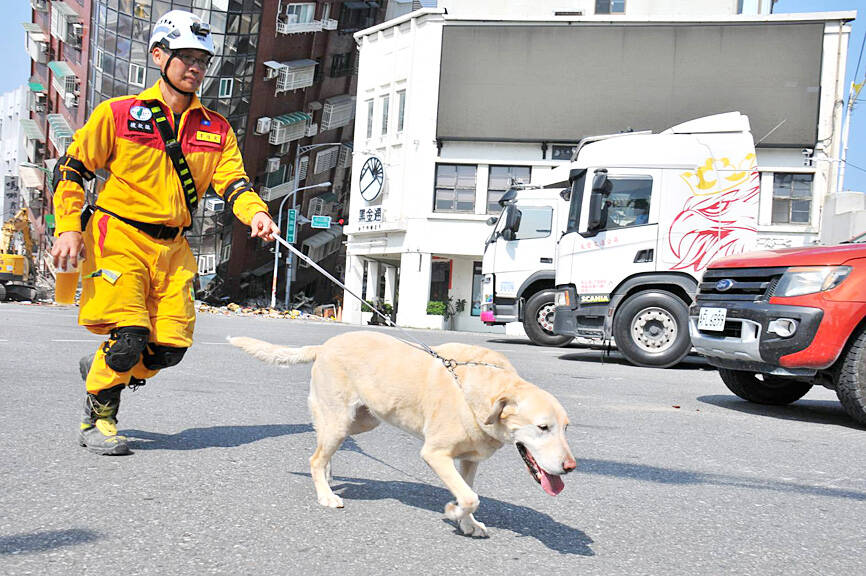
Photo: Hua Meng-ching, Taipei Times
Another man was killed working in Taiwan Cement Heren (和仁) mining area, also hit by falling rocks. Six people were trapped.
The Central Emergency Operation Center said that two people were still trapped in Chongde Tunnel (崇德隧道).
Minister of the Interior Lin Yu-chang (林右昌) said in an evening briefing that rescue workers made contact with 15 people trapped in the Dacingshuei Tunnel and about 60 people trapped in the Jinwun Tunnel (錦文隧道).
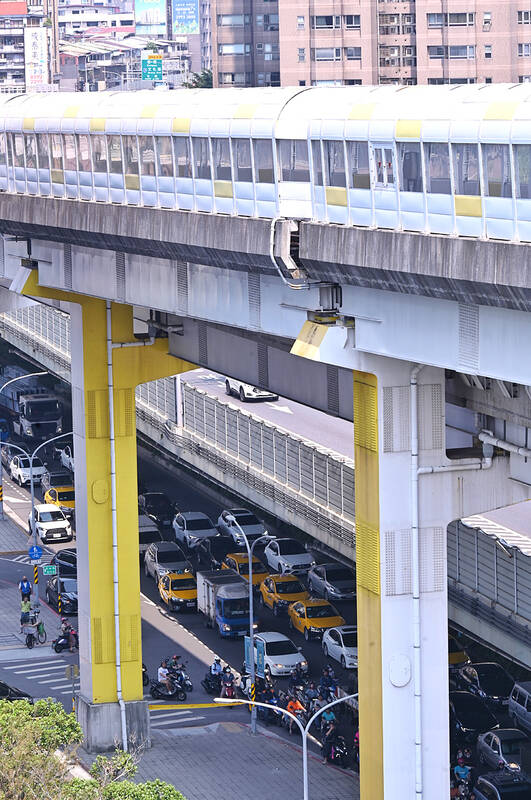
Photo: Liu Hsin-de, Taipei Times
The rescue of both groups was expected to be completed by 6pm last night.
In addition, four minibuses carrying 50 employees of the Silks Place Taroko hotel could not be reached, but were traced by a GPS signal to Taroko National Park’s Tunnel of Nine Turns (九轉洞), he said.
A rescue team was searching for the missing minibuses, he said.
Three of the employees in the minibuses walked out of the tunnel and returned to the hotel by themselves, the Highway Bureau said, adding that it anticipated freeing the rest before midnight.
Separately, New Taipei City reported a total of eight structures tilted or collapsed following the quake.
A warehouse reportedly collapsed in New Taipei City’s Jhonghe District (中和), with four people injured, but not in critical condition, and everyone else was accounted for, the New Taipei City Fire Department said.
Thirteen residents from eight households were evacuated from a structure in the city’s Sindian District (新店) that partially sank into its foundations, it said, adding that no one was hurt or trapped.
The earthquake also bent a section of the metro system’s rails out of shape, causing stoppages on the Circular line, the New Taipei City Department of Rapid Transit Systems said.
The damage occurred on the bridge between Zhongyuan and Jingan stations, it said, adding that the automatic stop system was activated to allow passengers to evacuate on foot.

Considering that most countries issue more than five denominations of banknotes, the central bank has decided to redesign all five denominations, the bank said as it prepares for the first major overhaul of the banknotes in more than 24 years. Central bank Governor Yang Chin-lung (楊金龍) is expected to report to the Legislative Yuan today on the bank’s operations and the redesign’s progress. The bank in a report sent to the legislature ahead of today’s meeting said it had commissioned a survey on the public’s preferences. Survey results showed that NT$100 and NT$1,000 banknotes are the most commonly used, while NT$200 and NT$2,000

The Centers for Disease Control (CDC) yesterday reported the first case of a new COVID-19 subvariant — BA.3.2 — in a 10-year-old Singaporean girl who had a fever upon arrival in Taiwan and tested positive for the disease. The girl left Taiwan on March 20 and the case did not have a direct impact on the local community, it said. The WHO added the BA.3.2 strain to its list of Variants Under Monitoring in December last year, but this was the first imported case of the COVID-19 variant in Taiwan, CDC Deputy Director-General Lin Ming-cheng (林明誠) said. The girl arrived in Taiwan on

South Korea is planning to revise its controversial electronic arrival card, a step Taiwanese officials said prompted them to hold off on planned retaliatory measures, a South Korean media report said yesterday. A Yonhap News Agency report said that the South Korean Ministry of Foreign Affairs is planning to remove the “previous departure place” and “next destination” fields from its e-arrival card system. The plan, reached after interagency consultations, is under review and aims to simplify entry procedures and align the electronic form with the paper version, a South Korean ministry official said. The fields — which appeared only on the electronic form

The Ministry of Foreign Affairs (MOFA) is suspending retaliation measures against South Korea that were set to take effect tomorrow, after Seoul said it is updating its e-arrival system, MOFA said today. The measures were to be a new round of retaliation after Taiwan on March 1 changed South Korea's designation on government-issued alien resident certificates held by South Korean nationals to "South Korea” from the "Republic of Korea," the country’s official name. The move came after months of protests to Seoul over its listing of Taiwan as "China (Taiwan)" in dropdown menus on its new online immigration entry system. MOFA last week


 RSS
RSS