


A draft statute governing the construction of an expressway connecting Hualien and Taitung, proposed by Chinese Nationalist Party (KMT) Legislator Fu Kun-chi (傅崑萁), would be unconstitutional and would cause government spending to surge, the Ministry of Transportation and Communications (MOTC) said in a written report to the legislature.
The legislature’s Transportation Committee is to deliberate on the proposed statute today.
Aside from the draft statute on the construction of the expressway, Fu also proposed a draft statute governing the construction of a high-speed rail system around Taiwan proper and the extension of the Shuishalian Freeway (Freeway No. 6), also known as the Central East-West Freeway, further east to Hualien.
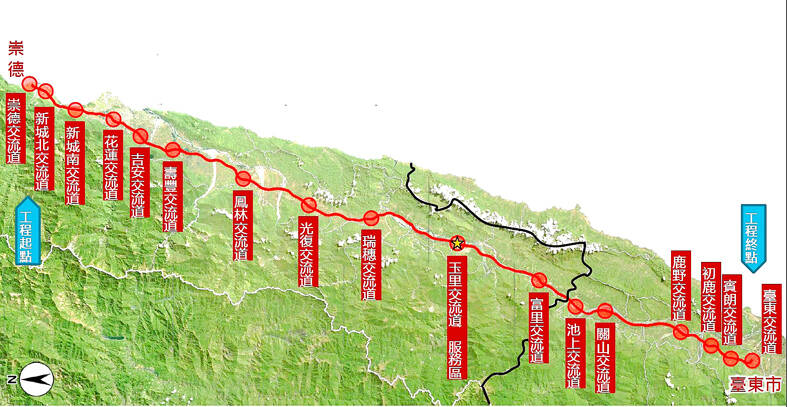
Photo courtesy of the Directorate General of Highways
Legislative Speaker Han Kuo-yu (韓國瑜) and Deputy Legislative Speaker Johnny Chiang (江啟臣) co-sponsored bills on the around-the-nation high-speed rail system and the extension of Freeway No. 6.
The ministry said it began re-evaluating the feasibility of building the Hualien-Taitung Expressway in October 2020, following a motion passed by the committee in December 2019, adding that the re-evaluation is to be completed in August this year.
The proposed expressway would be 174km long and pass through at least 11 villages of indigenous peoples, the ministry said.
There are agricultural districts, the East Rift Valley (花東縱谷), Dulan Mountain (都蘭山), the Liji Badlands (利吉惡地) and other geologically sensitive zones along the route as well, it added.
These factors would add to the complexity of the project when it is reviewed by members of the environmental impact assessment committee and are likely to trigger opposition from environmental activists, the ministry said.
Should the committee reject the project, the proposed statute would become unenforceable, it said.
The Indigenous Peoples Basic Act (原住民族基本法) also stipulates that any development projects on lands belonging to indigenous people can only proceed after securing their consent, the ministry added.
Construction of the Hualien-Taitung Expressway is roughly estimated to top NT$255.5 billion (US$7.99 million), it said.
“Based on the Constitution, the Legislative Yuan must not propose legislation that would increase the expenditure in the budget plan proposed by the Executive Yuan. As such, the proposed statute could lead to the debate [of] whether the legislative branch has intervened in the business of the executive branch,” the ministry said.
“We suggest that the project be assessed by professionals first, and certain parts of the project deemed feasible could be enforced based on the procedures for short-term or long-term plans laid out by the Executive Yuan,” it said, adding that drafting a special statute for the project is unnecessary.
The ministry said it has spent more than NT$220 billion in recent years on improving railway and highway infrastructure in Hualien and Taitung.
“Our land transportation policy for the east coast focuses mainly on the railway system, with the highway system serving as a supplementary system. The goal is to make public transport the main means of transportation, supplemented by the use of private vehicles,” the ministry said.
Fast food chain McDonald's is to raise prices by up to NT$5 on some products at its restaurants across Taiwan, starting on Wednesday next week, the company announced today. The prices of all extra value meals and sharing boxes are to increase by NT$5, while breakfast combos and creamy corn soup would go up by NT$3, the company said in a statement. The price of the main items of those meals, if ordered individually, would remain the same. Meanwhile, the price of a medium-sized lemon iced tea and hot cappuccino would rise by NT$3, extra dipping sauces for chicken nuggets would go up

Nvidia Corp CEO Jensen Huang (黃仁勳) arrived in Taiwan yesterday ahead of upcoming AI and technology events, saying he plans to meet with clients and Taiwan Semiconductor Manufacturing Co Chairman C.C. Wei (魏哲家) during his visit. After landing at Taipei Songshan Airport, Huang posed for photos with fans and handed out Yakult drinks to reporters and supporters waiting at the scene, saying he has “a lot to do” during the trip. Asked about reports that Nvidia’s planned headquarters site in Taipei’s Beitou Shilin Technology Park could break ground on May 27, Huang said that if the company holds an event, he would

FUKUOKA SITUATION: Japanese media reported that the pathogen is expected to be identified by the summer, while the CDC downplayed the idea that it was hMPV A “mysterious cold-like illness” reported in Japan’s Fukuoka Prefecture does not seem to be a new disease, but Japanese authorities have been asked about the situation, the Centers for Disease Control (CDC) said yesterday. The Fukuoka Prefectural Medical Association on Wednesday told a news conference that a “mystery cold” that has become a hot topic on social media is “highly likely to be caused by some kind of viral infection,” Japan’s KBC News reported. “Many people are experiencing symptoms starting with a sore throat, followed by a runny nose, phlegm and a severe cough,” KBC News reported, citing association officials. Health authorities are

Carrefour Taiwan is to begin using a new name from the start of July, but it cannot divulge the name until then, the chairman of the supermarket chain's parent company said today. President Chain Store Co chairman Lo Chih-hsien (羅智先) was asked by reporters after a shareholders' meeting to confirm whether the company has settled on a new name for the supermarket brand. In March, the government-registered name of two Carrefour Taiwan branches was quietly changed to "Le Chia Kang" (樂家康) in Chinese, raising speculation that has been selected as the name. Lo said that because of local regulations and contractual obligations, the


 RSS
RSS