


President-elect William Lai (賴清德) yesterday visited the Asia UAV AI Innovation Application R&D Center in Chiayi County to get an insight into Taiwan’s emerging drone industry, before visiting defense units in southern Taiwan in preparation for taking over the presidency in May.
Like his recent engagement with semiconductor companies in Hsinchu, Lai said the purpose of the visit was to engage in face-to-face dialogue with industry operators.
The vice president said his upcoming administration looks forward to working with domestic drone businesses as they overcome challenges, continue making advances and expand their global reach.
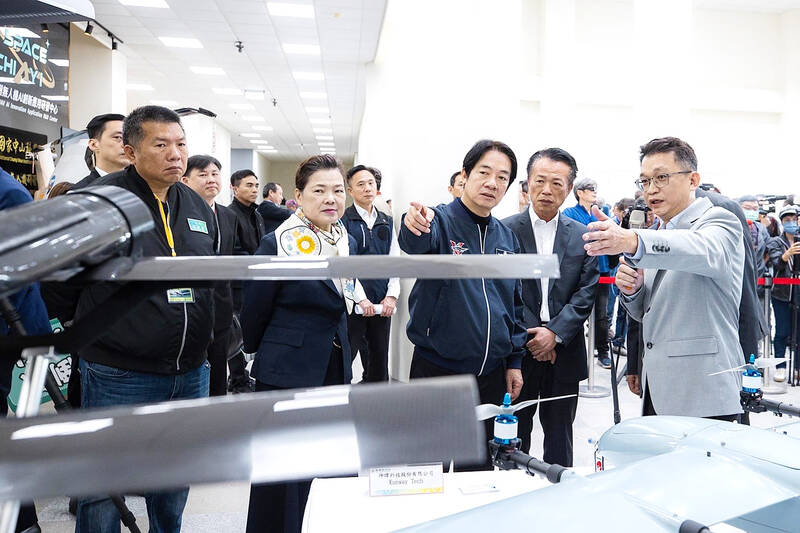
Photo from William Lai’s Facebook page
Uncrewed surface vessels have great development potential and are expected to bring new advances to the domestic drone industry, Thunder Tiger Corp chairman Chen Kuan-ju (陳冠如) told Lai.
Drones can also play a land, sea and air deterrence role, he said.
Taiwan operates three types of commercial drones for military use, not including uncrewed surface vessels, which could play an essential role in deterring Chinese vessels from entering Taiwan’s territorial waters, he said.
Drones have played a key role in the Russia-Ukraine war and have become a major emerging industry in the past few years, a business operator who preferred not to be named said.
Taiwan’s highly developed information and communications technology industry could serve as an important foundation in the development of drone technology, the person added.
Lai said that national defense and the economy are the two pillars that support the survival and development of a country.
Besides visiting several sites relevant to major industries, the president-elect said that he also intends to get a grip on matters related to national defense and national security before he takes office on May 20.
Lai spent the afternoon visiting an air defense military unit in southern Taiwan. The exact location was not disclosed.

Considering that most countries issue more than five denominations of banknotes, the central bank has decided to redesign all five denominations, the bank said as it prepares for the first major overhaul of the banknotes in more than 24 years. Central bank Governor Yang Chin-lung (楊金龍) is expected to report to the Legislative Yuan today on the bank’s operations and the redesign’s progress. The bank in a report sent to the legislature ahead of today’s meeting said it had commissioned a survey on the public’s preferences. Survey results showed that NT$100 and NT$1,000 banknotes are the most commonly used, while NT$200 and NT$2,000

The Centers for Disease Control (CDC) yesterday reported the first case of a new COVID-19 subvariant — BA.3.2 — in a 10-year-old Singaporean girl who had a fever upon arrival in Taiwan and tested positive for the disease. The girl left Taiwan on March 20 and the case did not have a direct impact on the local community, it said. The WHO added the BA.3.2 strain to its list of Variants Under Monitoring in December last year, but this was the first imported case of the COVID-19 variant in Taiwan, CDC Deputy Director-General Lin Ming-cheng (林明誠) said. The girl arrived in Taiwan on

South Korea is planning to revise its controversial electronic arrival card, a step Taiwanese officials said prompted them to hold off on planned retaliatory measures, a South Korean media report said yesterday. A Yonhap News Agency report said that the South Korean Ministry of Foreign Affairs is planning to remove the “previous departure place” and “next destination” fields from its e-arrival card system. The plan, reached after interagency consultations, is under review and aims to simplify entry procedures and align the electronic form with the paper version, a South Korean ministry official said. The fields — which appeared only on the electronic form

The Ministry of Foreign Affairs (MOFA) is suspending retaliation measures against South Korea that were set to take effect tomorrow, after Seoul said it is updating its e-arrival system, MOFA said today. The measures were to be a new round of retaliation after Taiwan on March 1 changed South Korea's designation on government-issued alien resident certificates held by South Korean nationals to "South Korea” from the "Republic of Korea," the country’s official name. The move came after months of protests to Seoul over its listing of Taiwan as "China (Taiwan)" in dropdown menus on its new online immigration entry system. MOFA last week


 RSS
RSS