


Taiwan ranked 31st in this year’s World Happiness Report released on Wednesday, coming second in East Asia behind Singapore.
The annual World Happiness Report, launched in 2012 to support the UN's sustainable development goals, is based on data from US market research company Gallup, analyzed by a global team now led by the University of Oxford.
People in 143 countries and territories are asked to evaluate their life on a scale from zero to 10, with 10 representing their best possible life.
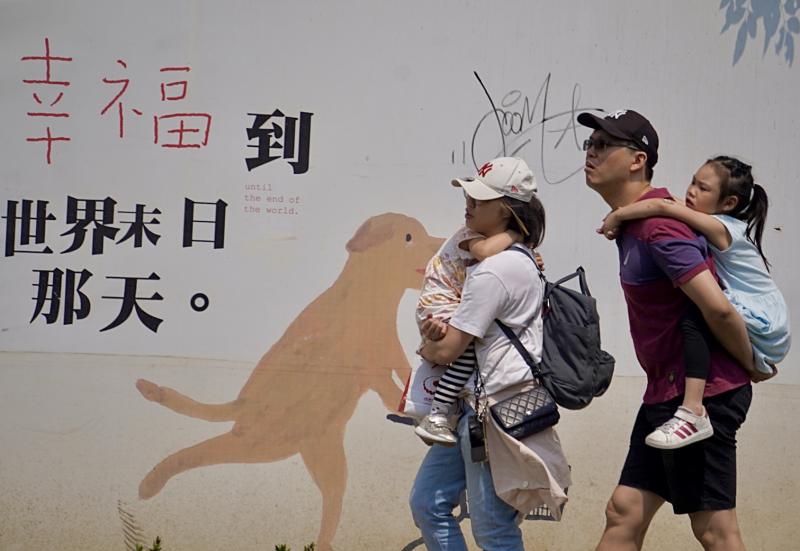
Photo: CNA
Results from the past three years are averaged to create a ranking.
Taiwan this year ranked 31st globally with a score of 6.503, behind its ranking of 27th in last year’s report.
However, it retained its status as the second-happiest place in East Asia just behind Singapore at No. 30 with a score of 6.523.
This year’s report also looked at happiness by age, finding that young Taiwanese aged below 30 were 25th-happiest in the world, the highest in East Asia.
Those aged 60 and above came in at No. 34 globally, behind Singapore at No. 26 and China at No. 30.
The findings suggest that overall, young people are happiest in Taiwan, while older people are the least happy.
Looking outside of Asia, the index found rising unhappiness among younger people, causing the US and some large western European countries to fall down the ranking, while Nordic nations retained their grip on the top.
Finland remained in the top spot with an average score of 7.741, followed closely by Denmark, Iceland and Sweden, while Afghanistan and Lebanon held the bottom two spots with scores of 1.721 and 2.707 respectively.
In broad terms, the rankings are loosely correlated with countries' prosperity, but other factors such as life expectancy, social bonds, personal freedom and corruption appear to influence individuals' assessments as well.
The US dropped out of the top 20 for the first time, falling to 23rd place from 15th last year, due to a big drop in the sense of wellbeing of Americans aged under 30.
While a global ranking of the happiness of those aged 60 and over would place the US 10th, under 30s' life evaluations alone put the US in 62nd place.
The findings are at odds with much previous research into wellbeing, which found happiness highest in childhood and early teens, before falling to its lowest in middle age, then rising around retirement.
While the phenomenon is starkest in the US, the age gap in wellbeing is also wide in Canada and Japan, and to a decreasing extent in France, Germany and Britain, which all lost ground in this year's rankings.
By contrast, many of the countries with the biggest improvements in wellbeing are former communist countries in central and eastern Europe.
There, unlike in richer countries, young people report significantly better quality of life than older people, often on a par or better than in western Europe.
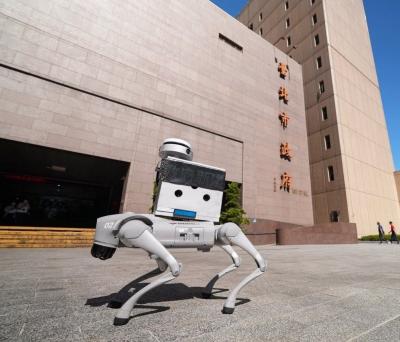
The inspection equipment and data transmission system for new robotic dogs that Taipei is planning to use for sidewalk patrols were developed by a Taiwanese company, the city’s New Construction Office said today, dismissing concerns that the China-made robots could pose a security risk. The city is bringing in smart robotic dogs to help with sidewalk inspections, Taipei Deputy Mayor Lee Ssu-chuan (李四川) said on Facebook. Equipped with a panoramic surveillance system, the robots would be able to automatically flag problems and easily navigate narrow sidewalks, making inspections faster and more accurate, Lee said. By collecting more accurate data, they would help Taipei
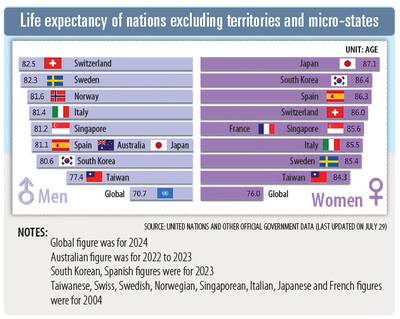
STATS: Taiwan’s average life expectancy of 80.77 years was lower than that of Japan, Singapore and South Korea, but higher than in China, Malaysia and Indonesia Taiwan’s average life expectancy last year increased to 80.77 years, but was still not back to its pre-COVID-19 pandemic peak of 81.32 years in 2020, the Ministry of the Interior said yesterday. The average life expectancy last year increased the 0.54 years from 2023, the ministry said in a statement. For men and women, the average life expectancy last year was 77.42 years and 84.30 years respectively, up 0.48 years and 0.56 years from the previous year. Taiwan’s average life expectancy peaked at 81.32 years in 2020, as the nation was relatively unaffected by the pandemic that year. The metric

TAKING STOCK: The USMC is rebuilding a once-abandoned airfield in Palau to support large-scale ground operations as China’s missile range grows, Naval News reported The US Marine Corps (USMC) is considering new sites for stockpiling equipment in the West Pacific to harden military supply chains and enhance mobility across the Indo-Pacific region, US-based Naval News reported on Saturday. The proposed sites in Palau — one of Taiwan’s diplomatic allies — and Australia would enable a “rapid standup of stored equipment within a year” of the program’s approval, the report said, citing documents published by the USMC last month. In Palau, the service is rebuilding a formerly abandoned World War II-era airfield and establishing ancillary structures to support large-scale ground operations “as China’s missile range and magazine
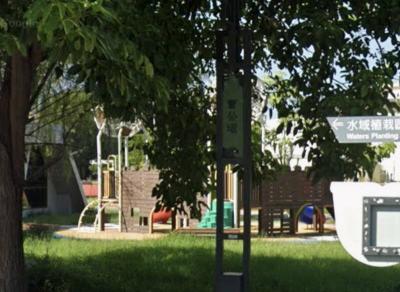
A 72-year-old man in Kaohsiung was sentenced to 40 days in jail after he was found having sex with a 67-year-old woman under a slide in a public park on Sunday afternoon. At 3pm on Sunday, a mother surnamed Liang (梁) was with her child at a neighborhood park when they found the man, surnamed Tsai (蔡), and woman, surnamed Huang (黃), underneath the slide. Liang took her child away from the scene, took photographs of the two and called the police, who arrived and arrested the couple. During questioning, Tsai told police that he had met Huang that day and offered to


 RSS
RSS