


Beijing would use “gray zone” tactics to push president-elect William Lai (賴清德) to adopt a cross-strait policy in line with its “one China” principle, a Taiwanese academic said in Taipei yesterday.
To ensure that Lai stays within a “one China” framework in his inauguration speech on May 20, as well as with his choices in appointing officials, Beijing would use military pressure through “gray zone” tactics and push the US to use its influence to sway decisions in Taipei, National Taiwan University professor of political science Tso Chen-dong (左正東) told a forum.
President Tsai Ing-wen (蔡英文) has stayed within the framework for most of her eight years in office, Tso said, citing sources that described Tsai’s inauguration speech in 2016 as her version of the “one China” policy.

Photo: CNA
Only in her Double Ten National Day address in 2021 did she show signs of “breaking out” of the framework by noting that “the Republic of China and the People’s Republic of China should not be subordinate to each other,” he said.
Lai put it more bluntly during his campaign last year when he stated that accepting the so-called “1992 consensus” would be equivalent to abandoning the sovereignty of Taiwan, he said.
The “1992 consensus” refers to a tacit understanding between the Chinese Nationalist Party (KMT) and the Chinese Communist Party (CCP) that both sides of the Taiwan Strait acknowledge that there is “one China,” with each side having its own interpretation of what “China” means.
Lai has repeatedly made clear his opposition to “one China,” Tso said, adding that how he is to put the words into policy is “a core question” for Taiwan-US-China ties.
Beijing is intensifying its “gray zone” tactics against Taiwan to force it to negotiate and compel Lai to adopt a cross-strait policy that is “acceptable or tolerable” for China, Tso said.
For example, China’s Taiwan Affairs Office last month stated that Beijing is willing to negotiate with Taipei as long as the Democratic Progressive Party accepts the “1992 consensus” after two Chinese died fleeing a Coast Guard Administration vessel in restricted waters near Kinmen County, he said.
China and the US restored high-level communications when Chinese President Xi Jinping (習近平) met with US President Joe Biden in November last year, and Beijing is hoping to use the US to restrain Lai, Tso said.
China is flexing its military muscles while avoiding giving the US reasons to take military counteractions, as well as advocating for “peaceful” unification with Taiwan, he said.
Leading up to the US presidential election in November, in which former US president Donald Trump and Biden are the presumed main candidates, Taiwan should not “bet on one side,” but be prepared to cooperate with whoever wins, Tamkang University Graduate Institute of International Affairs and Strategic Studies director Li Da-jung (李大中) said.
If Biden is re-elected, the US’ China policy is likely to be consistent; if Trump wins, the policy would be more unpredictable, Li said.
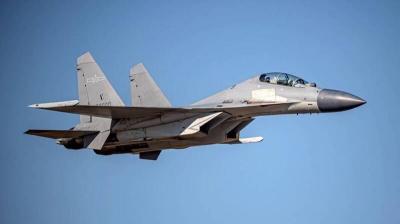
Eight Chinese naval vessels and 24 military aircraft were detected crossing the median line of the Taiwan Strait between 6am yesterday and 6am today, the Ministry of National Defense said this morning. The aircraft entered Taiwan’s northern, central, southwestern and eastern air defense identification zones, the ministry said. The armed forces responded with mission aircraft, naval vessels and shore-based missile systems to closely monitor the situation, it added. Eight naval vessels, one official ship and 36 aircraft sorties were spotted in total, the ministry said.
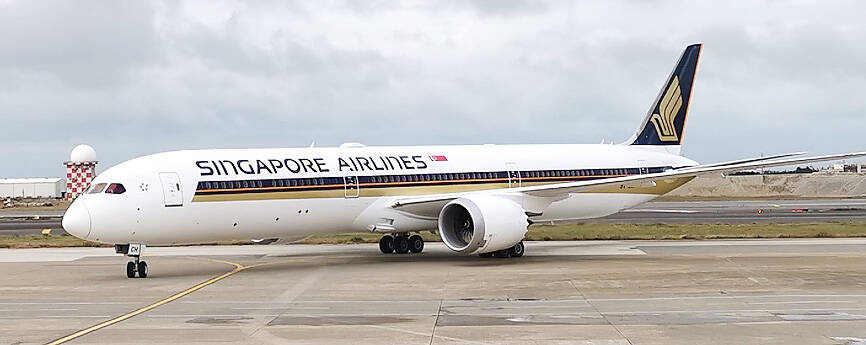
INCREASED CAPACITY: The flights on Mondays, Wednesdays, Fridays and Sundays would leave Singapore in the morning and Taipei in the afternoon Singapore Airlines is adding four supplementary flights to Taipei per week until May to meet increased tourist and business travel demand, the carrier said on Friday. The addition would raise the number of weekly flights it operates to Taipei to 18, Singapore Airlines Taiwan general manager Timothy Ouyang (歐陽漢源) said. The airline has recorded a steady rise in tourist and business travel to and from Taipei, and aims to provide more flexible travel arrangements for passengers, said Ouyang, who assumed the post in July last year. From now until Saturday next week, four additional flights would depart from Singapore on Monday, Wednesday, Friday
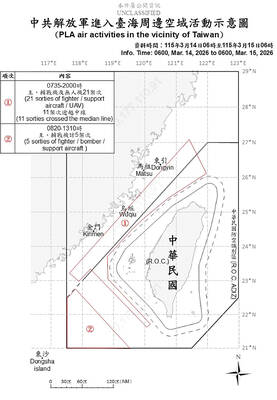
The Ministry of National Defense yesterday reported the return of large-scale Chinese air force activities after their unexplained absence for more than two weeks, which had prompted speculation regarding Beijing’s motives. China usually sends fighter jets, drones and other military aircraft around the nation on a daily basis. Interruptions to such routine are generally caused by bad weather. The Ministry of National Defense said it had detected 26 Chinese military aircraft in the Taiwan Strait over the previous 24 hours. It last reported that many aircraft on Feb. 25, when it spotted 30 aircraft, saying Beijing was carrying out another “joint combat
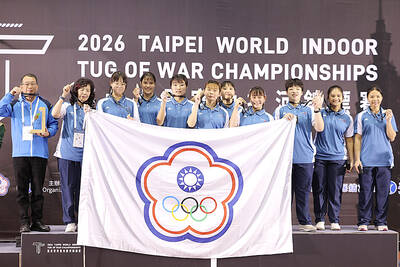
Taiwan successfully defended its women’s 540 kilogram title and won its first-ever men’s 640 kg title at the 2026 World Indoor Tug of War Championships in Taipei yesterday. In the women’s event, Taiwan’s eight-person squad reached the final following a round-robin preliminary round and semifinals featuring teams from Ukraine, Japan, Thailand, Vietnam, the Basque Country and South Korea. In the finals, they swept the Basque team 2-0, giving the team composed mainly of National Taiwan Normal University students and graduates its second championship in a row, and its fourth in five years. Team captain


 RSS
RSS