


Taiwan has performed relatively well in protecting government agencies and infrastructure from overseas cyberattacks, Minister of Digital Affairs Audrey Tang (唐鳳) said yesterday, following reports that China is recruiting private contractors to spy on dissenters and conduct cyberattacks.
Tang defended the Ministry of Digital Affairs’ performance in safeguarding the nation’s cybersecurity systems in a Yahoo talk show hosted by political commentator Wang Shi-chi (王時齊).
Taiwan experiences millions of cyberattacks and cybersecurity breach attempts every day, and the intensity of such attacks only increases when there is a major event, from the visit of then-US House of Representatives speaker Nancy Pelosi in August 2022, to the presidential and legislative elections in January, Tang said.
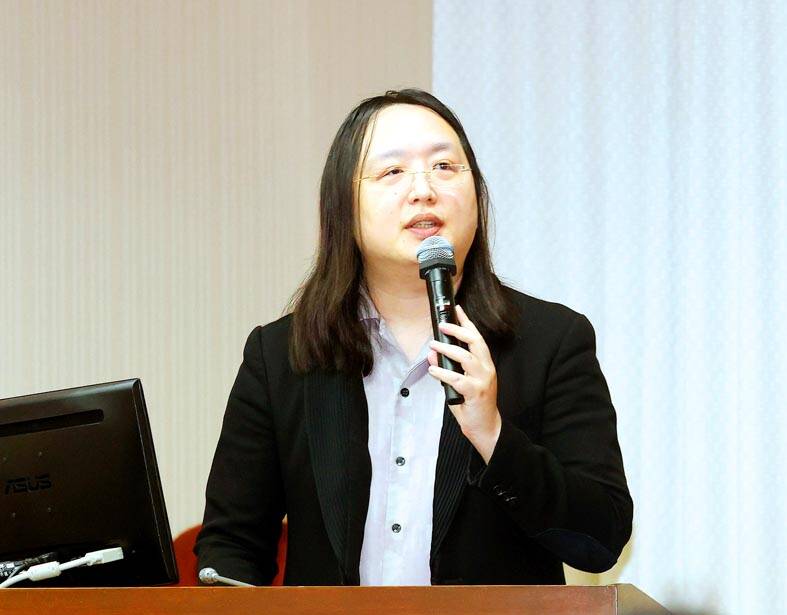
Photo: CNA
Staff at the National Institute of Cybersecurity are monitoring attacks against government agency Web sites and informing the authorities when attacks are detected, she said.
“Most cyberattacks target the external service portals of government agencies, including via messages to ministers,” Tang said. “Moreover, hackers need not actually break into the Web sites. All they have to do is prevent people from accessing the sites by freezing the pages.”
A recent Wall Street Journal report on leaked documents of Chinese cybersecurity firm I-Soon (安洵信息), a company that competed for Chinese government contracts, that private firms have been recruited by Beijing to monitor dissenters inside and outside its borders.
The documents were originally uploaded to an online platform for developers before being erased.
“What we have seen from the documents is that they launched cyberattacks against India, Thailand, Vietnam and NATO countries. However, their cyberattacks against government agencies and key infrastructure in Taiwan seemed less successful, as the report only mentioned that they only managed to hack three private firms in Taiwan,” Tang said, adding that the ministry has worked to protect Taiwan’s cybersecurity systems.
Cybersecurity experts from 18 countries were invited to Taiwan to engage in offensive and defensive cyberexercises, in which they tried launching cyberattacks against Taiwanese systems.
“Taiwan is often at the receiving end of the latest offensive cybertechnology. Through the exercises, these countries can also examine if they have experienced similar attacks,” Tang said. “If we can withstand new cyberattacks with these battle-tested measures, the measures can also be applied to help other countries resist cyberattacks.”
Cyberattacks could come from China or other hostile regimes, but can be difficult to trace as connections can be rerouted through several countries, she said.
“Different hackers specialize in different forms of cyberattacks, and they form support networks as well,” she said. “Once they detect changes in the way we defend against cyberattacks, they change their tactics, too.”
Taiwan has also formed a united front with other countries by sharing cybersecurity intelligence, and convinced Microsoft and other public firms to have operations here, she said.

Considering that most countries issue more than five denominations of banknotes, the central bank has decided to redesign all five denominations, the bank said as it prepares for the first major overhaul of the banknotes in more than 24 years. Central bank Governor Yang Chin-lung (楊金龍) is expected to report to the Legislative Yuan today on the bank’s operations and the redesign’s progress. The bank in a report sent to the legislature ahead of today’s meeting said it had commissioned a survey on the public’s preferences. Survey results showed that NT$100 and NT$1,000 banknotes are the most commonly used, while NT$200 and NT$2,000

The Centers for Disease Control (CDC) yesterday reported the first case of a new COVID-19 subvariant — BA.3.2 — in a 10-year-old Singaporean girl who had a fever upon arrival in Taiwan and tested positive for the disease. The girl left Taiwan on March 20 and the case did not have a direct impact on the local community, it said. The WHO added the BA.3.2 strain to its list of Variants Under Monitoring in December last year, but this was the first imported case of the COVID-19 variant in Taiwan, CDC Deputy Director-General Lin Ming-cheng (林明誠) said. The girl arrived in Taiwan on

South Korea is planning to revise its controversial electronic arrival card, a step Taiwanese officials said prompted them to hold off on planned retaliatory measures, a South Korean media report said yesterday. A Yonhap News Agency report said that the South Korean Ministry of Foreign Affairs is planning to remove the “previous departure place” and “next destination” fields from its e-arrival card system. The plan, reached after interagency consultations, is under review and aims to simplify entry procedures and align the electronic form with the paper version, a South Korean ministry official said. The fields — which appeared only on the electronic form

The Ministry of Foreign Affairs (MOFA) is suspending retaliation measures against South Korea that were set to take effect tomorrow, after Seoul said it is updating its e-arrival system, MOFA said today. The measures were to be a new round of retaliation after Taiwan on March 1 changed South Korea's designation on government-issued alien resident certificates held by South Korean nationals to "South Korea” from the "Republic of Korea," the country’s official name. The move came after months of protests to Seoul over its listing of Taiwan as "China (Taiwan)" in dropdown menus on its new online immigration entry system. MOFA last week


 RSS
RSS