


An investigation into the nation’s food safety mechanisms is under way to better protect public health, three Control Yuan members said yesterday, following January’s discovery of toxic dyes in chili powders circulating domestically.
Tien Chiu-chin (田秋堇), Lin Kuo-ming (林國明) and Tsai Chung-yi (蔡崇義) said they would focus on the food safety inspection system and prospective preventive measures to address public concerns, following the importation of chili powder shipments from China made with Sudan III dye, classified as toxic substances and banned in Taiwan.
As a result, the members of the top government watchdog said that they are investigating whether there are flaws in the Act Governing Food Safety and Sanitation (食品安全衛生管理法) and determining if improvements can be made to the legislation.
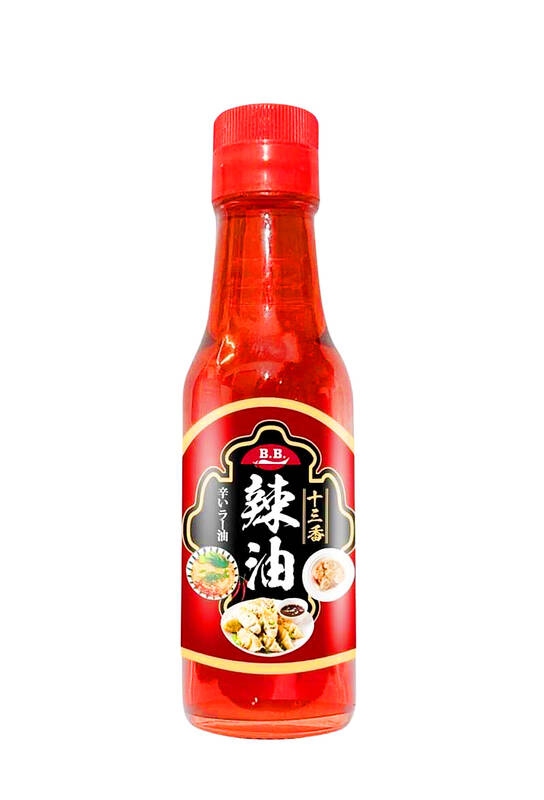
Photo: Screen grab from B.B. Chili Oil’s Web site
For instance, the act seems to have fallen short in ensuring effective food quality control, they said in a news release.
While the act mandates that listed food companies set up laboratories for voluntary product testing, smaller-scale businesses have been exempted from establishing similar mechanisms, they said.
There is no mention of penalties for failure to do so in the act, they said.
The chili powder situation came to light when the Yunlin Public Health Bureau on Feb. 8 reported that in late January it had found that red chili powder imported by a company in Taiwan contained 18 parts per billion of Sudan III.
That resulted in several food products across Taiwan, including spicy shrimp chips called Hsia Wei Hsien (蝦味先), being recalled over the past month. All 22 administrative regions have announced temporary bans on the use of chili and curry powders in school lunches.
The Food and Drug Administration (FDA) said that 127,089.2kg of chili powder and related products had been removed from shelves as of Thursday.
The FDA on Friday announced that all imported chili powder would be subject to shipment-by-shipment inspections at the border effective immediately.
The FDA said it would also broaden the ongoing inspection of chili powder imported from China.
As such, over the next month it would conduct retrospective random inspections at 29 local businesses that have imported Chinese chili powder in the past three years, the FDA said.
The FDA also disclosed the test results for 59 shipments of Chinese chili powder imported before Dec. 11 last year. Fourteen shipments did not meet inspection standards — which brought the number of tainted batches discovered to 18, it said.
The 59 shipments were imported from 21 Chinese exporters and manufacturers who were barred on Feb. 20 from shipping their products to Taiwan for three months due to violations of regulations.
Separately, the Taipei Department of Health on Friday said that 17,112 jars of chili oil found to contain the banned Sudan III dye had been supplied to PX Mart and that it ordered the supermarket chain to remove them from shelves.
The department said that all unsold jars had either been pulled or were in the process of being pulled, adding that members of the public who have already purchased the product can bring them along with a receipt to any PX Mart store for a refund.
During the inspections, it was found that the problematic “B.B. Chili Oil” that was manufactured by Tainan-based Mercy Food Co (慈光食品有限公司) had been supplied to PX Mart, it said.
The chili powder used to produce the chili oil was purchased from Kaohsiung-based Gin Zhan International Co (津棧國際貿易) and Chia Guang International Co (佳廣國際貿易), which imported it from China’s Kavin Shipping, it added.

FUKUOKA SITUATION: Japanese media reported that the pathogen is expected to be identified by the summer, while the CDC downplayed the idea that it was hMPV A “mysterious cold-like illness” reported in Japan’s Fukuoka Prefecture does not seem to be a new disease, but Japanese authorities have been asked about the situation, the Centers for Disease Control (CDC) said yesterday. The Fukuoka Prefectural Medical Association on Wednesday told a news conference that a “mystery cold” that has become a hot topic on social media is “highly likely to be caused by some kind of viral infection,” Japan’s KBC News reported. “Many people are experiencing symptoms starting with a sore throat, followed by a runny nose, phlegm and a severe cough,” KBC News reported, citing association officials. Health authorities are

Nvidia Corp CEO Jensen Huang (黃仁勳) arrived in Taiwan yesterday ahead of upcoming AI and technology events, saying he plans to meet with clients and Taiwan Semiconductor Manufacturing Co Chairman C.C. Wei (魏哲家) during his visit. After landing at Taipei Songshan Airport, Huang posed for photos with fans and handed out Yakult drinks to reporters and supporters waiting at the scene, saying he has “a lot to do” during the trip. Asked about reports that Nvidia’s planned headquarters site in Taipei’s Beitou Shilin Technology Park could break ground on May 27, Huang said that if the company holds an event, he would

The Ministry of Finance this afternoon announced the winning numbers for the March-April uniform invoice lottery. The winning number for the NT$10 million (US$318,060) special prize is 19531471, and the winning number for the NT$2 million grand prize is 85941329. Three numbers were drawn for the NT$200,000 first prize: 07225810, 20231230 and 83518781. Those with receipts matching the last seven digits of any of the first-prize numbers will win the NT$40,000 second prize, while those matching the last six digits will win the NT$10,000 third prize. Those whose receipts match the last five digits of the first-prize numbers can claim the NT$4,000 fourth prize,

SIX SUBSIDIES: The monthly allowance for older farmers is to increase to NT$10,000, and NT$5,000 is to be given to homemakers under the national pension system, Lai said The government is to implement major welfare policies for disadvantaged groups, including raising the monthly allowance for older farmers to NT$10,000 and providing homemakers with NT$5,000 per month, President William Lai (賴清德) said yesterday. Lai made the remarks during a visit to Wangling Temple in Chiayi County, saying that the planned increases were being introduced amid economic growth and an increase in tax revenue. Touting a policy, in which the government plans to provide a monthly allowance of NT$5,000 for every child under the age of 18 in a bid to address Taiwan’s low birthrate, Lai said that if received for the


 RSS
RSS