


A coalition of fishery associations yesterday visited a fleet branch of the Coast Guard Administration (CGA) in a show of support after the agency drew criticism over the capsizing of a Chinese boat while it was evading arrest near Kinmen County last month.
Representatives from 23 fishery groups met CGA officials at the branch in Kaohsiung, two days after Taipei and Beijing broke off talks over proposed compensations for the two Chinese crew members who perished.
The coast guard in a report to the legislature on Monday said that the Chinese vessel, which it did not describe as a fishing boat, had overturned due to high-speed maneuvers while weighed down by an excessive load.

Photo: Wu Jen-chieh, Taipei Times
National Fishermen’s Association general manager Lin Chi-tsang (林啟滄) said Taiwanese fishers appreciate and support the CGA’s efforts to enforce the law and protect them and the nation’s fishery resources.
The coast guard’s determination to enforce maritime laws and defend national rights to economic zones is key to Taiwan’s ability to securely utilize fisheries near Kinmen and Lienchiang County, and the more distant ones off Japan and the Philippines, he said.
Taiwan’s fishers had a good year in terms of the tonnage they caught, from tuna to crabs, which would not have been possible if the CGA did not have their backs, Lin said.
Taiwan’s fishery associations jointly express regret for the loss of life that has occurred, but hope the incident will not deter the coast guard from upholding the law, and defending the rights and safety of fishers, he said.
The Kaohsiung-based Suao Fishermen’s Association head, Chen Chun-sheng (陳春生), said Taiwanese fishers will not abandon the agency that has faithfully served them.
“Enforcing our laws in our house is part of a nation’s right to survive and the other side is trying to erase this,” he said.
The agency should carry out its mission with the same zeal as before, he added.
The CGA need not apologize for correctly enforcing the law and it should be confident that it has the support of the nation’s 400,000 fishers, Chen said.
New Taipei City-based Tamsui Fishermen’s Association secretary-general Wu Yung-kuan (吳永寬) said the coast guard has been unfairly blamed for doing its job of keeping Taiwan’s waters safe from interlopers.
“We feel indignant on the coast guards’ behalf,” he said.
Fishery association heads attended the event to ensure that political backlash to the incident would not harm the CGA’s morale,” Wu said.
“This is the least we can do to repay coast guard personnel for risking their lives to protect us at sea,” Wu added.
A spokesperson for the Pingtung-based Tung Kang Fishermen’s Association said the CGA’s fleet branch deploys three large patrol vessels in waters near the Philippines every April to provide round-the-clock escorts for fishers of blackfin tuna.
“They have had our backs, so we have theirs,” he said.

The Taipei Summer Festival is to begin tomorrow at Dadaocheng Wharf (大稻埕), featuring four themed firework shows and five live music performances throughout the month, the Taipei Department of Information and Tourism said today. The festival in the city’s Datong District (大同) is to run until Aug. 30, holding firework displays on Wednesdays and the final Saturday of the event. The first show is scheduled for tomorrow, followed by Aug. 13, 20 and 30. To celebrate the 30th anniversary of Disney Pixar's movie Toy Story, the festival has partnered with Walt Disney Co (Taiwan) to host a special themed area on
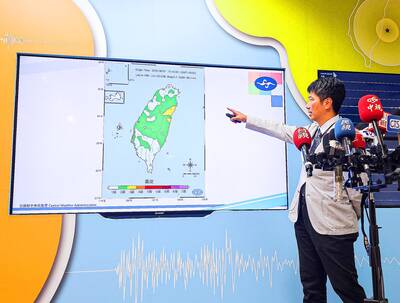
Aftershocks from a magnitude 6.2 earthquake that struck off Yilan County at 3:45pm yesterday could reach a magnitude of 5 to 5.5, the Central Weather Administration (CWA) said. Seismological Center technical officer Chiu Chun-ta (邱俊達) told a news conference that the epicenter of the temblor was more than 100km from Taiwan. Although predicted to measure between magnitude 5 and 5.5, the aftershocks would reach an intensity of 1 on Taiwan’s 7-tier scale, which gauges the actual effect of an earthquake, he said. The earthquake lasted longer in Taipei because the city is in a basin, he said. The quake’s epicenter was about 128.9km east-southeast

BE CAREFUL: The virus rarely causes severe illness or death, but newborns, older people and those with medical conditions are at risk of more severe illness As more than 7,000 cases of chikungunya fever have been reported in China’s Guangdong Province this year, including 2,892 new cases last week, the Centers for Disease Control (CDC) yesterday said it is monitoring the situation and considering raising the travel notice level, which might be announced today. The CDC issued a level 1 travel notice, or “watch,” for Guangdong Province on July 22, citing an outbreak in Foshan, a manufacturing hub in the south of the province, that was reported early last month. Between July 27 and Saturday, the province reported 2,892 new cases of chikungunya, reaching a total of 7,716
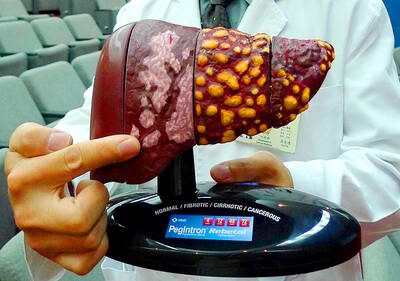
STAY VIGILANT: People should reduce the risk of chronic liver inflammation by avoiding excessive alcohol consumption, smoking and eating pickled foods, the physician said A doctor last week urged people to look for five key warning signs of acute liver failure after popular producer-turned-entertainer Shen Yu-lin (沈玉琳) was reportedly admitted to an intensive care unit for fulminant hepatitis. Fulminant hepatitis is the rapid and massive death of liver cells, impairing the organ’s detoxification, metabolic, protein synthesis and bile production functions, which if left untreated has a mortality rate as high as 80 percent, according to the Web site of Advancing Clinical Treatment of Liver Disease, an international organization focused on liver disease prevention and treatment. People with hepatitis B or C are at higher risk of


 RSS
RSS