


Legislative diplomacy has sparked competition among the ruling and opposition parties, as the establishment of interparliamentary friendship groups is in full swing, with 25 groups established in two weeks, including 22 led by the Democratic Progressive Party (DPP).
Amid China’s increasing efforts to suppress Taiwan’s international presence, legislative diplomacy has become an alternative and flexible diplomatic channel for Taipei to deepen ties with like-minded countries.
The Legislative Yuan in 1990 established the Eastern Europe and Soviet Union, Norther American, Europe and Asian-Pacific study groups, and last year, former legislative speaker You Si-kun (游錫?) established the legislature’s Department of International Affairs.
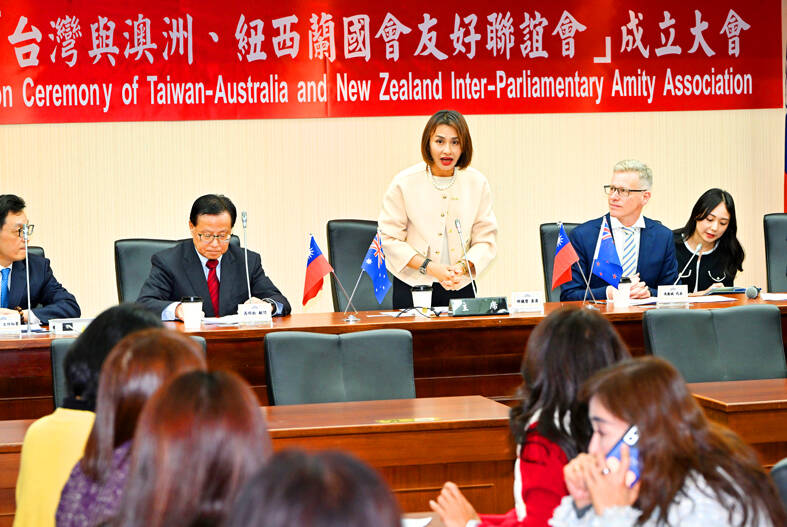
Photo: Tien Yu-hua, Taipei Times
The 10th Legislative Yuan created 73 interparliamentary friendship groups, including 58 led by the DPP, and 11 led by the Chinese Nationalist Party (KMT).
The interparliamentary friendship groups must start over again with the new legislature, but if a former group chair has been re-elected, they have priority to initiate the same friendship group.
However, as new legislators account for nearly 50 percent of the seats in the 11th Legislative Yuan, many former groups must be handed over or competed for.
A row over the re-establishment of the largest interparliamentary group — Legislative Yuan US Caucus — almost led to the formation of two separate caucuses last month, as DPP Legislator Wang Ting-yu (王定宇) and Legislative Deputy Speaker Johnny Chiang (江啟臣) of the KMT both sought signatures to be the caucus chair.
As the American Institute in Taiwan signaled that it wanted to have a single point of contact with the legislature, the parties negotiated for a week before forming a dual-chairperson system, cochaired by Wang and KMT Legislator Ko Chih-en (柯志恩), with Chiang as honorary chair of the caucus.
The legislative speaker is conventionally the chair of the Taiwan–Japan Amity Association, but Legislator Kuo Kuo-wen (郭國文), who is familiar with Japan-Taiwan affairs, said that when Legislative Speaker Han Kuo-yu (韓國瑜) was Kaohsiung mayor, he was late to a meeting with Hajime Sasaki, who was then-director of the local Junior Chamber of Japan’s Liberal Democratic Party.
Han was dubbed the “late devil” by Japanese media at the time, leaving a bad impression, Kuo said, adding that if Han cannot stand up to China’s suppression or set limits on himself, Taiwan’s space for legislative diplomacy might narrow and negatively affect the foundation laid by the previous legislature.
Three of the new legislature’s 25 interparliamentary friendship groups are led by KMT legislators, including the amity association with Spain, chaired by Legislator Lu Yu-ling (呂玉玲); the amity association with Asian-Pacific countries, chaired by Legislator Cheng Cheng-chien (鄭正鈐); and the Legislative Yuan US Caucus cochaired by Ko.
KMT members yesterday said that as the DPP has dominated the discourse of legislative diplomacy, they would form more interparliamentary friendship groups, while increasing their interactions with foreign media and think tanks, to showcase the KMT’s importance within Taiwan.
The Republic of China (ROC) has special international status, which requires legislative diplomacy to overcome diplomatic difficulties, an important job for the Legislative Yuan, Chiang said.
It is the responsibility of lawmakers to participate in legislative diplomacy, he said, adding that he had been the chair of amity associations with the UK and Singapore.
As deputy speaker, he said he would continue to convey Taiwanese’s voices and promote the ROC’s freedom and democracy to the international community.
KMT Legislator Hsu Chiao-hsin (徐巧芯) said she has established an international youth political participation friendship group, and also submitted an op-ed to a US think tank discussing the KMT’s changes and direction.
She said she would continue to communicate through international channels to let other countries know that the legislature is not only represented by the DPP.

Considering that most countries issue more than five denominations of banknotes, the central bank has decided to redesign all five denominations, the bank said as it prepares for the first major overhaul of the banknotes in more than 24 years. Central bank Governor Yang Chin-lung (楊金龍) is expected to report to the Legislative Yuan today on the bank’s operations and the redesign’s progress. The bank in a report sent to the legislature ahead of today’s meeting said it had commissioned a survey on the public’s preferences. Survey results showed that NT$100 and NT$1,000 banknotes are the most commonly used, while NT$200 and NT$2,000

The Centers for Disease Control (CDC) yesterday reported the first case of a new COVID-19 subvariant — BA.3.2 — in a 10-year-old Singaporean girl who had a fever upon arrival in Taiwan and tested positive for the disease. The girl left Taiwan on March 20 and the case did not have a direct impact on the local community, it said. The WHO added the BA.3.2 strain to its list of Variants Under Monitoring in December last year, but this was the first imported case of the COVID-19 variant in Taiwan, CDC Deputy Director-General Lin Ming-cheng (林明誠) said. The girl arrived in Taiwan on

ANNUAL EVENT: Two massive Pokemon balloons are to be set up in Daan Park, with an event zone operating from 10am to 6pm This year’s Taipei Floral Picnic is to be held at Daan Park today and tomorrow, featuring an exclusive Pokemon Go event, a themed food market, a coffee rave picnic area and stage performances, the Taipei Department of Information and Tourism said yesterday. Two massive Pokemon balloons are to be set up in the park as attractions, with an exclusive event zone operating from 10am to 6pm, it said. Participants who complete designated tasks on-site would have a chance to receive limited-edition souvenirs, it added. People could also try the newly launched game Pokemon Pokopia in the trial area, the department said. Three PokeStops are

South Korea is planning to revise its controversial electronic arrival card, a step Taiwanese officials said prompted them to hold off on planned retaliatory measures, a South Korean media report said yesterday. A Yonhap News Agency report said that the South Korean Ministry of Foreign Affairs is planning to remove the “previous departure place” and “next destination” fields from its e-arrival card system. The plan, reached after interagency consultations, is under review and aims to simplify entry procedures and align the electronic form with the paper version, a South Korean ministry official said. The fields — which appeared only on the electronic form


 RSS
RSS