


President Tsai Ing-wen (蔡英文) yesterday in Chiayi County outlined the advances on transitional justice made by her administration during her address at a memorial ceremony marking the 77th anniversary of the 228 Incident.
Tsai said her government has made a series of efforts to implement transitional justice, including admitting wrongdoing, issuing apologies to victims of the Incident, launching investigations and paying compensation.
It has passed or amended five pieces of legislation, formed a special Cabinet-level body to promote transitional justice and published four investigative reports on the Incident and the ensuing White Terror era from 1949 to 1987, when Taiwan was under martial law.
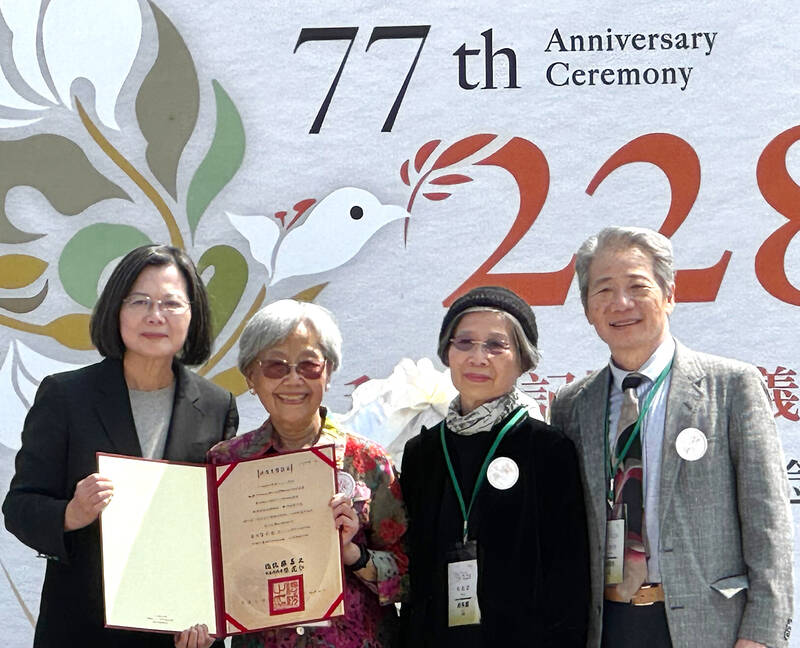
Photo: Tsai Tsung-hsun, Taipei Times
A foundation established early last year responsible for compensating victims of the Incident and the White Terror era has so far accepted claims from nearly 2,000 applicants, she said.
It has paid more than NT$4 billion (US$126.7 million) in compensation to the families of people who had their property illegally confiscated by the government, she added.
Efforts have also been made to declassify previously sealed national security files to learn more about the Incident and White Terror era, Tsai said.
The Political Archives Act (政治檔案條例) was amended last year to require political files categorized as national security information to be declassified instead of being kept confidential, she said.
The revisions, promulgated by the president on Dec. 27 last year and which took effect yesterday, require the declassification of files after 30 years, removing a designation allowing for indefinite classification of documents pertaining to national security or foreign affairs.
In addition to declassifying thousands of political archives from Aug. 15, 1945, to Nov. 6, 1992, the National Archives Administration yesterday vowed to expedite the review of potentially sensitive documents.
In declassifying documents, “the government is not targeting any specific political party. We are doing so to take responsibility for the previous authoritarian regime’s illegal actions,” Tsai said.
Despite these efforts, Tsai said she understood that the “horrible memories and scars” would not go away for the victims and their families, “but we must find a way to coexist peacefully with the past and build an more open society together.”
“We shall never forget the past nor shall we choose not to commemorate the past because we are too afraid to do so,” she said.
The Incident refers to protesters being shot by security personnel on Feb. 28, 1947, at the Governor-General’s Office in Taipei (currently the Executive Yuan compound). The protesters were demanding the arrest of those responsible for the indiscriminate killing of a bystander in an angry crowd on Feb. 27 outside the Tianma Tea House on Nanjing W Road. The crowd had challenged Tobacco Monopoly Bureau officials after one of them hit Lin Chiang-mai (林江邁), a woman selling cigarettes illegally, in the head with his pistol after she demanded that the officials return cigarettes they had confiscated from her.
An estimated 18,000 to 28,000 people were killed during the crackdown, which lasted into early May, according to an investigation commissioned by the Cabinet in 1992.
During the ceremony, Tsai exonerated four Incident victims — Wu Tien-shang (吳天賞), Tu Kuan-huang (杜崑煌), Chiang Chen-yu (江振猷) and Ho Keng-tse (何鏗澤) — by awarding “certificates of restored reputation” to their sons and daughters to redress the state’s wrongdoing.
Also at Wednesday’s ceremony, 228 Memorial Foundation chairman Hsueh Hua-yuan (薛化元) said his foundation would help the families of potential Incident victims file for government compensation by validating their claims.
The opening of sealed files has provided the proof needed to help families applying for compensation confirm that their relatives were victims of the Incident, Hsueh said, adding that the families of more than 4,000 victims have been helped by the foundation.
“We continue to seek the truth about the Incident, not only for the sake of the victims and their families, but for the future. After making sure who should be responsible for the tragedy, we can all move on to create a future together,” he said.
The foundation also completed translations of English and Japanese versions of The Tragedy of 228: Historical Truth and Transitional Justice in Taiwan, Hsueh said.
The publication of English and Japanese versions of the book would allow non-Mandarin speakers to gain a better understand of the history of Taiwan, he said.
Additional reporting by Kayleigh Madjar
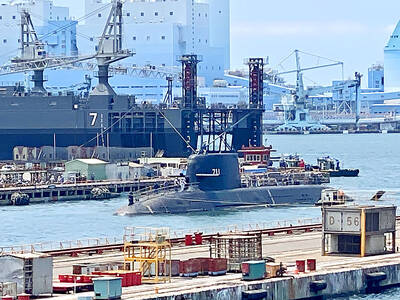
AGING: While Japan has 22 submarines, Taiwan only operates four, two of which were commissioned by the US in 1945 and 1946, and transferred to Taiwan in 1973 Taiwan would need at least 12 submarines to reach modern fleet capabilities, CSBC Corp, Taiwan chairman Chen Cheng-hung (陳政宏) said in an interview broadcast on Friday, citing a US assessment. CSBC is testing the nation’s first indigenous defense submarine, the Hai Kun (海鯤, Narwhal), which is scheduled to be delivered to the navy next month or in July. The Hai Kun has completed torpedo-firing tests and is scheduled to undergo overnight sea trials, Chen said on an SET TV military affairs program. Taiwan would require at least 12 submarines to establish a modern submarine force after assessing the nation’s operational environment and defense

Yangmingshan National Park authorities yesterday urged visitors to respect public spaces and obey the law after a couple was caught on a camera livestream having sex at the park’s Qingtiangang (擎天崗) earlier in the day. The Shilin Police Precinct in Taipei said it has identified a suspect and his vehicle registration number, and would summon him for questioning. The case would be handled in accordance with public indecency charges, it added. The couple entered the park at about 11pm on Thursday and began fooling around by 1am yesterday, the police said, adding that the two were unaware of the park’s all-day live
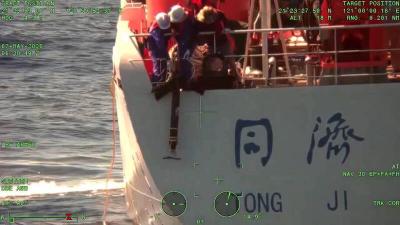
The coast guard today said that it had disrupted "illegal" operations by a Chinese research ship in waters close to the nation and driven it away, part of what Taipei sees a provocative pattern of China's stepped up maritime activities. The coast guard said that it on Thursday last week detected the Chinese ship Tongji (同濟號), which was commissioned only last year, 29 nautical miles (54km) southeast of the southern tip of Taiwan, although just outside restricted waters. The ship was observed lowering ropes into the water, suspected to be the deployment of scientific instruments for "illegal" survey operations, and the coast

A former soldier and an active-duty army officer were yesterday indicted for allegedly selling classified military training materials to a Chinese intelligence operative for a total of NT$79,440. The Taipei District Prosecutors’ Office indicted Chen Tai-yin (陳泰尹) and Lee Chun-ta (李俊達) for contravening the National Security Act (國家安全法) and the Anti-Corruption Act (貪污治罪條例). Chen left the military in September 2013 after serving alongside then-staff sergeant Lee, now an army lieutenant, at the 21st Artillery Command of the army’s Sixth Corps from 2011 to 2013, according to the indictment. Chen met a Chinese intelligence operative identified as “Wang” (王) through a friend in November


 RSS
RSS