

As Taiwan’s compulsory military service is being restored to a full year, a group of military conscripts were given nuclear, biological and chemical training on Saturday in a gas chamber for the first time in more than a decade.
During the training session held on Cheng Kung Lin Base in Taichung to familiarize soldiers with gas masks, the new conscripts were first taught how to properly wear their masks, the state-run Military News Agency said in an article yesterday.
After military instructors checked each conscript to make sure their masks were put on properly, the conscripts were instructed to enter the chamber — about the size of a classroom — one after another in their protective gear and gather around a burner emitting tear gas, the agency said.
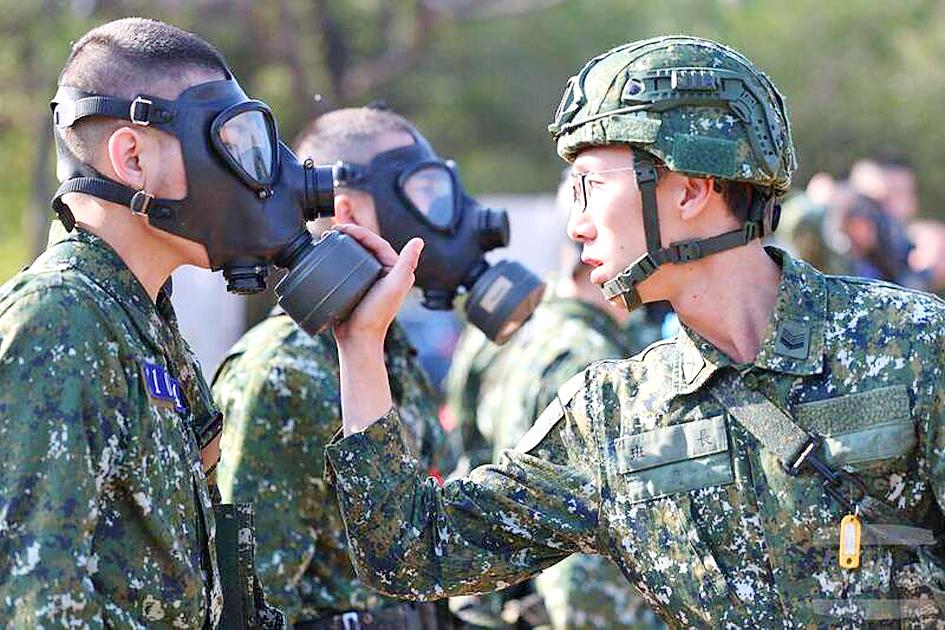
Photo courtesy of Military News Agency
The goal was for the conscripts to gain confidence in their protective equipment and also experience how the tear gas would affect their skin before leaving the room, it said.
Next, the instructors told the group to go back into the chamber without their masks to understand what dealing with tear gas without protection would be like, it said.
The volunteers, who left the chamber with their eyes filled with tears and coughing, were instructed to use cool water to avoid further irritation.
The gas chamber training was standard practice for all conscripts during boot camp until compulsory military service was shortened to four months in 2013, the Ministry of National Defense said.
With the reimposition of the one-year military service program that began on Jan. 1, the ministry reintroduced the gas chamber drill, and the conscripts in Taichung were the first ones doing a year of military service to face this type of training in Taiwan in 11 years.
The extension of military service to a full year applies to conscripts who were born on or after Jan. 1, 2005. Compulsory military service for those born before that date is for four months.
The decision to lengthen the period of compulsory military service for Taiwanese men was aimed at strengthening the nation’s combat readiness in the face of threats from China, the government said.
Other steps have been taken on that front, including updating training regimens, providing conscripts with new helmets and bulletproof vests, and purchasing new mortars, cannons and machine guns.
The one-year compulsory service consists of eight weeks of boot camp and then an assignment with a designated unit in the army, navy, air force, Information, Communications and Electronic Force Command, military police, the Political Warfare Bureau, or the Medical Affairs Bureau, based on each individual’s skills, the ministry said.
The Taiwanese military is mainly a volunteer force of about 215,000 people, with conscripts serving in a supporting role.
As of 2021, there were 160,000 voluntary military personnel in the armed forces.
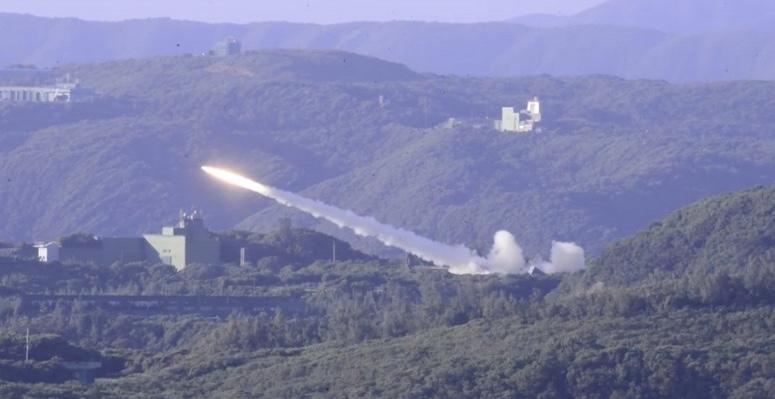
A Chinese military drone was spotted conducting reconnaissance off Taitung County as President William Lai (賴清德) visited Pingtung County this morning to inspect a drill of the armed forces’ precision-strike capabilities, prompting the military to closely monitor its actions. Today was the final day of a three-day military exercise at Jioupeng Base (九鵬基地) to test the joint combat capabilities of the armed forces and coast guard. The exercise began on Wednesday simulating air defense interception and yesterday tested long-range strike capabilities and new air defense weapons. This morning, the military conducted a final exercise involving air defense, anti-ship and drone operations. Military sources said

OCT. 31: The antiviral drugs Tamiflu and Eraflu have been distributed to about 4,000 medical facilities nationwide for people in seven groups who develop flu-like symptoms As the domestic influenza epidemic enters its peak season and continues to escalate, the Centers for Disease Control (CDC) yesterday announced that publicly funded influenza antiviral drugs for seven eligible groups have been extended to Oct. 31, allowing those who develop flu-like symptoms to receive the medication without undergoing a rapid influenza test. The CDC has extended the expanded use of flu antiviral drugs to seven groups: healthcare and influenza-prevention personnel; residents and staff at nursing homes, long-term care facilities and similar institutions; kindergarten and daycare workers and home-based caregivers; students from kindergarten through high school, vocational high school and the
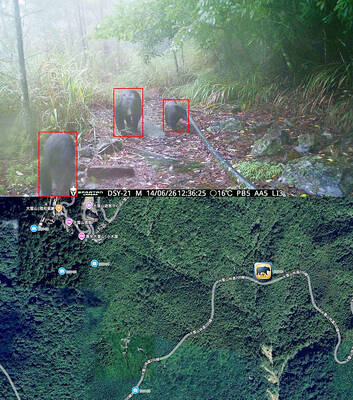
RARE PEEK: The footage released showed one of the bears staying in a cave for as long as 70 days, providing the first record of Formosan black bear’s overwintering The Forestry and Nature Conservation Agency yesterday released tracking records of released Formosan black bears for the first time, showing that they get much closer to human settlements than previously thought. The agency said it had captured two bears, Da Qu-ali (達古阿里) and Aziman (阿里曼), in indigenous villages in Hualien County and began to track them with a camera-mounted satellite collar after releasing them back into the wild. The results confirmed that the bears have moved from deep mountain areas into lowland hills closer to human communities, leading to an increase in human-bear conflicts, it said. The agency has introduced artificial intelligence-assisted early

DIPLOMATIC TOUR: Chinese President Xi Jinping began a series of overseas visits last month to Kyrgyzstan, Egypt and India, aimed at securing leverage, an official said Recent Chinese diplomatic and military moves are aimed at creating pressure ahead of a planned meeting between Chinese President Xi Jinping (習近平) and US President Donald Trump, National Security Council adviser Huang Chung-yen (黃重諺) said. Trump when visiting China in May extended an invitation to Xi to visit Washington on Sept. 24. China is yet to officially announce plans for Xi’s visit to the US. In an interview with the Liberty Times (sister paper of the Taipei Times) on Thursday, Huang said Xi’s overseas visits, China’s “gray zone” activities along the First Island Chain and efforts to expand its trade surplus with the


 RSS
RSS