


The National Palace Museum (NPM) in Taipei and its southern branch in Chiayi County are to stay open throughout the Lunar New Year holiday, providing the public with an artistic and cultural option for things to do with family and friends during the break.
Visitors to the Taipei museum may also pick up free red envelopes or new year couplets written with auspicious blessings until Wednesday next week.
The Gleam Ensemble, a small classical Western musical troupe from Taiwan, is to put on a free concert at the Taipei museum from 3pm to 4pm on Tuesday.
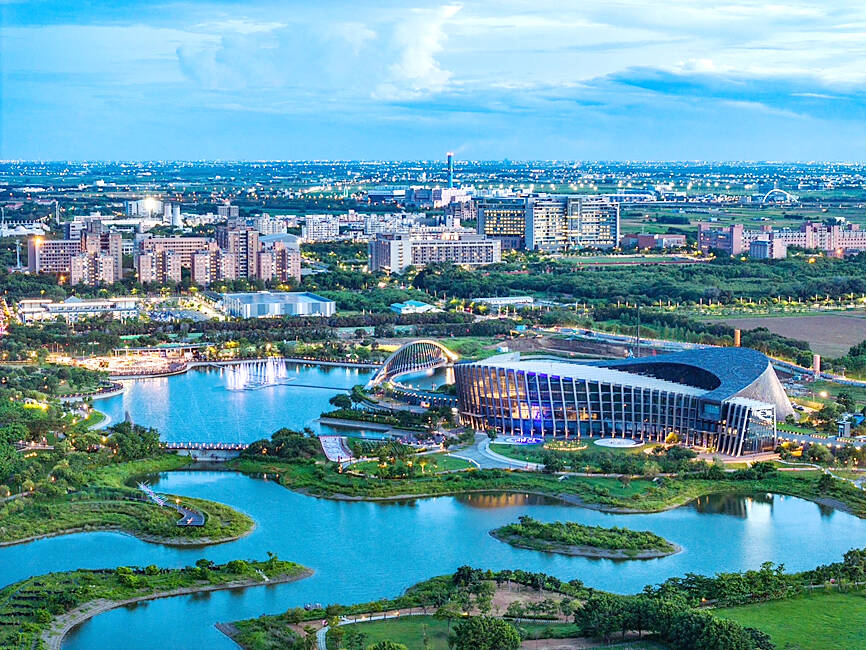
Photo courtesy of Chiayi County Government
Meanwhile, the Southern Branch of the museum said that it has an ongoing collaboration with the county’s Sugar Cane Train Railway at Suantou Sugar Factory, which allows train passengers to use their ticket stubs to enter the museum for free until Thursday.
In other news, the National Museum of History in Taipei is set to reopen to the public on Feb. 21, after a five-year renovation of the first public museum established by the Nationalist government in Taiwan after 1949.
Aside from expanding the museum’s display space by 866.12m2, people will for the first time be allowed to visit the top floor of the five-story museum, it said.
The fifth floor was previously used to store the museum’s collection of more than 50,000 artifacts, including prehistoric colored pottery, as well as modern calligraphy, it said.
The top floor is to host a special exhibition of the architectural features of the museum, which was built in the style of a northern Chinese palace, it said.
Visitors will also be able to enjoy views of the Taipei Botanical Garden and the cultural and educational institutes in “Nanhai Academy,” veteran architecture researcher Lee Chian-lang (李乾朗) said.
Formally opened on March 12, 1956, the museum was built next to the lotus pond in the botanical garden and started with a collection of artifacts handed over by Japan after World War II and items originally from Henan Museum in China.
A new permanent exhibition titled “Discover our connections, right here” features Chang Dai-chien’s (張大千) 1965 painting Morning View at Alishan (阿里山曉望), as well as fang-hu, a squarish ritual wine vessel, from China’s Spring and Autumn period, the museum said.
Three of the 750 so-called “Chinese culture” boxes containing copies of artifacts that included works by artists in Taiwan will also be on display.
The artifacts toured more than 30 countries between 1969 and 1986 to assert the role played by the Republic of China in preserving Chinese culture, as the country faced an increasingly challenging diplomatic environment.
The museum is also to host a special exhibition titled “Monuments of Brush and Ink” showcasing calligraphy and ink painting masterpieces in its collection, as well as the “Birth of the Modernist Art Movement in Taiwan” in another exhibition, it said.
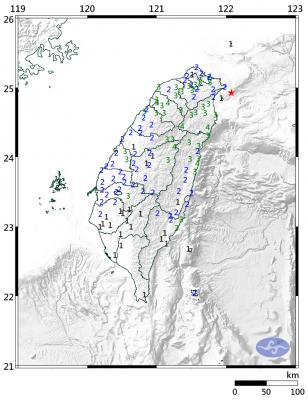
A magnitude 6.1 earthquake struck off the coast of Yilan County at 8:39pm tonight, the Central Weather Administration (CWA) said, with no immediate reports of damage or injuries. The epicenter was 38.7km east-northeast of Yilan County Hall at a focal depth of 98.3km, the CWA’s Seismological Center said. The quake’s maximum intensity, which gauges the actual physical effect of a seismic event, was a level 4 on Taiwan’s 7-tier intensity scale, the center said. That intensity level was recorded in Yilan County’s Nanao Township (南澳), Hsinchu County’s Guansi Township (關西), Nantou County’s Hehuanshan (合歡山) and Hualien County’s Yanliao (鹽寮). An intensity of 3 was
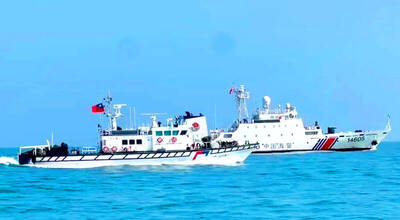
Instead of focusing solely on the threat of a full-scale military invasion, the US and its allies must prepare for a potential Chinese “quarantine” of Taiwan enforced through customs inspections, Stanford University Hoover fellow Eyck Freymann said in a Foreign Affairs article published on Wednesday. China could use various “gray zone” tactics in “reconfiguring the regional and ultimately the global economic order without a war,” said Freymann, who is also a nonresident research fellow at the US Naval War College. China might seize control of Taiwan’s links to the outside world by requiring all flights and ships entering or leaving Taiwan
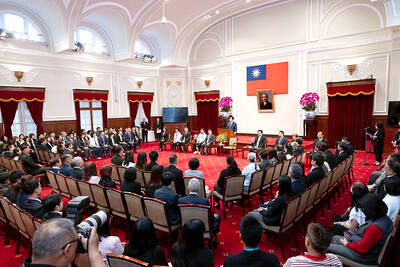
The next minimum wage hike is expected to exceed NT$30,000, President William Lai (賴清德) said yesterday during an award ceremony honoring “model workers,” including migrant workers, at the Presidential Office ahead of Workers’ Day today. Lai said he wished to thank the awardees on behalf of the nation and extend his most sincere respect for their hard work, on which Taiwan’s prosperity has been built. Lai specifically thanked 10 migrant workers selected for the award, saying that although they left their home countries to further their own goals, their efforts have benefited Taiwan as well. The nation’s industrial sector and small businesses lay
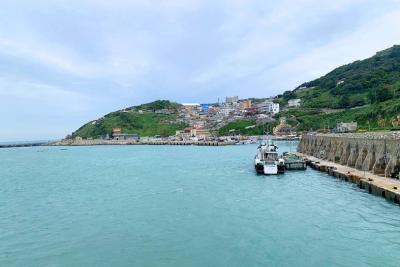
Taiwan has activated backup communications for its northernmost territory, the remote and strategically located island of Dongyin (東引), after poor weather conditions apparently shifted the wreckage of a ship onto an undersea cable causing it to break. The vulnerability of undersea communication cables linking Taiwan with its outlying islands has been a persistent cause of concern for Taipei, whose government has on several occasions blamed Chinese ships for intentionally causing damage. Dongyin, home to about 1,500 people, sits in a strategic position at the top of the Taiwan Strait and the island has a heavy military presence. It does not have an


 RSS
RSS