


Hsu Huang-yen (許煌烟), a Nantou-based artist known for constructing intricate architectural models inside glass bottles, has died at the age of 88.
Hsu’s death late last month was confirmed by his children, who said that after casting divination blocks, they had decided to donate their father’s more than 100 artworks to his close friend, folklore expert Liao Ta-yi (廖大乙).
Liao said in a statement on Tuesday that he was making plans to arrange free exhibitions of Hsu’s work to convey the “determined, persevering spirit” behind his friend’s creations.
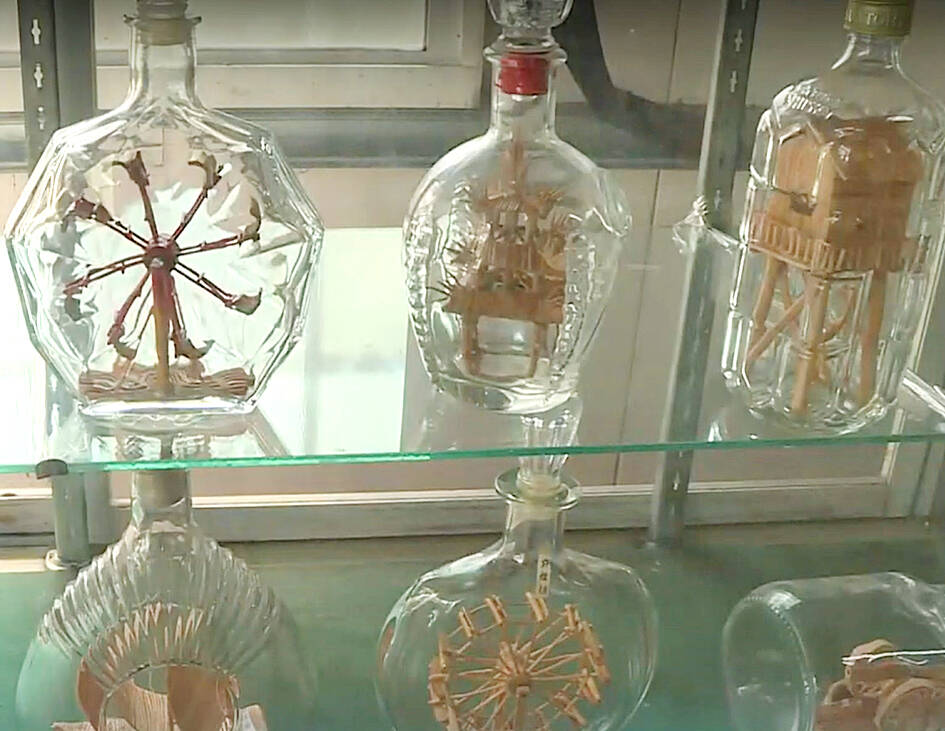
Photo: CNA
A resident of Nantou’s Yuchi Township (魚池), Hsu began his artistic career about 20 years ago. He attributed his style to work he had done as a construction engineer building tunnels at the Taiwan Power Co’s Mingtan Power Station (明潭).
Using long chopsticks, Hsu assembled detailed architectural models — such as Taipei 101 and Kaohsiung’s 85 Sky Tower, as well as transmission towers, sailboats and pagodas — inside glass bottles, using only bamboo sticks and glue as his building materials.
The process required him to constantly adjust the angle of the bottle, and frequently left him with a sore neck and eyes, Hsu had previously said.
The work could only be done slowly, in a state of mental calm, and was impossible when frustrated or angry, he said.
In an interview before his death, Hsu joked that he had never seen anyone try to imitate his art.
“Without patience, it’s really hard to stick to” something like this, he said.

Considering that most countries issue more than five denominations of banknotes, the central bank has decided to redesign all five denominations, the bank said as it prepares for the first major overhaul of the banknotes in more than 24 years. Central bank Governor Yang Chin-lung (楊金龍) is expected to report to the Legislative Yuan today on the bank’s operations and the redesign’s progress. The bank in a report sent to the legislature ahead of today’s meeting said it had commissioned a survey on the public’s preferences. Survey results showed that NT$100 and NT$1,000 banknotes are the most commonly used, while NT$200 and NT$2,000

The Centers for Disease Control (CDC) yesterday reported the first case of a new COVID-19 subvariant — BA.3.2 — in a 10-year-old Singaporean girl who had a fever upon arrival in Taiwan and tested positive for the disease. The girl left Taiwan on March 20 and the case did not have a direct impact on the local community, it said. The WHO added the BA.3.2 strain to its list of Variants Under Monitoring in December last year, but this was the first imported case of the COVID-19 variant in Taiwan, CDC Deputy Director-General Lin Ming-cheng (林明誠) said. The girl arrived in Taiwan on

South Korea is planning to revise its controversial electronic arrival card, a step Taiwanese officials said prompted them to hold off on planned retaliatory measures, a South Korean media report said yesterday. A Yonhap News Agency report said that the South Korean Ministry of Foreign Affairs is planning to remove the “previous departure place” and “next destination” fields from its e-arrival card system. The plan, reached after interagency consultations, is under review and aims to simplify entry procedures and align the electronic form with the paper version, a South Korean ministry official said. The fields — which appeared only on the electronic form

The Ministry of Foreign Affairs (MOFA) is suspending retaliation measures against South Korea that were set to take effect tomorrow, after Seoul said it is updating its e-arrival system, MOFA said today. The measures were to be a new round of retaliation after Taiwan on March 1 changed South Korea's designation on government-issued alien resident certificates held by South Korean nationals to "South Korea” from the "Republic of Korea," the country’s official name. The move came after months of protests to Seoul over its listing of Taiwan as "China (Taiwan)" in dropdown menus on its new online immigration entry system. MOFA last week


 RSS
RSS