


The Ministry of Foreign Affairs (MOFA) yesterday reaffirmed Taiwan’s ties with Guatemala after Reuters on Monday reported that the Central American nation is considering establishing formal trade relations with China.
“We are going to continue working with Taiwan at the levels we have been doing,” Guatemalan Minister of Foreign Affairs Carlos Ramiro Martinez told Reuters. “But the president has pointed out that we cannot ignore the weight and power China represents.”
“We are interested in approaching them [China] to try and develop some relationship around trade,” Martinez said, adding that an “office of trade interests” could be formed that would assist in finding a market in China for Guatemalan products.
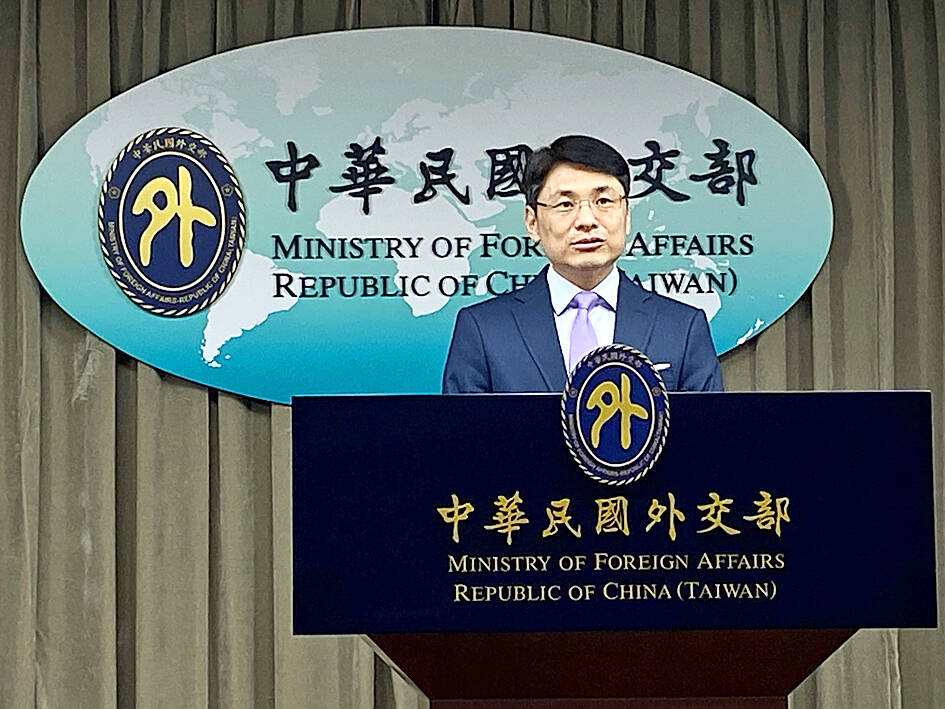
Photo: Yang Yao-ru, Taipei Times
“We are making it public, this is not an ambush against Taiwan or the United States,” Martinez added.
In Taipei, foreign ministry deputy spokesman Hsiao Kuang-wei (蕭光偉) yesterday told a regular news briefing that Guatemalan President Bernardo Arevalo has publicly expressed support for his country’s diplomatic relations with Taiwan on multiple occasions, during his election campaign and after winning last year’s election.
When Minister of Foreign Affairs Joseph Wu (吳釗燮) visited Guatemala to attend Arevalo’s inauguration on Jan. 14, Arevalo told him that he would maintain the diplomatic ties between the two sides and wished to bolster cooperation with Taiwan, Hsiao said.
The ministry would continue to deepen cooperation and exchanges between Taiwan and Guatemala, working with Arevalo’s administration to solidify the nations’ long-term diplomatic ties and pursue the greatest well-being for their people, he said.
Chinese Ministry of Foreign Affairs spokesman Wang Wenbin (汪文斌) yesterday told Reuters that it “is hoped that the new government of Guatemala will respond to the historical and contemporary trend and make a correct decision as soon as possible that is in the fundamental and long-term interests of the Guatemalan nation and people.”
In other news, South Korean Ambassador to China Chung Jae-ho underlined the importance of peace and stability in the Taiwan Strait, which the ministry yesterday said reflects international consensus.
Chung told reporters at the South Korean embassy in Beijing on Monday that “South Korea respects the ‘one China’ principle and will enhance substantive cooperation with Taiwan in various fields based on the principle,” South Korea’s Yonhap News Agency reported.
“South Korea hopes to see peace and stability in the Taiwan Strait be maintained and cross-strait relations develop in a peaceful and stable manner,” he added.
The assertion is in line with a statement made by South Korean Ministry of Foreign Affairs officials issued after Taiwan’s presidential and legislative elections on Jan. 13, Yonhap said.
In Taipei, Hsiao yesterday said that South Korea, the US and other like-minded countries have issued joint statements on multiple occasions in bilateral and multilateral arenas to reaffirm the importance of cross-strait peace and stability.
The statements reflect these countries’ determination to prevent the expansion of authoritarianism, he said.
The ministry thanked like-minded countries for taking a firm stance and voicing support for the nation, he said.
Taiwan would not provoke, nor act rashly or yield to pressure, and would continue to cooperate with like-minded countries to safeguard regional peace and stability, he said.

Considering that most countries issue more than five denominations of banknotes, the central bank has decided to redesign all five denominations, the bank said as it prepares for the first major overhaul of the banknotes in more than 24 years. Central bank Governor Yang Chin-lung (楊金龍) is expected to report to the Legislative Yuan today on the bank’s operations and the redesign’s progress. The bank in a report sent to the legislature ahead of today’s meeting said it had commissioned a survey on the public’s preferences. Survey results showed that NT$100 and NT$1,000 banknotes are the most commonly used, while NT$200 and NT$2,000

The Centers for Disease Control (CDC) yesterday reported the first case of a new COVID-19 subvariant — BA.3.2 — in a 10-year-old Singaporean girl who had a fever upon arrival in Taiwan and tested positive for the disease. The girl left Taiwan on March 20 and the case did not have a direct impact on the local community, it said. The WHO added the BA.3.2 strain to its list of Variants Under Monitoring in December last year, but this was the first imported case of the COVID-19 variant in Taiwan, CDC Deputy Director-General Lin Ming-cheng (林明誠) said. The girl arrived in Taiwan on

South Korea is planning to revise its controversial electronic arrival card, a step Taiwanese officials said prompted them to hold off on planned retaliatory measures, a South Korean media report said yesterday. A Yonhap News Agency report said that the South Korean Ministry of Foreign Affairs is planning to remove the “previous departure place” and “next destination” fields from its e-arrival card system. The plan, reached after interagency consultations, is under review and aims to simplify entry procedures and align the electronic form with the paper version, a South Korean ministry official said. The fields — which appeared only on the electronic form

The Ministry of Foreign Affairs (MOFA) is suspending retaliation measures against South Korea that were set to take effect tomorrow, after Seoul said it is updating its e-arrival system, MOFA said today. The measures were to be a new round of retaliation after Taiwan on March 1 changed South Korea's designation on government-issued alien resident certificates held by South Korean nationals to "South Korea” from the "Republic of Korea," the country’s official name. The move came after months of protests to Seoul over its listing of Taiwan as "China (Taiwan)" in dropdown menus on its new online immigration entry system. MOFA last week


 RSS
RSS