


Travelers returning to Taiwan from overseas could soon enjoy a duty exemption of up to NT$35,000 per person, up from the current NT$20,000, based on a proposed amendment to the Regulations Governing the Declaration, Inspection, Duty and Release of Personal Luggage or Goods of Inbound Passengers (入境旅客攜帶行李物品報驗稅放辦法).
The rules state that, except for control led goods and tobacco or liquor products, luggage or goods for personal or home use outside the allowed duty-free items are exempt from duty if the total duty-paid value is under NT$20,000.
However, such a provision would not be applicable to passengers who are carrying goods for business or commercial use, or who frequently travel in and out of the country and have prior records of customs duty breaches.
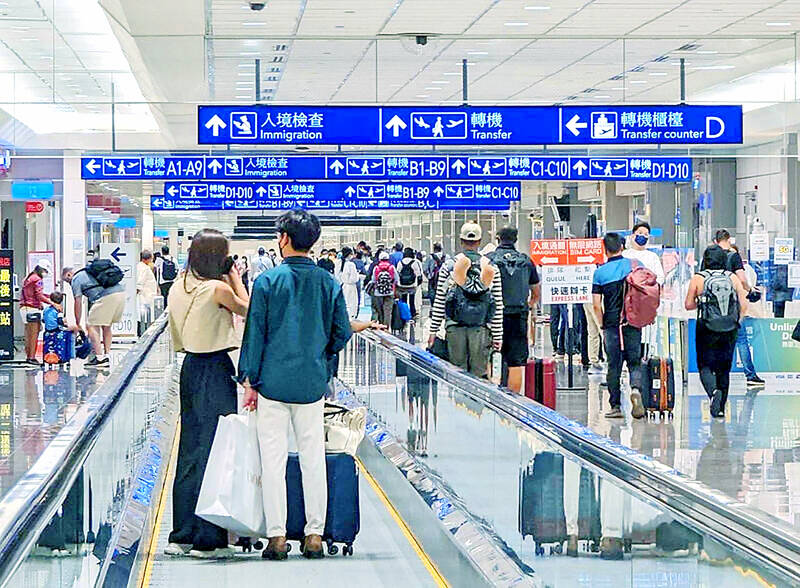
Photo courtesy of Taoyuan International Airport Corp
The Customs Administration said that the rules were stipulated in 1989, and both the consumer price index (CPI) and consumers’ spending power have increased in the past 35 years. Some have suggested that the criteria set for duty exemption need to be reviewed.
The duty exemption would be increased to NT$35,000 per person following negotiations among officials of the Customs Administration and Taxation Administration, the Customs Administration said, adding that the proposal would need to be approved by the Executive Yuan.
The increase in tax exemption would be in line with the increase in the CPI, it said.
Customs Administration officials said the amount was set after referencing that in other countries. Japan’s duty exemption was about ¥200,000 (US$1,350), while in South Korea it is US$800.
Data from the Directorate-General of Budget, Accounting and Statistics showed that since 1989, Taiwan’s CPI has risen almost 70 percent.
The amendment could take effect during the first half of this year, the Customs Administration said.
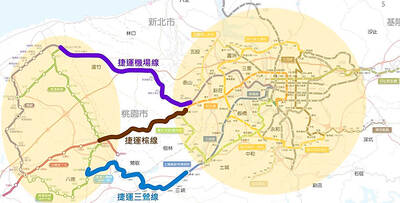
The Executive Yuan yesterday approved a southwestern extension of the Sanying MRT Line from New Taipei to Bade District (八德) in Taoyuan, with a goal of starting construction by late 2026. The 4.03-kilometer extension, featuring three new stations, will run from the current terminus at Yingtao Fude Station (LB12) in New Taipei City to Dannan Station (LB14), where it will connect with Taoyuan’s Green Line, New Taipei City Metro Corp said in a statement. This extension will follow the completion of core Sanying Line, a 14.29-kilometer medium-capacity system linking Tucheng (土城), Sansia (三峽)
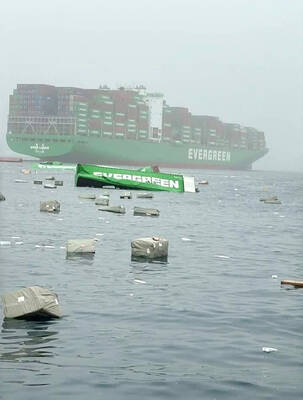
CARGO LOSS: About 50 containers at the stern of the ‘Ever Lunar’ cargo ship went overboard, prompting the temporary closure of the port and disrupting operations Evergreen Marine Corp, Taiwan’s largest container shipper, yesterday said that all crew members aboard the Ever Lunar (長月) were safe after dozens of containers fell overboard off the coast of Peru the previous day. The incident occurred at 9:40am on Friday as the Ever Lunar was anchored and waiting to enter the Port of Callao when it suddenly experienced severe rolling, Evergreen said in a statement. The rolling, which caused the containers to fall, might have been caused by factors including a tsunami triggered by an earthquake in Russia, poor winter sea conditions in South America or a sudden influx of waves,
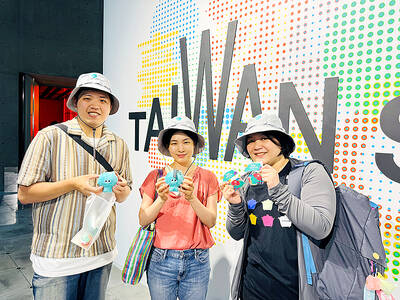
The Ministry of Culture yesterday officially launched the “We TAIWAN” cultural program on Osaka’s Nakanoshima sandbank, with the program’s mascot receiving overwhelming popularity. The cultural program, which runs from Aug. 2 to 20, was designed to partner with and capitalize on the 2025 World Expo that is being held in Osaka, Japan, from April 13 to Oct. 13, the ministry said. On the first day of the cultural program, its mascot, a green creature named “a-We,” proved to be extremely popular, as its merch was immediately in high demand. Long lines formed yesterday for the opening

The Taipei Summer Festival is to begin tomorrow at Dadaocheng Wharf (大稻埕), featuring four themed firework shows and five live music performances throughout the month, the Taipei Department of Information and Tourism said today. The festival in the city’s Datong District (大同) is to run until Aug. 30, holding firework displays on Wednesdays and the final Saturday of the event. The first show is scheduled for tomorrow, followed by Aug. 13, 20 and 30. To celebrate the 30th anniversary of Disney Pixar's movie Toy Story, the festival has partnered with Walt Disney Co (Taiwan) to host a special themed area on


 RSS
RSS