


The military should enhance its response to China’s “gray zone” operations near Taiwan, and consider shooting down Chinese balloons over the ocean, Taiwanese researchers said on Saturday.
Several Chinese balloons have been detected in Taiwanese airspace in the past few weeks, in what some say is part of Beijing’s gray zone tactics, which also include incursions by military aircraft, warships and drones, Institute for National Policy Research senior consultant Chen Wen-jia (陳文甲) said.
“Intelligence and surveillance capabilities should be enhanced, and a set of corresponding standard operating procedures formulated as soon as possible,” he said.
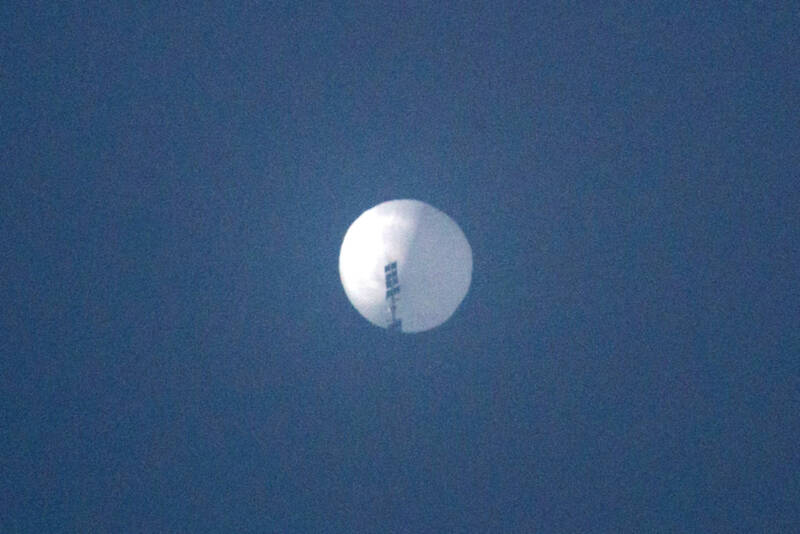
Photo: AFP / Chase Doak
“It costs China comparatively little to send balloons into Taiwanese airspace, and we should remain highly vigilant in the face of these incursions,” he said.
Thirty-two balloons were detected crossing the Taiwan Strait from China from Jan. 1 to Jan. 13, the day of Taiwan’s presidential and legislative elections, Ministry of National Defense data showed.
Thirteen of those balloons passed over Taiwan proper.
From Jan. 14 to Friday, 22 balloons were detected, three of which passed over Taiwan proper, the data showed.
Shu Hsiao-huang (舒孝煌), a researcher at the government-funded think tank Institute for National Defense and Security Research, said in an interview that China is using seasonal winds to harass Taiwan with balloons.
The current sea conditions around the Taiwan Strait make it difficult for China to conduct drills with warships, but they are ideal for balloons, Shu said.
Balloons are a particular nuisance because they cannot be shot down over land without risking injury or damage to personal property, he said, adding that the military might shoot them down over the sea to collect material for intelligence analysis.
“China failed in its attempts to influence Taiwanese voters during the election, but this has not stopped it from persisting with these gray zone tactics,” Chen said.
China uses the balloons to collect information on atmospheric data over Taiwan, as well as Taiwan’s military deployments on the ground, which would help it prepare for launching rockets and missiles, he said.
“It is also testing Taiwan’s air defense capabilities and response. This information would be used in a possible joint operation by China’s military to invade Taiwan,” he said, adding that the government should maintain a high degree of vigilance against the incursions. “We need to devise a set of standard operating procedures as soon as possible, to be ready to respond to such incursions.”
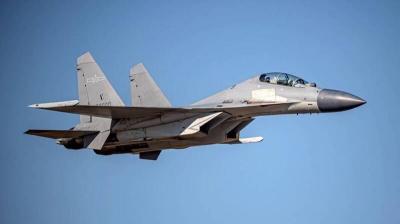
Eight Chinese naval vessels and 24 military aircraft were detected crossing the median line of the Taiwan Strait between 6am yesterday and 6am today, the Ministry of National Defense said this morning. The aircraft entered Taiwan’s northern, central, southwestern and eastern air defense identification zones, the ministry said. The armed forces responded with mission aircraft, naval vessels and shore-based missile systems to closely monitor the situation, it added. Eight naval vessels, one official ship and 36 aircraft sorties were spotted in total, the ministry said.
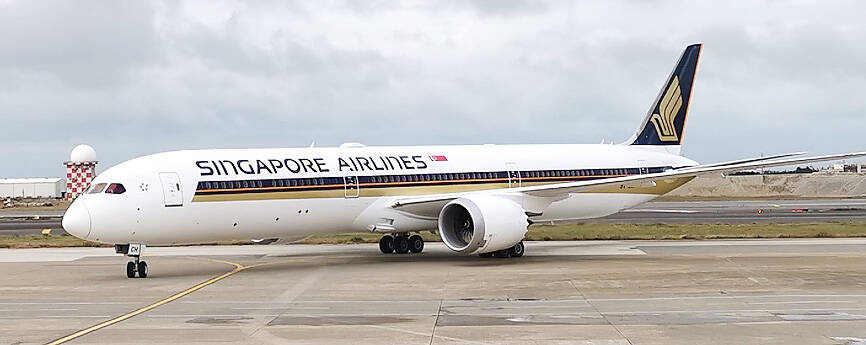
INCREASED CAPACITY: The flights on Mondays, Wednesdays, Fridays and Sundays would leave Singapore in the morning and Taipei in the afternoon Singapore Airlines is adding four supplementary flights to Taipei per week until May to meet increased tourist and business travel demand, the carrier said on Friday. The addition would raise the number of weekly flights it operates to Taipei to 18, Singapore Airlines Taiwan general manager Timothy Ouyang (歐陽漢源) said. The airline has recorded a steady rise in tourist and business travel to and from Taipei, and aims to provide more flexible travel arrangements for passengers, said Ouyang, who assumed the post in July last year. From now until Saturday next week, four additional flights would depart from Singapore on Monday, Wednesday, Friday
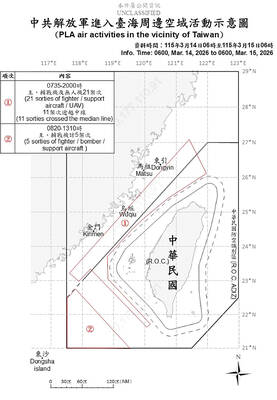
The Ministry of National Defense yesterday reported the return of large-scale Chinese air force activities after their unexplained absence for more than two weeks, which had prompted speculation regarding Beijing’s motives. China usually sends fighter jets, drones and other military aircraft around the nation on a daily basis. Interruptions to such routine are generally caused by bad weather. The Ministry of National Defense said it had detected 26 Chinese military aircraft in the Taiwan Strait over the previous 24 hours. It last reported that many aircraft on Feb. 25, when it spotted 30 aircraft, saying Beijing was carrying out another “joint combat
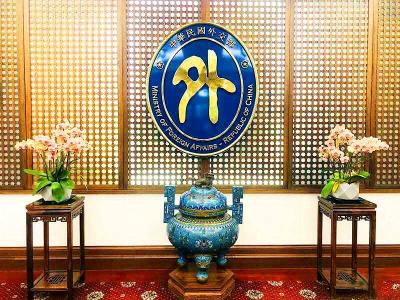
The Ministry of Foreign Affairs (MOFA) today said that if South Korea does not reply appropriately to its request to correct Taiwan’s name on its e-Arrival card system before March 31, it would take corresponding measures to alter how South Korea is labeled on the online Taiwan Arrival Card system. South Korea’s e-Arrival card system lists Taiwan as “China (Taiwan)” in the “point of departure” and “next destination” fields. The ministry said that it changed the nationality for South Koreans on Taiwan’s Alien Resident Certificates from “Korea” to “South Korea” on March 1, in a gesture of goodwill and based on the


 RSS
RSS