


Incoming legislators and their caucuses must consider the importance of legislative diplomacy, Legislative Speaker You Si-kun (游錫?) said yesterday in an exclusive interview with the Liberty Times (sister paper of the Taipei Times).
During his time as speaker, You was a great proponent of legislative diplomacy and arranged many visits to legislative bodies in the US, Japan and Europe.
Parliamentary diplomacy is an important strategy that helps sidestep Taiwan’s diplomatic constraints, he said, adding that the strategy should focus on democratic, non-ally countries, such as the Czech Republic and Lithuania.
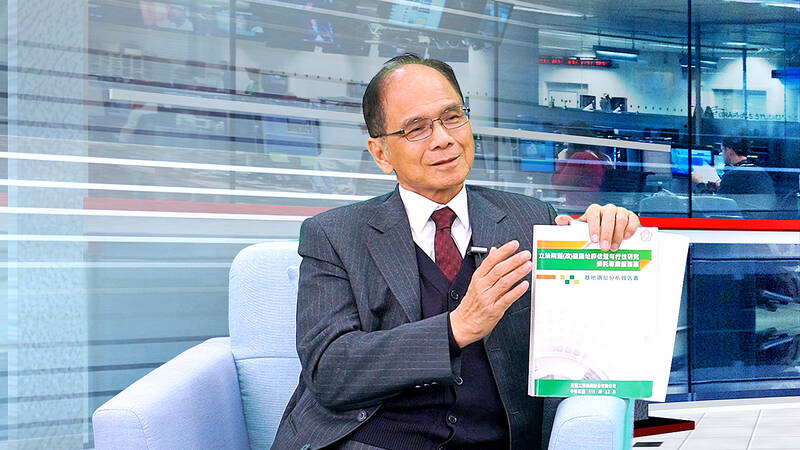
Photo: Taipei Times
He said that a prime example was the historic visit of Czech Senate President Milos Vystrcil, who was the first parliamentary leader from a country that is not a diplomatic ally to speak at the Legislative Yuan.
Subsequent visits from Czech Chamber of Deputies President Marketa Pekarova Adamova and Lithuanian Parliament Speaker Viktorija Cmilyte-Nielsen show that Taiwan has made breakthroughs regarding its international diplomacy, You said.
However, the divergent stances on cross-strait issues among the three main political parties would affect how active the incoming speaker will be in pushing legislative diplomacy, he added.
If the new speaker places more emphasis on Beijing’s opinions, they are unlikely to push much for a policy of unity, he said.
It would be a shame not to support a method that is working, he said, urging incoming lawmakers to “consider the importance of legislative diplomacy” when voting for a speaker.
It is possible that a minority party would be a “leading” force in the legislature, You said, citing the Lithuanian parliament as an example, with Cmilyte-Nielsen heading it despite her party having only one-10th of the seats.
In Taiwan’s legislative elections on Saturday last week, the Chinese Nationalist Party (KMT) claimed 52 seats, the Democratic Progressive Party won 51, the Taiwan People’s Party garnered eight and two seats went to independents, meaning a coalition would be required to form a majority.
That “might not happen during the next legislative session,” You said, adding that minority parties playing a leading role is “a constant in democratic politics.”
The new legislative speaker should strive for neutrality, and refrain from attending party events and caucus meetings, he said.

Considering that most countries issue more than five denominations of banknotes, the central bank has decided to redesign all five denominations, the bank said as it prepares for the first major overhaul of the banknotes in more than 24 years. Central bank Governor Yang Chin-lung (楊金龍) is expected to report to the Legislative Yuan today on the bank’s operations and the redesign’s progress. The bank in a report sent to the legislature ahead of today’s meeting said it had commissioned a survey on the public’s preferences. Survey results showed that NT$100 and NT$1,000 banknotes are the most commonly used, while NT$200 and NT$2,000

The Centers for Disease Control (CDC) yesterday reported the first case of a new COVID-19 subvariant — BA.3.2 — in a 10-year-old Singaporean girl who had a fever upon arrival in Taiwan and tested positive for the disease. The girl left Taiwan on March 20 and the case did not have a direct impact on the local community, it said. The WHO added the BA.3.2 strain to its list of Variants Under Monitoring in December last year, but this was the first imported case of the COVID-19 variant in Taiwan, CDC Deputy Director-General Lin Ming-cheng (林明誠) said. The girl arrived in Taiwan on

South Korea is planning to revise its controversial electronic arrival card, a step Taiwanese officials said prompted them to hold off on planned retaliatory measures, a South Korean media report said yesterday. A Yonhap News Agency report said that the South Korean Ministry of Foreign Affairs is planning to remove the “previous departure place” and “next destination” fields from its e-arrival card system. The plan, reached after interagency consultations, is under review and aims to simplify entry procedures and align the electronic form with the paper version, a South Korean ministry official said. The fields — which appeared only on the electronic form

The Ministry of Foreign Affairs (MOFA) is suspending retaliation measures against South Korea that were set to take effect tomorrow, after Seoul said it is updating its e-arrival system, MOFA said today. The measures were to be a new round of retaliation after Taiwan on March 1 changed South Korea's designation on government-issued alien resident certificates held by South Korean nationals to "South Korea” from the "Republic of Korea," the country’s official name. The move came after months of protests to Seoul over its listing of Taiwan as "China (Taiwan)" in dropdown menus on its new online immigration entry system. MOFA last week


 RSS
RSS