


Highwealth Construction Corp (興富發), which caused a fatal crash on a Taichung MRT line in May last year, has been ordered to compensate the Taichung City Government and Taichung Mass Rapid Transit Corp a combined NT$222.64 million (US$7.05 million).
Highwealth Construction said in a statement on Wednesday that it is to pay NT$210 million to the city government and NT$12.64 million to Taichung Mass Rapid Transit Corp, but added that the payments would not affect its operations.
The city and the MRT operator in September last year jointly filed an arbitration claim requesting NT$260 million in compensation from the construction firm for the fatal incident on May 10 last year, when a crane boom fell from a construction site above elevated mass rapid transit tracks near Feng-le Park Station on the Taichung MRT’s Green Line.
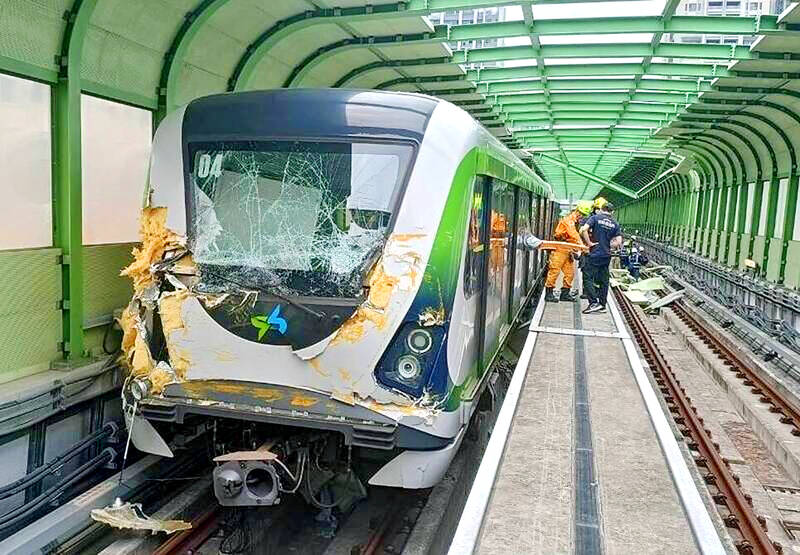
Photo courtesy of the Taichung Fire Bureau
A train hit the boom moments after departing from the station, killing one passenger and injuring 15.
Taichung Mayor Lu Shiow-yen (盧秀燕) on Wednesday told reporters that the result of the arbitration was close to the amount expected by city authorities and that the city respects the decision.
Highwealth Construction had already transferred the NT$260 million originally requested to a city government bank account, which the city would access in the near future, the city said.
The balance of the funds would be returned to Highwealth Construction, the city added.

Considering that most countries issue more than five denominations of banknotes, the central bank has decided to redesign all five denominations, the bank said as it prepares for the first major overhaul of the banknotes in more than 24 years. Central bank Governor Yang Chin-lung (楊金龍) is expected to report to the Legislative Yuan today on the bank’s operations and the redesign’s progress. The bank in a report sent to the legislature ahead of today’s meeting said it had commissioned a survey on the public’s preferences. Survey results showed that NT$100 and NT$1,000 banknotes are the most commonly used, while NT$200 and NT$2,000

The Centers for Disease Control (CDC) yesterday reported the first case of a new COVID-19 subvariant — BA.3.2 — in a 10-year-old Singaporean girl who had a fever upon arrival in Taiwan and tested positive for the disease. The girl left Taiwan on March 20 and the case did not have a direct impact on the local community, it said. The WHO added the BA.3.2 strain to its list of Variants Under Monitoring in December last year, but this was the first imported case of the COVID-19 variant in Taiwan, CDC Deputy Director-General Lin Ming-cheng (林明誠) said. The girl arrived in Taiwan on

South Korea is planning to revise its controversial electronic arrival card, a step Taiwanese officials said prompted them to hold off on planned retaliatory measures, a South Korean media report said yesterday. A Yonhap News Agency report said that the South Korean Ministry of Foreign Affairs is planning to remove the “previous departure place” and “next destination” fields from its e-arrival card system. The plan, reached after interagency consultations, is under review and aims to simplify entry procedures and align the electronic form with the paper version, a South Korean ministry official said. The fields — which appeared only on the electronic form

The Ministry of Foreign Affairs (MOFA) is suspending retaliation measures against South Korea that were set to take effect tomorrow, after Seoul said it is updating its e-arrival system, MOFA said today. The measures were to be a new round of retaliation after Taiwan on March 1 changed South Korea's designation on government-issued alien resident certificates held by South Korean nationals to "South Korea” from the "Republic of Korea," the country’s official name. The move came after months of protests to Seoul over its listing of Taiwan as "China (Taiwan)" in dropdown menus on its new online immigration entry system. MOFA last week


 RSS
RSS