


A shipment of dried black sesame seeds from Malaysia was recently seized at Taiwan’s border after being found to contain excessive pesticide residue, the Food and Drug Administration (FDA) said on Tuesday.
The 38,400kg of black sesame seeds, imported by Kaohsiung-based Long Weleare Industry Co, were seized after sample testing of the shipment sent for examinations on Dec. 15 detected 0.06 parts per million (ppm) of phosphine, exceeding the allowable limit of 0.01ppm.
The product has been returned to the country of origin or destroyed, the FDA said.
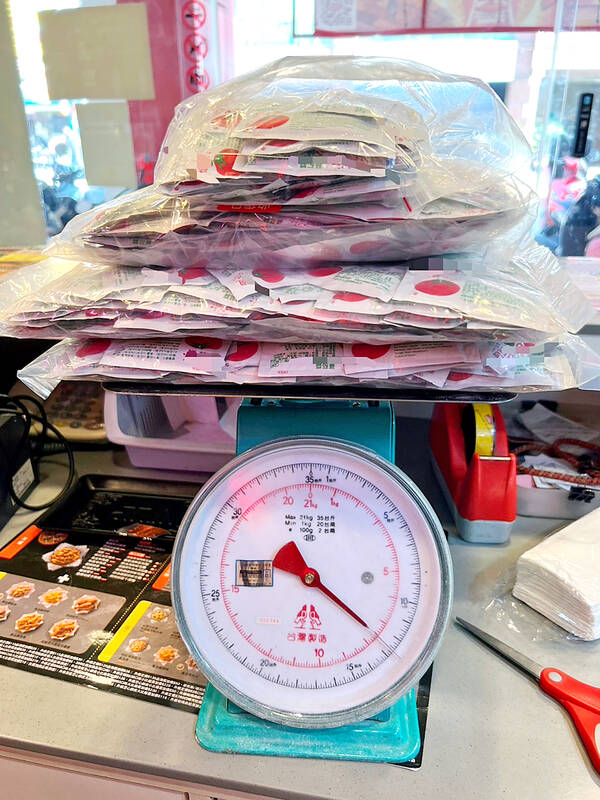
Photo courtesy of the Food and Drug Administration
Phosphine is a colorless gas used as a fumigant for stored grains, FDA Deputy Director-General Lin Chin-fu (林金富) said.
Lin said it was first violation by the importer, so the rate of inspections on its future shipments would be raised to 20 to 50 percent from 2 to 10 percent.
Phosphine is a chemical commonly used for fumigation to control pests in stored grains and seeds, Taipei Veterans General Hospital toxicologist Yang Chen-chang (楊振昌) said.
Since it takes a long time to ship bulk grain to Taiwan by sea, and insects and pests can infest grain in storage and shipment, fumigation to eliminate insects is usually performed after arriving in Taiwan and before the cargoes are sent to granaries, Yang said.
Inhaling high concentrations of phosphine can cause gastrointestinal disorders, bronchitis and pulmonary edema, and can even lead to death, Yang said.
The black sesame seeds were intercepted along with 12 other product shipments, including fresh white truffles from Italy, fresh grapes from South Korea and lion’s mane mushrooms from China, after they were found to contain excessive amounts of agricultural chemicals or failed to conform to regulations on the inspection of imported foods and related products, the FDA’s weekly report on intercepted imports showed.
Three shipments of fresh strawberries from Japan also failed border inspections after being found to contain excessive pesticide residues, the report said.
FDA statistics showed that, from July 8 last year to Monday last week, 13 out of 273 shipments of fruit from Japan failed to meet Taiwan’s safety standards during border checks.
As such, fresh strawberries from Japan would still be subject to batch-by-batch border inspections until April 30, while products from six Japanese suppliers would be banned from entering Taiwan until Feb. 11.
In addition, two batches of chili powder imported from China failed pesticide tests, and such imports from across the Taiwan Strait would be subject to batch-by-batch border checks until June 10, the report said.
In other news, the FDA on Monday said that seven of 453 food and beverage operators working with food delivery platforms failed food safety and sanitation inspections carried out between Aug. 1 and Oct. 31 last year.
The seven catering operators that failed the “2023 delivery platform project” inspections carried out by the FDA and local health authorities include a Pizza Hut store in Hsinchu and an eatery in Hualien after their ketchup and peanut powder were found to have expired, Lin said, adding that each was fined NT$60,000 for breaching the Act Governing Food Safety and Sanitation (食品安全衛生管理法).
A supplier to the Hualien eatery has also been fined NT$30,000 for providing dessert ingredients without an expiry date, and two beverage shops in Tainan were fined NT$30,000 each after their tea drinks were found to contain excessive levels of Enterobacteriaceae, he said.
A hamburger store in Keelung was fined NT$15,000 for failing to meet food liability insurance requirements, while a supplier of meat glue for a Kaohsiung meal box supplier was also fined NT$30,000 for not meeting labeling requirements, Lin added.
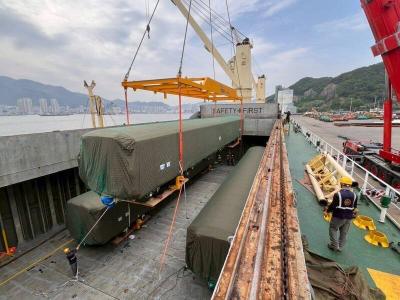
The first of 10 new high-capacity trains purchased from South Korea’s Hyundai Rotem arrived at the Port of Taipei yesterday to meet the demands of an expanding metro network, Taipei Rapid Transit Corp (TRTC) said yesterday. The train completed a three-day, 1,200km voyage from the Port of Masan in South Korea, the company said. Costing NT$590 million (US$18.79 million) each, the new six-carriage trains feature a redesigned interior based on "human-centric" transportation concepts, TRTC said. The design utilizes continuous longitudinal seating to widen the aisles and optimize passenger flow, while also upgrading passenger information displays and driving control systems for a more comfortable
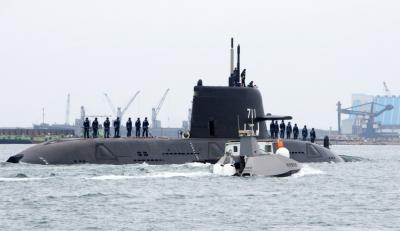
Taiwan's first indigenous defense submarine, the SS-711 Hai Kun (海鯤, or Narwhal), departed for its 13th sea trial at 7am today, marking its seventh submerged test, with delivery to the navy scheduled for July. The outing also marked its first sea deployment since President William Lai (賴清德) boarded the submarine for an inspection on March 19, drawing a crowd of military enthusiasts who gathered to show support. The submarine this morning departed port accompanied by CSBC Corp’s Endeavor Manta (奮進魔鬼魚號) uncrewed surface vessel and a navy M109 assault boat. Amid public interest in key milestones such as torpedo-launching operations and overnight submerged trials,
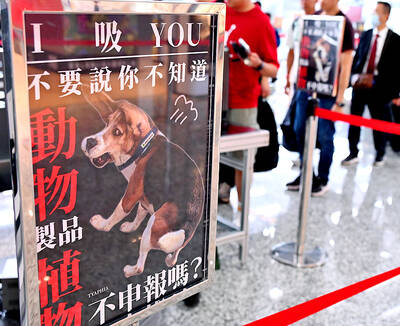
Quarantine awareness posters at Taiwan Taoyuan International Airport have gone viral for their use of wordplay. Issued by the airport branch of the Animal and Plant Health Inspection Agency, the posters feature sniffer dogs making a range of facial expressions, paired with advisory messages built around homophones. “We update the messages for holidays and campaign needs, periodically refreshing materials to attract people’s attention,” quarantine officials said. “The aim is to use the dogs’ appeal to draw focus to quarantine regulations.” A Japanese traveler visiting Taiwan has posted a photo on X of a poster showing a quarantine dog with a
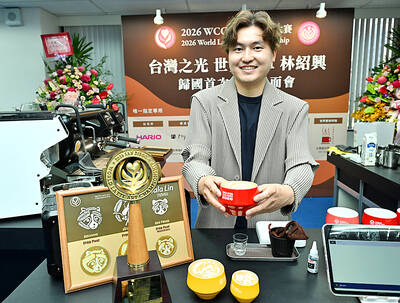
Taiwan’s coffee community has launched a “one-person-one-e-mail” campaign, calling for people to send a protest-e-mail to the World Coffee Championships (WCC) urging it to redesignate Taiwanese competitors as from “Taiwan,” rather than “Chinese Taipei.” The call followed sudden action last week after the WCC changed all references to Taiwanese competitors from “Taiwan” to “Chinese Taipei,” including recent World Latte Art champion Bala (林紹興), who won the World Latte Art Championship in San Diego earlier this month. When Bala received the trophy, he was referred to as representing Taiwan, as well as in the announcement on the WCC’s Web site, until it


 RSS
RSS