


China is likely to attempt to put pressure on Taiwan’s incoming president after the nation goes to the polls today, including staging military maneuvers near the country this spring, two senior government officials said.
No matter which candidate wins the presidential election, Beijing’s military and economic pressure on Taiwan’s next president is likely to increase, officials speaking on condition of anonymity said.
Taiwan goes to the polls today to elect a new president and legislature under the shadow of an increasingly assertive China which has called the vote a choice between “war and peace.”
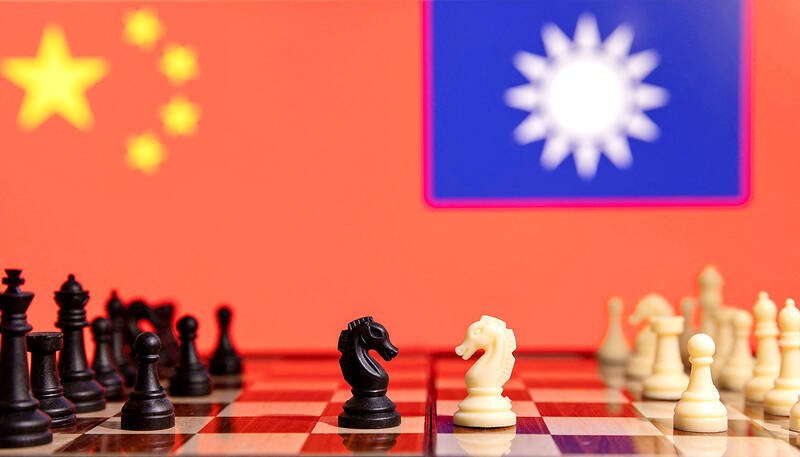
Photo: Reuters
Beijing is likely to apply “great pressure” in a bid to influence the new president’s inaugural address on May 20, which is expected to set the tone for the new administration’s China policy, said one official, who has knowledge of Taiwan’s security planning.
China’s top Taiwan policy agency, the Taiwan Affairs Office, did not immediately respond to a request for comment.
While large-scale military drills near Taiwan are unlikely immediately after the vote, Beijing is likely to stage maneuvers near the nation after March due to more favorable weather and sea conditions, the official said, citing Taiwan’s security assessment.
The potential for increasing tensions over Taiwan, especially after China staged two rounds of major war games near the nation in April of last year and August of 2022, is being closely watched in the region and by Washington and its allies.
Two Western security officials, speaking on condition of anonymity as they were not authorized to speak to the media, said China was likely to respond militarily at some point after the election, although they did not believe it would be on the scale of the last two war games.
The Taiwanese official said Beijing could also opt to limit any show of military force in the coming months because of considerations including improving US-China relations.
The US-China relationship tumbled to historic lows last year, but since US President Joe Biden and Chinese President Xi Jinping’s (習近平) meeting in November last year and an agreement to re-establish military-to-military ties, senior Chinese and US officials have staged meetings.
Should a party that wins the presidency fail to gain a legislative majority, China is likely to label the new administration a “minority government,” the Taiwanese official said.
In what Taiwan views as a bid to weaken a new administration, China is also likely to invite pro-Beijing Taiwanese politicians to visit China and continue what Taipei perceives as disinformation campaigns against the government, the official said.
Taiwan’s Ministry of National Defense yesterday said that it had detected five Chinese balloons flying over the Taiwan Strait over the past 24 hours, one of which crossed Taiwan proper, the latest in a spate of such balloons the ministry says it has spotted over the past month.
Taiwan has described a range of actions by China, including the balloon flights, reports by China’s state-media and threats of further trade sanctions as a form of psychological warfare against Taiwanese ahead of the vote.
“China’s voting interference in Taiwan is a textbook example,” the first Taiwanese official said. “Other countries must come and learn quickly.”
Election interference allegations are the Democratic Progressive Party’s “dirty trick” to win votes, Beijing said.
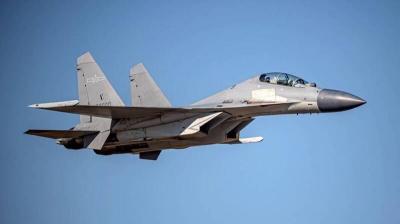
Eight Chinese naval vessels and 24 military aircraft were detected crossing the median line of the Taiwan Strait between 6am yesterday and 6am today, the Ministry of National Defense said this morning. The aircraft entered Taiwan’s northern, central, southwestern and eastern air defense identification zones, the ministry said. The armed forces responded with mission aircraft, naval vessels and shore-based missile systems to closely monitor the situation, it added. Eight naval vessels, one official ship and 36 aircraft sorties were spotted in total, the ministry said.
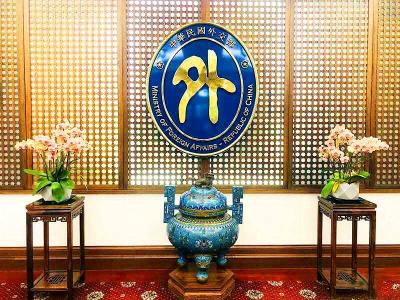
The Ministry of Foreign Affairs (MOFA) today said that if South Korea does not reply appropriately to its request to correct Taiwan’s name on its e-Arrival card system before March 31, it would take corresponding measures to alter how South Korea is labeled on the online Taiwan Arrival Card system. South Korea’s e-Arrival card system lists Taiwan as “China (Taiwan)” in the “point of departure” and “next destination” fields. The ministry said that it changed the nationality for South Koreans on Taiwan’s Alien Resident Certificates from “Korea” to “South Korea” on March 1, in a gesture of goodwill and based on the

Taiwanese officials were shown the first of 66 F-16V fighter jets purchased by Taiwan from the United States, the Ministry of National Defense said yesterday, adding the aircraft has completed an initial flight test and is expected to be delivered later this year. A delegation led by Deputy Minister of National Defense Hsu Szu-chien (徐斯儉) visited Lockheed Martin’s F-16 C/D Block 70 (also known as F-16V) assembly line in South Carolina on March 16 to view the aircraft. The jet will undergo a final acceptance flight in the US before being delivered to Taiwan, the
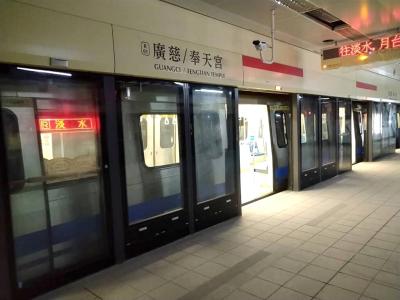
The New Taipei Metro's Sanyin Line and the eastern extension of the Taipei Metro's Tamsui-Xinyi Line (Red Line) are scheduled to begin operations in June, the National Development Council said today. The Red Line, which terminates at Xiangshan Station, would be connected by the 1.4km extension to a new eastern terminal, Guangci/Fengtian Temple Station, while the Sanyin Line would link New Taipei City's Tucheng and Yingge stations via Sanxia District (三峽). The council gave the updates at a council meeting reviewing progress on public construction projects for this year. Taiwan's annual public infrastructure budget would remain at NT$800 billion (US$25.08 billion), with NT$97.3


 RSS
RSS