


Prosecutors on Tuesday questioned former Mainland Affairs Council deputy minister Chang Hsien-yao (張顯耀) in relation to a case involving the fabrication of opinion polls to influence election results, days before polls open on Saturday.
He was released on bail of NT$1 million (US$32,113).
The Ciaotou District Prosecutors’ Office in Kaohsiung is investigating allegations of groups disseminating fabricated polling results in news reports or on social media.
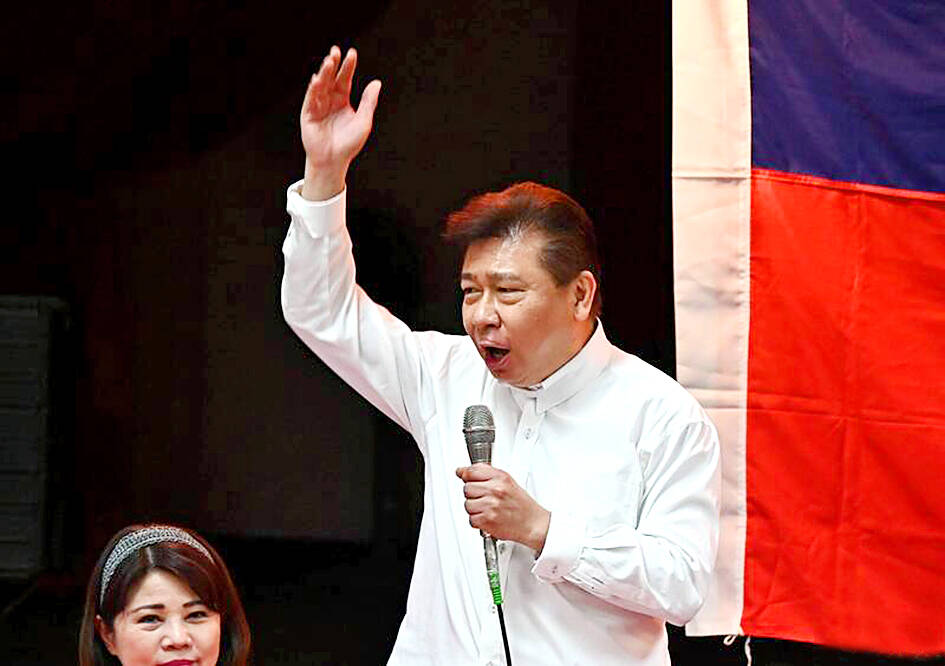
Photo: Lee Hui-chou, Taipei Times
The office late last month detained former For Public Good Party deputy chairman Hsu Shao-tung (徐少東) and released two suspected coconspirators on bail.
An expanded investigation reportedly implicated Chang, a former legislator and council deputy minister who is now chairman of the Cross-Strait Roundtable Forum Association, prosecutors said.
He was summoned for questioning over alleged contraventions of the Anti-infiltration Act (反滲透法) and the Presidential and Vice Presidential Election and Recall Act (總統副總統選舉罷免法), the office said yesterday.
It declined to give further details on the investigation or the nature of Chang’s alleged involvement, although he has reportedly denied any wrongdoing.
In related news, 53 people who allegedly traveled to Beijing last month on a five-day trip that was “disproportionately subsidized” by the Chinese government have been listed as defendants after questioning, the Yilan District Prosecutors’ Office said yesterday.
The tour guides were not tourism professionals, and the itineraries were believed to have been arranged by local offices under China’s Taiwan Affairs Office (TAO), prosecutors said in a statement.
An initial investigation found that the travelers were part of three tour groups, fewer than the 100 people and five groups initially rumored to have traveled, prosecutors said.
They are suspected of contravening the Anti-infiltration Act, Public Officials Election and Recall Act (公職人員選舉罷免法), and the Presidential and Vice Presidential Election and Recall Act, prosecutors said, adding that they were questioned by the police and the National Immigration Agency on Tuesday.
During questioning, the participants said that they had been invited by Chinese officials from Jiangsu Province’s Changzhou and Hebei Province, and that the schedules had been organized by TAO officials, prosecutors said.
During the trip, Chinese officials made statements such as “support the parties that boost cross-strait relations” or “oppose Taiwanese independence,” and asked them to repeat phrases such as “both sides share the same language and blood” and “both sides need to facilitate peaceful exchanges,” they said.
Prosecutors said they would seek to clarify whether the suspects were involved in foreign interference or bribery.
Meanwhile, prosecutors said they are also investigating several people in Yilan County on suspicion of inviting village and township officials on trips to China since August last year.
The attendees were allegedly only required to pay for their airfare, while the rest of the travel expenses were paid by Chinese officials, prosecutors said.
Some attendees posted and shared photographs from the trip on social media, saying they had been invited and hosted by the TAO, they said.
After investigating the travel records of the officials, they found that the frequency of trips to the Chinese cities of Shanghai, Nanjing, Guangzhou and Xiamen had increased since May last year.
Tour participants also included leaders of Taiwanese civil groups, prosecutors added.
Additional reporting by CNA

NATIONAL SECURITY: Authorities are working to confirm the identities of the military personnel involved and investigating possible illegal conduct and regulatory violations Authorities are probing possible national security implications after Kinmen police and immigration officers on Sunday found a Chinese woman allegedly posing as a tourist while engaging in prostitution involving more than 10 military personnel. The woman, surnamed Chen (陳), has since been deported, authorities said, adding that investigators are still working to confirm the identities of those implicated, as the records only listed code names and aliases. The case stemmed from a report received by the Kinmen District Prosecutors’ Office on Friday last week from the Jinhu Precinct of the Kinmen County Police Bureau. On Sunday, police, along with the National Immigration

GLOBALGIVING: ‘ Caving to external pressure is not acceptable for an organization that has cultivated justice reform and human rights for 30 years,’ one NGO said A slew of non-government organizations (NGOs) have withdrawn from the GlobalGiving fundraising platform after it announced it would use “Chinese Taipei” instead of “Taiwan” from next month. The Taiwan Good Rice Association wrote on Facebook on Friday that it was informed on April 28 via a teleconference call of the change, which was made because the platform wanted to operate in China. Taiwan Good Rice is to terminate all cooperative relationships with GlobalGiving in response to the platform’s “unilateral and non-negotiable” decision to remove references to Taiwan, the NGO said. “Taiwan is in the official name of Taiwan Good Rice Association and the

HEAVY WEATHER: Typhoon Jangmi is due to crash straight into the Ryukyus as airlines look to shift flights to larger aircraft or cancel flights to Okinawa entirely Taiwan’s international air carriers announced flight adjustments over the weekend as Typhoon Jangmi is forecast to hit the Ryukyu Islands today and tomorrow. The Central Weather Administration (CWA) upgraded Jangmi from a tropical storm to a typhoon at 8am yesterday, with the eye located 580km south of Naha city. It was moving north at 19kph. Today, China Airlines’ CI-120, CI-121, CI-122 and CI-123 flights between Taoyuan and Naha, Okinawa, have been canceled as well as CI-132 and CI-133 between Kaohsiung and Naha. EVA Air’s BR-112, BR-113, BR-186 and BR-185 flights between Taoyuan and Naha are also canceled. Low-cost carrier Tigerair Taiwan canceled IT-230,
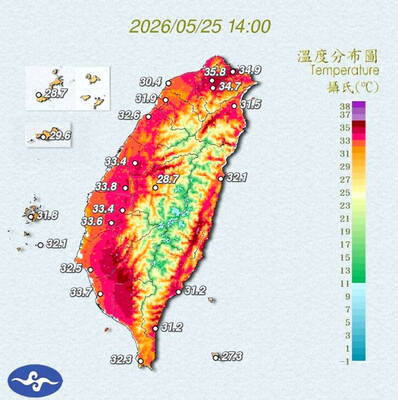
STAY COOL: The HPA recommended that people stay hydrated, use air-conditioning or fans while indoors, wear loose-fitting clothes and walk in the shade while outdoors Employers must implement measures such as installing cooling equipment, and providing drinking water and rest breaks for outdoor workers starting from Monday next week, the Taipei Department of Labor said on Sunday. Employers who fail to comply could face fines of NT$30,000 to NT$300,000 under the Occupational Safety and Health Act (職業安全衛生法), the department said. Businesses in Taipei employing fewer than 100 workers, as well as registered self-employed workers with labor insurance coverage, could receive on-site assessments and guidance from occupational safety consultants to help them apply for central government subsidies to implement or improve heat-protection measures, it said. Under the Ministry of


 RSS
RSS