


The Chinese Nationalist Party (KMT) on Wednesday unveiled a new “KMT Girls” campaign group as it makes a final push to woo female and young voters before the elections on Saturday next week.
At a news conference in Taipei, KMT Chairman Eric Chu (朱立倫) introduced members of the KMT Girls group and said that they would be deployed in competitive constituencies across Taiwan to campaign for its candidates, highlighting the “strong fighting spirit of KMT women.”
The KMT, the only party not to have a woman on its presidential ticket, is looking to broaden its support as campaigning nears an end, Chu said.
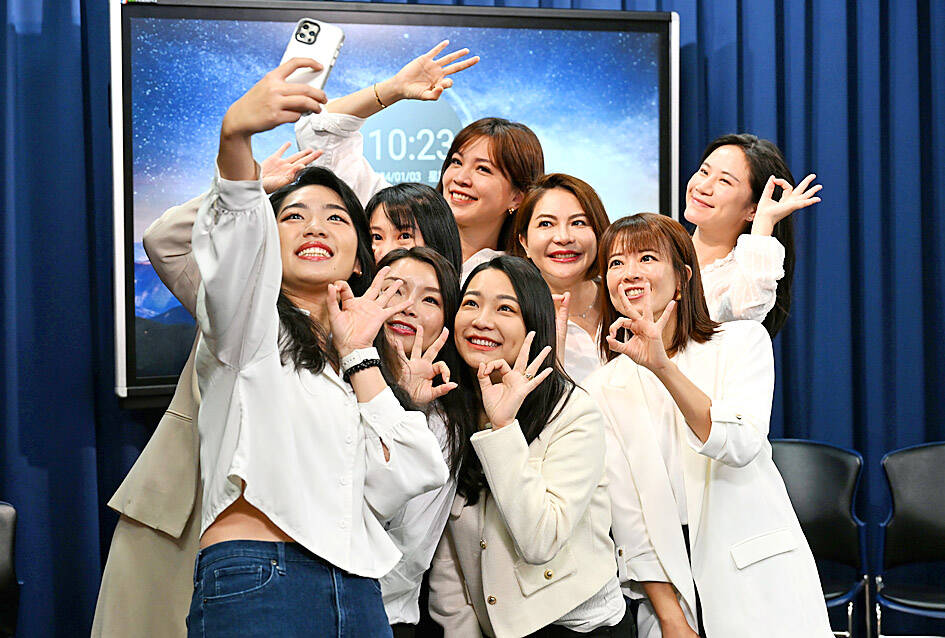
Photo: Lin Cheng-kun, Taipei Times
The focus is on appealing to women, swing voters and young voters in tight races, he said.
KMT Girls has more than 10 members, including KMT legislator-at-large nominees Chen Ching-hui (陳菁徽), Chang Chia-chun (張嘉郡), Chung Pei-chun (鍾沛君), Wennie Wu (吳亮儀) and Yang Chih-yu (楊智?), the party said.
Yang told the news conference that the group would set out across Taiwan and make sure people “feel our passion.”
Separately, Taiwan People’s Party Chairman and presidential candidate Ko Wen-je (柯文哲) and his running mate, Legislator Cynthia Wu (吳欣盈), are on a nationwide bus tour.
They departed on Tuesday from Ko’s campaign headquarters in New Taipei City and visited Taoyuan on Wednesday to boost the party’s momentum.
They traveled to Hsinchu yesterday, the campaign office said.

Considering that most countries issue more than five denominations of banknotes, the central bank has decided to redesign all five denominations, the bank said as it prepares for the first major overhaul of the banknotes in more than 24 years. Central bank Governor Yang Chin-lung (楊金龍) is expected to report to the Legislative Yuan today on the bank’s operations and the redesign’s progress. The bank in a report sent to the legislature ahead of today’s meeting said it had commissioned a survey on the public’s preferences. Survey results showed that NT$100 and NT$1,000 banknotes are the most commonly used, while NT$200 and NT$2,000

The Centers for Disease Control (CDC) yesterday reported the first case of a new COVID-19 subvariant — BA.3.2 — in a 10-year-old Singaporean girl who had a fever upon arrival in Taiwan and tested positive for the disease. The girl left Taiwan on March 20 and the case did not have a direct impact on the local community, it said. The WHO added the BA.3.2 strain to its list of Variants Under Monitoring in December last year, but this was the first imported case of the COVID-19 variant in Taiwan, CDC Deputy Director-General Lin Ming-cheng (林明誠) said. The girl arrived in Taiwan on

South Korea is planning to revise its controversial electronic arrival card, a step Taiwanese officials said prompted them to hold off on planned retaliatory measures, a South Korean media report said yesterday. A Yonhap News Agency report said that the South Korean Ministry of Foreign Affairs is planning to remove the “previous departure place” and “next destination” fields from its e-arrival card system. The plan, reached after interagency consultations, is under review and aims to simplify entry procedures and align the electronic form with the paper version, a South Korean ministry official said. The fields — which appeared only on the electronic form

The Ministry of Foreign Affairs (MOFA) is suspending retaliation measures against South Korea that were set to take effect tomorrow, after Seoul said it is updating its e-arrival system, MOFA said today. The measures were to be a new round of retaliation after Taiwan on March 1 changed South Korea's designation on government-issued alien resident certificates held by South Korean nationals to "South Korea” from the "Republic of Korea," the country’s official name. The move came after months of protests to Seoul over its listing of Taiwan as "China (Taiwan)" in dropdown menus on its new online immigration entry system. MOFA last week


 RSS
RSS