


Immigrants from China and Southeast Asia are not being unduly targeted in investigations of election interference, the Cabinet and the Supreme Prosecutors’ Office said yesterday.
Criticism of the efforts arose after media reported that a Ministry of Justice report at a Cabinet meeting last week listed “new residents” as a priority for monitoring.
“New residents” broadly refers to recent immigrants and naturalized citizens through marriage, with many people associating the term with spouses from China and Southeast Asian countries.
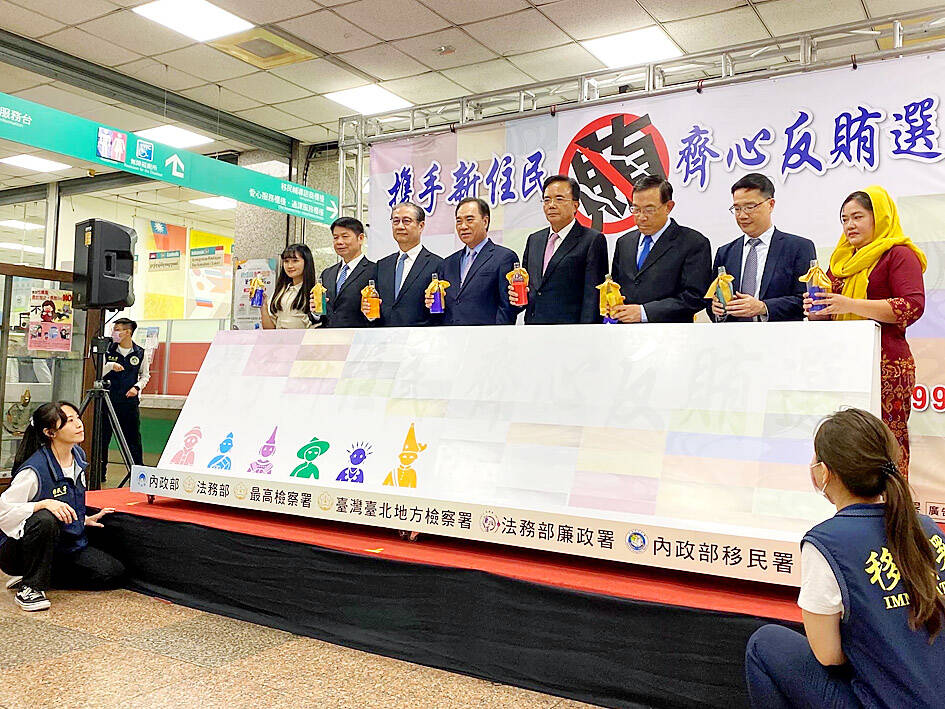
Photo courtesy of the Supreme Prosecutors’ Office
Media reported that the ministry had referred to cases of new residents and their social organizations unlawfully meddling in next weeks presidential and legislative elections, with some Cabinet officials saying that might be viewed as vilification of new residents.
Ministry officials have changed the wording of the report to refer to “local collaborators working through Taiwan-based organizations to develop networks undertaking unlawful actions to meddle in the elections” on Saturday next week, Cabinet spokesman Lin Tze-luen (林子倫) said.
“The report aimed to remind people of the tactics China uses and does not target any specific group,” Lin said.
“Although terms used could be misconstrued and the ministry has made the adjustment ... hopefully people would not read too much into the language and cast aspersions,” he added.
The prosecutors’ office in a news release said that “everyone is equal before the law,” and it is the duty of prosecutors to ensure that the human rights of all groups are protected.
Prosecutors do not target specific groups, it said.
“In seminars and workshops dealing with vote-buying and contraventions of election laws, prosecutors have endorsed the many contributions to society by new residents,” it said. “New residents would also have the same positive viewpoints.”
The office also explained the use of terms in the report such as “black” referring to vilifying candidates by smearing with disinformation, “red” meaning “foreign forces headed by the Chinese government to influence the elections and “gold” referring to money to buy votes and illegal gambling pools betting on election outcomes.
“There was no specific targeting,” it said, adding that the misunderstanding arose from comments by a captain at the National Immigration Agency, who during the Cabinet meeting had spoken on the composition of communities and warned to watch for “new residents and their affiliated organizations” offering enticements for people to travel to China or free banquets.
Additional reporting by Chien Li-chung

Considering that most countries issue more than five denominations of banknotes, the central bank has decided to redesign all five denominations, the bank said as it prepares for the first major overhaul of the banknotes in more than 24 years. Central bank Governor Yang Chin-lung (楊金龍) is expected to report to the Legislative Yuan today on the bank’s operations and the redesign’s progress. The bank in a report sent to the legislature ahead of today’s meeting said it had commissioned a survey on the public’s preferences. Survey results showed that NT$100 and NT$1,000 banknotes are the most commonly used, while NT$200 and NT$2,000

The Centers for Disease Control (CDC) yesterday reported the first case of a new COVID-19 subvariant — BA.3.2 — in a 10-year-old Singaporean girl who had a fever upon arrival in Taiwan and tested positive for the disease. The girl left Taiwan on March 20 and the case did not have a direct impact on the local community, it said. The WHO added the BA.3.2 strain to its list of Variants Under Monitoring in December last year, but this was the first imported case of the COVID-19 variant in Taiwan, CDC Deputy Director-General Lin Ming-cheng (林明誠) said. The girl arrived in Taiwan on

South Korea is planning to revise its controversial electronic arrival card, a step Taiwanese officials said prompted them to hold off on planned retaliatory measures, a South Korean media report said yesterday. A Yonhap News Agency report said that the South Korean Ministry of Foreign Affairs is planning to remove the “previous departure place” and “next destination” fields from its e-arrival card system. The plan, reached after interagency consultations, is under review and aims to simplify entry procedures and align the electronic form with the paper version, a South Korean ministry official said. The fields — which appeared only on the electronic form

The Ministry of Foreign Affairs (MOFA) is suspending retaliation measures against South Korea that were set to take effect tomorrow, after Seoul said it is updating its e-arrival system, MOFA said today. The measures were to be a new round of retaliation after Taiwan on March 1 changed South Korea's designation on government-issued alien resident certificates held by South Korean nationals to "South Korea” from the "Republic of Korea," the country’s official name. The move came after months of protests to Seoul over its listing of Taiwan as "China (Taiwan)" in dropdown menus on its new online immigration entry system. MOFA last week


 RSS
RSS