


The nation’s presidential contenders and youth leaders have identified low wages, high rent and house prices and cross-strait issues as being the main concerns for young voters who could play a pivotal role in determining the presidential election outcome.
In a report published on Dec. 4, the New York Times dubbed “frustrated young voters” as “wild cards” in the Jan. 13 elections.
Eligible voters aged 20 to 40 constitute 25 percent of the 19.5 million electorate, of which prospective first-time voters account for 1.02 million, the Central Election Commission said.

Photo: Liao Chen-huei, Taipei Times
In the 2020 presidential election, about 70 percent of Taiwanese in their 20s and 30s voted, data showed.
Eight years after it became Taiwan’s ruling party, the Democratic Progressive Party (DPP) has articulated its stance on cross-strait and LGBTQ issues, but its understanding of the plight of young people regarding housing and commuting appears to be lacking, said Chang Yu-meng (張育萌), who heads the Taiwan Youth Association for Democracy (TYAD).
Lin Ting-chun (林鼎鈞), head of Taiwan Junior Chamber International, said that boosting income, being able to afford a home and worrying about war breaking out in the Taiwan Strait was top of the list of issues voters under the age of 40 had.
However, Chang said that interest in national affairs does not necessarily translate to support for certain candidates or voter turnout, as the potentially high cost of commuting back to one’s hometown to cast a ballot also needs to be taken into consideration.
Some young people have also said that they would vote — or not vote — based on how strongly they identify with the candidates’ stance on certain issues, rather than the party that nominated them.
As such, candidates need to focus on putting forward more youth-friendly policies if they want to garner support from younger voters, he said.
Lin said that despite all the hullaballoo in the media about the elections capturing people’s attention, turnout among younger voters would depend on whether they believe the candidate could improve their quality of life.
Meager wages and soaring house prices have left many young people disillusioned about their future and caused them to become indifferent toward politics, a source within the Chinese Nationalist Party (KMT) said.
Young people’s lives have not improved under the DPP administration, which has offered the KMT an opportunity to entice young voters by crafting policy proposals favorable to them, the source said.
Polls indicate that the KMT has struggled to garner support among younger voters, an area where the nascent Taiwan People’s Party (TPP) is appearing to shine.
A member of KMT presidential candidate New Taipei City Mayor Hou You-yi’s (侯友宜) campaign, who asked not to be named, said that the policy proposals unveiled by Hou to subsidize mortgages for first-time buyers, including a proposal to waive downpayments and provide more social housing appears to have gained traction among young people.
Lee Li-chen (李利貞), a spokesperson for Hou’s campaign, said that rather than prioritizing investment in public infrastructure, as the DPP has done, the government should focus on investing in young people, because it is an investment in the country’s future.
A campaign staff member of DPP presidential candidate Vice President William Lai (賴清德) said that the Lai camp is well aware of the risks disgruntled young voters pose to Lai’s campaign.
“Young people are dissatisfied. We saw that and we felt that,” they said.
In light of this, they said, the Lai camp has unveiled policy proposals designed to help young people, including increasing subsidies for tuition at private universities and housing rent, raising subsidies for infants enrolled in daycare centers and building more social housing.
Meanwhile, TPP chairman and presidential candidate Ko Wen-je (柯文哲) has proposed policies that seek to address housing problems and tackle low birthrates, including adding social housing units until they reach 5 percent of the total number of housing units in Taiwan, providing low-interest mortgages and increasing subsidies for expectant mothers and parents with young children, TPP spokesman Adam Lee (李頂立) said.
Turning to cross-strait relations, which have traditionally been a major point of contention in Taiwanese elections, those interviewed expressed conflicting views.
The DPP secured a landslide victory in the 2020 presidential election on a groundswell of anti-China sentiment and support for protecting Taiwan’s sovereignty, Chang said.
Four years later, young people have become more concerned with Taiwan’s defense and its relations with China, due to the extension of the military conscription period and the ongoing wars between Israel and Hamas, and Ukraine and Russia, he said.
Cross-strait issues were “by far and away” the issue young Taiwanese cared most about, as evidenced by the widespread interest shown at a recent forum held by the TYAD, he said.
However, Lin said it would be tricky to predict which candidate would have the most success in maintaining the “status quo” and safeguarding Taiwan’s democratic system — two things which he says are the priorities of most young people.
Against this, Adam Lee said that cross-strait issues are taking a backseat to economic issues such as stagnant wages, exorbitant house prices and the labor shortage.
Whichever candidate convinces voters of their ability to address these concerns is likely to emerge victorious, Lee said.
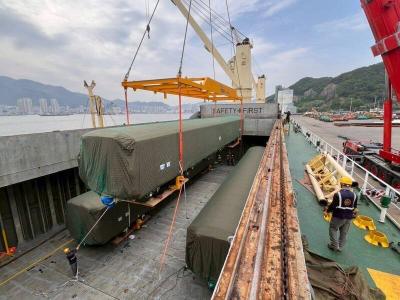
The first of 10 new high-capacity trains purchased from South Korea’s Hyundai Rotem arrived at the Port of Taipei yesterday to meet the demands of an expanding metro network, Taipei Rapid Transit Corp (TRTC) said yesterday. The train completed a three-day, 1,200km voyage from the Port of Masan in South Korea, the company said. Costing NT$590 million (US$18.79 million) each, the new six-carriage trains feature a redesigned interior based on "human-centric" transportation concepts, TRTC said. The design utilizes continuous longitudinal seating to widen the aisles and optimize passenger flow, while also upgrading passenger information displays and driving control systems for a more comfortable
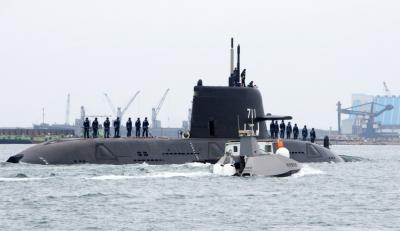
Taiwan's first indigenous defense submarine, the SS-711 Hai Kun (海鯤, or Narwhal), departed for its 13th sea trial at 7am today, marking its seventh submerged test, with delivery to the navy scheduled for July. The outing also marked its first sea deployment since President William Lai (賴清德) boarded the submarine for an inspection on March 19, drawing a crowd of military enthusiasts who gathered to show support. The submarine this morning departed port accompanied by CSBC Corp’s Endeavor Manta (奮進魔鬼魚號) uncrewed surface vessel and a navy M109 assault boat. Amid public interest in key milestones such as torpedo-launching operations and overnight submerged trials,
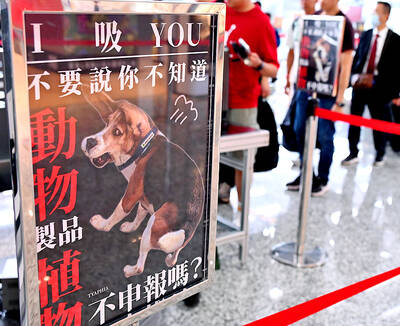
Quarantine awareness posters at Taiwan Taoyuan International Airport have gone viral for their use of wordplay. Issued by the airport branch of the Animal and Plant Health Inspection Agency, the posters feature sniffer dogs making a range of facial expressions, paired with advisory messages built around homophones. “We update the messages for holidays and campaign needs, periodically refreshing materials to attract people’s attention,” quarantine officials said. “The aim is to use the dogs’ appeal to draw focus to quarantine regulations.” A Japanese traveler visiting Taiwan has posted a photo on X of a poster showing a quarantine dog with a

Taiwan’s coffee community has launched a “one-person-one-e-mail” campaign, calling for people to send a protest-e-mail to the World Coffee Championships (WCC) urging it to redesignate Taiwanese competitors as from “Taiwan,” rather than “Chinese Taipei.” The call followed sudden action last week after the WCC changed all references to Taiwanese competitors from “Taiwan” to “Chinese Taipei,” including recent World Latte Art champion Bala (林紹興), who won the World Latte Art Championship in San Diego earlier this month. When Bala received the trophy, he was referred to as representing Taiwan, as well as in the announcement on the WCC’s Web site, until it


 RSS
RSS