


Cooperation between Taiwan and Poland has grown in various directions, ranging from economics and technology to culture, Polish Representative to Taiwan Cyryl Kozaczewski said on Friday last week in his first interview with Taiwanese media since taking office in December 2021.
Relations between Taiwan and Poland are “growing” in a “multifaceted” manner, Kozaczewski said.
On the economic front, he said that he had seen growing interest on the part of Taiwanese partners to invest in Poland and expects to announce new projects early next year.
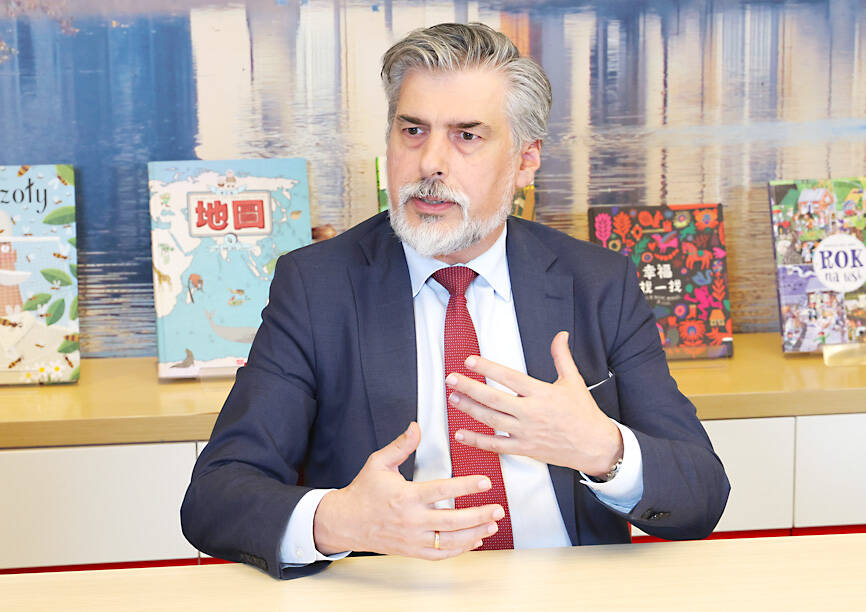
Photo: CNA
About 30 Taiwanese companies operate in Poland and some are seeking to expand their businesses in the central European nation, Kozaczewski said.
Poland is hoping to attract Taiwanese enterprises specializing in semiconductors, machinery and other advanced technologies, he said, adding that the nation, as a member of NATO, provides a secure investment environment.
Western Poland, bordering the eastern German state of Saxony where the world’s largest contract chipmaker Taiwan Semiconductor Manufacturing Co plans to build a new chip fab, could also be a potential destination for related suppliers, he said.
Poland, a member of the EU, is prepared to provide incentives, such as EU recovery and cohesion funds, to support foreign investors looking to establish a presence in the nation and expand into central Europe, he added.
Taiwanese businesses have invested more than US$25.8 million in Poland since the two sides signed an agreement in 2018 to promote two-way investment, representing an increase of 122.8 percent, government data in June showed.
Kozaczewski said his office is also working to attract more Polish entrepreneurs to Taiwan for scientific and technological collaboration.
Taiwan and Poland have since last year signed two memorandums of understanding to facilitate collaborations on research and development into semiconductors and hydrogen power.
Through these agreements, the two sides have established working groups to “streamline” communication between research institutes, he said, adding that he hopes such mechanisms can soon be expanded to include the business sector.
Kozaczewski said that his office does “not concentrate solely on economic development,” but is also seeking to expand exchanges with Taiwan in a range of spheres, including culture and tourism.
Poland in February was the “guest of honor” at the Taipei International Book Exhibition, which hosted more than a dozen events with Polish authors and illustrators.
That was a successful example of “introducing Poland to Taiwan,” he said.
Kozaczewski said that he would work to strengthen cultural connections between the two sides through the sister-city agreement inked between Taipei and Warsaw, without providing details.
Establishing direct flights between Taiwan and Poland would further promote “direct communication” between the two sides, he said, adding that such efforts would likely take “several years,” drawing on his past experience in pushing for direct flights between Tokyo and Warsaw in his previous capacity as Polish ambassador to Japan from 2012 to 2016.

Considering that most countries issue more than five denominations of banknotes, the central bank has decided to redesign all five denominations, the bank said as it prepares for the first major overhaul of the banknotes in more than 24 years. Central bank Governor Yang Chin-lung (楊金龍) is expected to report to the Legislative Yuan today on the bank’s operations and the redesign’s progress. The bank in a report sent to the legislature ahead of today’s meeting said it had commissioned a survey on the public’s preferences. Survey results showed that NT$100 and NT$1,000 banknotes are the most commonly used, while NT$200 and NT$2,000

The Centers for Disease Control (CDC) yesterday reported the first case of a new COVID-19 subvariant — BA.3.2 — in a 10-year-old Singaporean girl who had a fever upon arrival in Taiwan and tested positive for the disease. The girl left Taiwan on March 20 and the case did not have a direct impact on the local community, it said. The WHO added the BA.3.2 strain to its list of Variants Under Monitoring in December last year, but this was the first imported case of the COVID-19 variant in Taiwan, CDC Deputy Director-General Lin Ming-cheng (林明誠) said. The girl arrived in Taiwan on

South Korea is planning to revise its controversial electronic arrival card, a step Taiwanese officials said prompted them to hold off on planned retaliatory measures, a South Korean media report said yesterday. A Yonhap News Agency report said that the South Korean Ministry of Foreign Affairs is planning to remove the “previous departure place” and “next destination” fields from its e-arrival card system. The plan, reached after interagency consultations, is under review and aims to simplify entry procedures and align the electronic form with the paper version, a South Korean ministry official said. The fields — which appeared only on the electronic form

The Ministry of Foreign Affairs (MOFA) is suspending retaliation measures against South Korea that were set to take effect tomorrow, after Seoul said it is updating its e-arrival system, MOFA said today. The measures were to be a new round of retaliation after Taiwan on March 1 changed South Korea's designation on government-issued alien resident certificates held by South Korean nationals to "South Korea” from the "Republic of Korea," the country’s official name. The move came after months of protests to Seoul over its listing of Taiwan as "China (Taiwan)" in dropdown menus on its new online immigration entry system. MOFA last week


 RSS
RSS