


New Taipei City Mayor Hou You-yi (侯友宜), the Chinese Nationalist Party’s (KMT) presidential candidate, yesterday said that Chinese spouses would be able to obtain Taiwan’s identification cards in four years rather than six years if he is elected.
Hou made the pledge on International Migrants Day.
“Immigrants make Taiwan their home and lay roots here. My immigration policy is developed around the core concept that they would be able to build a home in Taiwan, with the goal of empowering them. My hope is that immigrants and the next generation of Taiwanese feel that they belong here and are free to pursue happiness,” Hou wrote on Facebook.
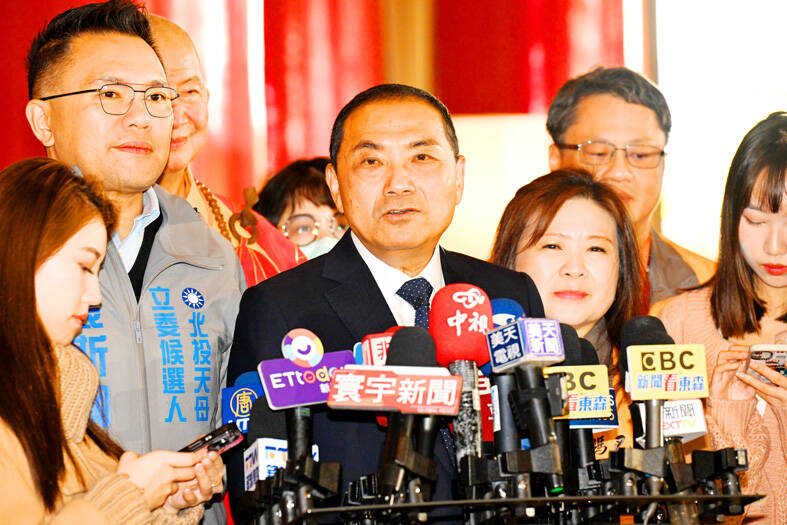
Photo: Tien Yu-hua, Taipei Times
If elected, Chinese spouses would receive Taiwanese identification cards in four years, the same as other foreign spouses, while pregnancy care for legal immigrants would be covered by the National Health Insurance system, he said.
His administration would review the offshore interview requirement of marriage-based migrants, and establish a national platform of interpreters to assist immigrants in accessing legal and medical services and to resolve labor disputes, he said.
“We would establish more language centers for immigrants to learn Mandarin, Hoklo (commonly known as Taiwanese), Hakka and indigenous languages. For the next generation, we would help develop their talents so they can help explore opportunities in Southeast Asian countries,” Hou said.
Immigrants would be allowed to take professional license exams and management-training courses, and an immigrant council would be formed to enforce his proposed immigration basic act, he said.
Hou’s campaign headquarters yesterday defended the candidate’s policy of developing the Wen Tzai Chun (塭仔圳) area — a 400-hectare property between New Taipei City’s Sinjhuang (新莊) and Taishan (泰山) districts — and offering a housing loan of NT$15 million (US$479,019) to young people, following criticisms from the Democratic Progressive Party (DPP).
The DPP’s housing policy is to pay landlords, rather than helping young people to buy a home, Hous’ campaign spokesperson, Wang Ming-hsu (王敏旭), said.
“Many occupational accidents have happened in Wen Tzai Chun in the past five decades. The DPP did nothing about this property when its politicians governed New Taipei City. Mayor Hou fixed up the property within two years of taking office,” Wang said.
“The housing loans we propose would help young people with stable incomes and good credit histories buy homes, and couples with double incomes would be able to quickly buy a residence to raise a family. Elderly Taiwanese would not need to use their savings to help their children buy a home anymore, and could comfortably plan for their retirements,” he said.
In other news, the New Power Party (NPP) yesterday urged the Control Yuan and prosecutors to investigate whether Hou had contravened the Political Donations Act (政治獻金法) and Criminal Code for accepting illegally collected political funds from Yeangder Group while running for mayor in 2018 and last year.
NPP Legislator Chiu Hsien-chih (邱顯智) accused the group of asking its employees to each donate NT$100,000 on specific dates for Hou’s campaigns, with donations topping NT$11 million.
Hou’s campaign office said that all political donations are handled in accordance with the Political Donations Act.

NATIONAL SECURITY: Authorities are working to confirm the identities of the military personnel involved and investigating possible illegal conduct and regulatory violations Authorities are probing possible national security implications after Kinmen police and immigration officers on Sunday found a Chinese woman allegedly posing as a tourist while engaging in prostitution involving more than 10 military personnel. The woman, surnamed Chen (陳), has since been deported, authorities said, adding that investigators are still working to confirm the identities of those implicated, as the records only listed code names and aliases. The case stemmed from a report received by the Kinmen District Prosecutors’ Office on Friday last week from the Jinhu Precinct of the Kinmen County Police Bureau. On Sunday, police, along with the National Immigration

GLOBALGIVING: ‘ Caving to external pressure is not acceptable for an organization that has cultivated justice reform and human rights for 30 years,’ one NGO said A slew of non-government organizations (NGOs) have withdrawn from the GlobalGiving fundraising platform after it announced it would use “Chinese Taipei” instead of “Taiwan” from next month. The Taiwan Good Rice Association wrote on Facebook on Friday that it was informed on April 28 via a teleconference call of the change, which was made because the platform wanted to operate in China. Taiwan Good Rice is to terminate all cooperative relationships with GlobalGiving in response to the platform’s “unilateral and non-negotiable” decision to remove references to Taiwan, the NGO said. “Taiwan is in the official name of Taiwan Good Rice Association and the

HEAVY WEATHER: Typhoon Jangmi is due to crash straight into the Ryukyus as airlines look to shift flights to larger aircraft or cancel flights to Okinawa entirely Taiwan’s international air carriers announced flight adjustments over the weekend as Typhoon Jangmi is forecast to hit the Ryukyu Islands today and tomorrow. The Central Weather Administration (CWA) upgraded Jangmi from a tropical storm to a typhoon at 8am yesterday, with the eye located 580km south of Naha city. It was moving north at 19kph. Today, China Airlines’ CI-120, CI-121, CI-122 and CI-123 flights between Taoyuan and Naha, Okinawa, have been canceled as well as CI-132 and CI-133 between Kaohsiung and Naha. EVA Air’s BR-112, BR-113, BR-186 and BR-185 flights between Taoyuan and Naha are also canceled. Low-cost carrier Tigerair Taiwan canceled IT-230,

REASONS FOR TRAVEL: An assistant professor said that proposed amendments to penalize drivers if they used drugs overseas would not deter people from traveling People who operate a motor vehicle under the influence of marijuana would have their driver’s license revoked, even if they used the substance while overseas, the Ministry of Transportation and Communications said yesterday, citing proposed amendments to the Road Traffic Management and Penalty Act (道路交通管理處罰條例). The amendments would also authorize the government to revoke the licenses of people determined to have used Category 1 or Category 2 narcotics, even if they were not operating a vehicle while under the influence of drugs, as well as ban them from taking the license test for three years, the ministry said. People aged 18 or


 RSS
RSS