


The Chinese Nationalist Party’s (KMT) presidential ticket topped their Democratic Progressive Party (DPP) rivals by 0.8 percent in an internal poll, KMT Chairman Eric Chu (朱立倫) said at a meeting of its Central Standing Committee in Taipei yesterday.
Support for New Taipei City Mayor Hou You-yi (侯友宜) and Broadcasting Corp of China chairman Jaw Shaw-kong (趙少康), the KMT’s presidential and vice presidential candidates, has been rising recently.
The party’s daily internal poll yesterday showed that support for the pair had overtaken the DPP’s candidates, Vice President William Lai (賴清德) and his running mate, former representative to the US Hsiao Bi-khim (蕭美琴).
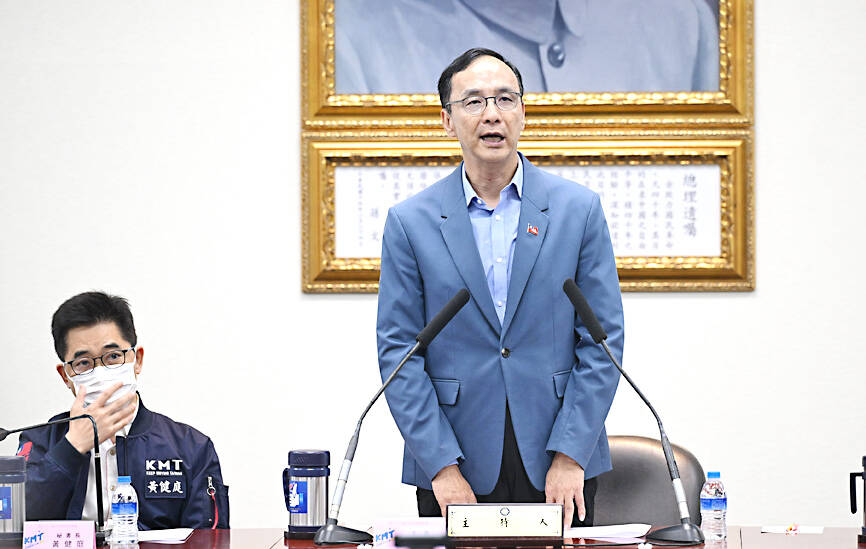
Photo: Chang Chia-ming, Taipei Times
The KMT needs more support among people aged 20 to 40, as well as in southern Taiwan, including Tainan and Kaohsiung, and Pingtung, Yunlin and Chiayi counties, Chu said.
The party’s candidates are leading in Taipei, New Taipei City, Keelung, Taoyuan and Taichung, as well as in Hsinchu, Miaoli, Changhua and Nantou counties, he said.
The KMT must consider strategies to flip regions with low support, he said.
KMT estimates show there would be “major” contention over 15 legislative seats, Chu said, adding that winning in those regions would determine whether the KMT regains a legislative majority.
KMT secretary-general Huang Chien-ting (黃健庭) and the party’s Organization and Development Affairs Committee are to review strategies to secure legislative seats, he said.
Chu asked party members to help with the election effort, making special mention of the work that former legislative speaker Wang Jin-pyng (王金平) and other party members who are local council speakers have done for its campaigns.
The KMT is concerned about the welfare of young people, which is reflected in its campaign platforms, Chu said.
The KMT supports waiving down payments and providing subsidies for young people who buy property, allowing more to own their own home, he said.
It supports state-funded after-class consultation for elementary-school students to ease the burden on parents, he said.
Separately, Hou told a news conference on Tuesday that if elected president, he would introduce free after-school care for children aged six to 12.
The scheme would benefit about 300,000 families, including 80,000 considered “underprivileged,” he said.
The program would provide after-school care until 7pm, including during vacations, he said, adding that it would allocate NT$5.4 billion (US$171.29 million) in the first year, rising to NT$8 billion in the 2024-2025 academic year and NT$10 billion in the 2026-2027 academic year, he said.
The policy would create “a safe environment for children and their parents” and “provide a sound and reliable service for less-privileged students,” Hou said.
The program would be offered whenever parents need it, he added.
In addition, special classes would be provided for underprivileged children, as well as those living in remote areas and those with disabilities, he said.
Access to the program would be expanded to cover about 360,000 children, or about 30 percent of students nationwide, he said.
The addition of an extra 20,000 after-school care classes would bring Taiwan on par with the level set by the Organisation for Economic Co-operation and Development, he said.
The program would help create jobs, giving young people seeking work in the education sector more employment opportunities, he said.
Government data showed that there were 26,731 after-school care classes for 445,882 students at 1,926 public schools during the 2022-2023 academic year.
Additional reporting by CNA

AGING: While Japan has 22 submarines, Taiwan only operates four, two of which were commissioned by the US in 1945 and 1946, and transferred to Taiwan in 1973 Taiwan would need at least 12 submarines to reach modern fleet capabilities, CSBC Corp, Taiwan chairman Chen Cheng-hung (陳政宏) said in an interview broadcast on Friday, citing a US assessment. CSBC is testing the nation’s first indigenous defense submarine, the Hai Kun (海鯤, Narwhal), which is scheduled to be delivered to the navy next month or in July. The Hai Kun has completed torpedo-firing tests and is scheduled to undergo overnight sea trials, Chen said on an SET TV military affairs program. Taiwan would require at least 12 submarines to establish a modern submarine force after assessing the nation’s operational environment and defense

A white king snake that frightened passengers and caused a stir on a Taipei MRT train on Friday evening has been claimed by its owner, who would be fined, Taipei Rapid Transit Corp (TRTC) said yesterday. A person on Threads posted that he thought he was lucky to find an empty row of seats on Friday after boarding a train on the Bannan (Blue) Line, only to spot a white snake with black stripes after sitting down. Startled, he jumped up, he wrote, describing the encounter as “terrifying.” “Taipei’s rat control plan: Release snakes on the metro,” one person wrote in reply, referring
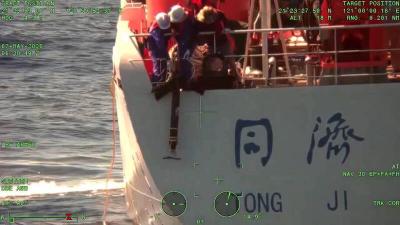
The coast guard today said that it had disrupted "illegal" operations by a Chinese research ship in waters close to the nation and driven it away, part of what Taipei sees a provocative pattern of China's stepped up maritime activities. The coast guard said that it on Thursday last week detected the Chinese ship Tongji (同濟號), which was commissioned only last year, 29 nautical miles (54km) southeast of the southern tip of Taiwan, although just outside restricted waters. The ship was observed lowering ropes into the water, suspected to be the deployment of scientific instruments for "illegal" survey operations, and the coast
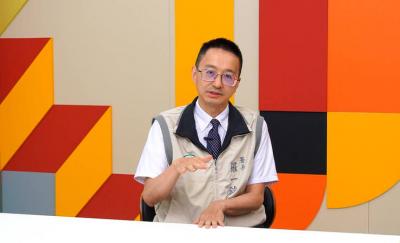
Taiwan’s two cases of hantavirus so far this year are on par with previous years’ case numbers, and the government is coordinating rat extermination work, so there should not be any outbreaks, Centers for Disease Control (CDC) Director-General Philip Lo (羅一鈞) said today in an interview with the Liberty Times (the Taipei Times’ sister newspaper). An increase in rat sightings in Taipei and New Taipei City has raised concerns about the spread of hantavirus, as rats can carry the disease. In January, a man in his 70s who lived in Taipei’s Daan District (大安) tested positive posthumously for hantavirus, Taiwan’s


 RSS
RSS