


The law should be amended if most people are against allowing heavy motorcycles on freeways, Taiwan People’s Party (TPP) Chairman and presidential candidate Ko Wen-je (柯文哲) said yesterday, going back on his previous policy proposal while sharing his vision for improving transportation in the nation.
Ko last month said that he would ask the Ministry of Transportation and Communications to allow heavy motorcycles on freeways if elected, but yesterday said if the ministry says 60 percent of the public are against it, then the law should be amended to prohibit it.
He said he had spoken with members of a professional drivers’ trade union, who expressed strong opposition against letting heavy motorcycles on freeways, as they are worried that it would increase the number of fatal accidents.
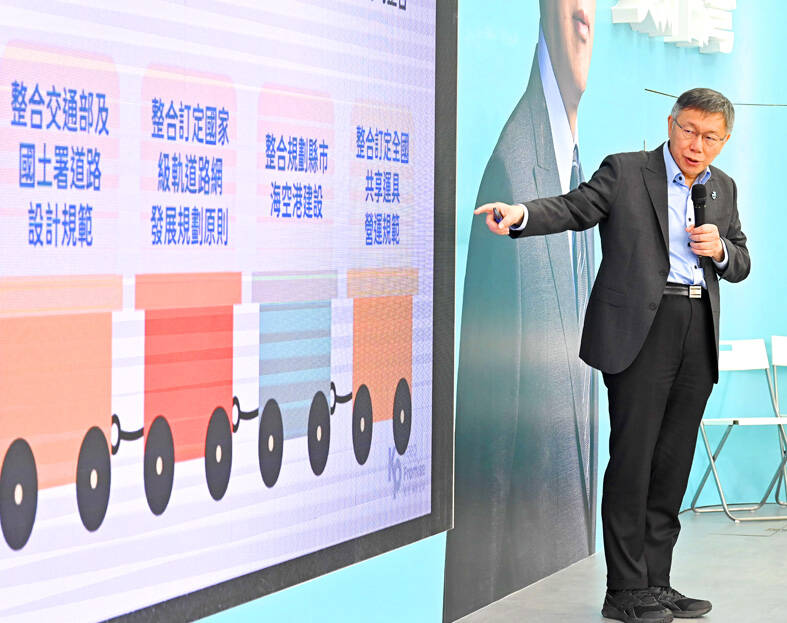
Photo: Tu Chien-jung, Taipei Times
He said the five major transportation problems in Taiwan are: driver-oriented traffic rules; neglect of pedestrian safety; a chaotic system that lacks nationwide planning; disregard for expertise; and politicians making empty promises about infrastructure projects.
They also include fragmented information hindering overall development, and the slow upgrade of international airports and harbors, he said.
Ko said the mortality rate caused by road traffic injuries in Taiwan is about 12.9 per 100,000 people, which is about five times that in Japan and eight times that in Norway.
Although Taiwanese believe it is just bad luck to have been hit by a car, the government must solve the problem, he said.
Ko proposed five solutions: speeding up traffic safety reforms; substantially amending traffic regulations; holding traffic reform meetings with public participation to clarify the reforms and supplementary measures; having the central government set standards; and having local governments implement the plans and give feedback.
Other solutions include leaving the evaluation of major transportation infrastructure to professionals with expertise; facing public opinion honestly; accelerating transit-oriented development; perfecting the aerial and maritime transportation network; enhancing data analysis; greening airports and harbors; cultivating professional airport and harbor personnel; integrating national data; developing intelligent transportation systems; and launching a national traffic app.
Ko criticized President Tsai Ing-wen (蔡英文) for having pledged to build a light railway between Taipei and Keelung, but allowing the planned budget to increase many times. The project is still not completed and Ko said he doubts that it would succeed.
The feasibility of transportation development plans must be assessed before allocating budgets, or else election promises are empty, he said.
The former Taipei mayor said the traffic congestion problem in Taipei’s Neihu District (內湖) is a typical example of failed urban planning, and that he had said “there is no hope for Neihu’s traffic” because the district’s population has increased fourfold in the past 30 years, but its roads did not.
He said the only two solutions are to finish the Taipei MRT circular line or to introduce a differential charging system in the district, making drivers of private vehicles pay more for driving into the district during certain hours.
Meanwhile, Ko said he had initiated a “five-five project” to encourage his supporters to phone their elderly family members for five minutes per day five days per week, as many elderly people do not use the Internet, and the information they receive from TV and radio is limited.

UPGRADE: The Kang Ding-class frigate is replacing its Chaparall missiles with Tien Chien II and Hua Yang VLS, which would provide it with long-range, 360° air defense Taiwan plans to produce 1,200 to 1,376 Hai Chien II missiles (海劍二, Sea Sword II) — also known as TC-2N — to serve as the standard air defense system of the navy’s surface combatant fleet, a source said yesterday. Last week, the Hai Chien II, the naval version of the Tien Kung II missile (天劍二, Sky Sword II), completed a live-fire test in waters off the National Chungshan Institute of Science and Technology’s Jiupeng facility (九鵬) in Pingtung County’s Manjhou Township (滿州). The MIM72 Chaparral and other dated air defense missiles that currently arm Taiwanese ships have inadequate range to combat Chinese

REASONS FOR TRAVEL: An assistant professor said that proposed amendments to penalize drivers if they used drugs overseas would not deter people from traveling People who operate a motor vehicle under the influence of marijuana would have their driver’s license revoked, even if they used the substance while overseas, the Ministry of Transportation and Communications said yesterday, citing proposed amendments to the Road Traffic Management and Penalty Act (道路交通管理處罰條例). The amendments would also authorize the government to revoke the licenses of people determined to have used Category 1 or Category 2 narcotics, even if they were not operating a vehicle while under the influence of drugs, as well as ban them from taking the license test for three years, the ministry said. People aged 18 or

GLOBALGIVING: ‘ Caving to external pressure is not acceptable for an organization that has cultivated justice reform and human rights for 30 years,’ one NGO said A slew of non-government organizations (NGOs) have withdrawn from the GlobalGiving fundraising platform after it announced it would use “Chinese Taipei” instead of “Taiwan” from next month. The Taiwan Good Rice Association wrote on Facebook on Friday that it was informed on April 28 via a teleconference call of the change, which was made because the platform wanted to operate in China. Taiwan Good Rice is to terminate all cooperative relationships with GlobalGiving in response to the platform’s “unilateral and non-negotiable” decision to remove references to Taiwan, the NGO said. “Taiwan is in the official name of Taiwan Good Rice Association and the

HEAVY WEATHER: Typhoon Jangmi is due to crash straight into the Ryukyus as airlines look to shift flights to larger aircraft or cancel flights to Okinawa entirely Taiwan’s international air carriers announced flight adjustments over the weekend as Typhoon Jangmi is forecast to hit the Ryukyu Islands today and tomorrow. The Central Weather Administration (CWA) upgraded Jangmi from a tropical storm to a typhoon at 8am yesterday, with the eye located 580km south of Naha city. It was moving north at 19kph. Today, China Airlines’ CI-120, CI-121, CI-122 and CI-123 flights between Taoyuan and Naha, Okinawa, have been canceled as well as CI-132 and CI-133 between Kaohsiung and Naha. EVA Air’s BR-112, BR-113, BR-186 and BR-185 flights between Taoyuan and Naha are also canceled. Low-cost carrier Tigerair Taiwan canceled IT-230,


 RSS
RSS