


The Chinese Nationalist Party (KMT) caucus yesterday announced that it would withdraw from negotiations over next year’s general budget in protest against the Democratic Progressive Party (DPP) caucus’ accusation that the KMT is helping Beijing interfere in Taiwan’s elections.
The dispute began when KMT Legislator Jessica Chen (陳玉珍), who represents districts in Kinmen County, proposed a motion to cut NT$45 million (US$1.43 million) from the budget to be allocated to the Straits Exchange Foundation (SEF), a semi-official organization set up by the government to handle technical and business matters with China.
The foundation had failed to facilitate trips for Taiwanese to scout for business opportunities in Kinmen County, she said.

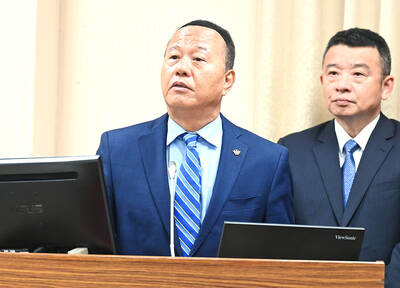
Photo: Fang Pin-chao, Taipei Times
KMT Legislator Hsieh Yi-fong (謝衣鳳) proposed freezing NT$1 million from the budget for the Mainland Affairs Council (MAC) until the council officially explained China’s interference in Taiwan’s elections.
The DPP caucus held a news conference yesterday morning accusing the KMT caucus of “turning the elbow the wrong way” (to favor an outsider instead of someone on one’s own side) by helping China meddle in Taiwan’s elections.
The KMT caucus then said that it would stop participating in the general budget negotiations, as the DPP had twisted the intentions behind their motions and showed contempt for legislators who were doing their duty by reviewing government budget plans.
“A legislator’s most important job is to review budget plans. KMT legislators proposed freezing part of the MAC’s budget, because they believed that officials from the Ministry of the Interior, National Security Bureau and the MAC should jointly explain how China has interfered in Taiwan’s elections,” KMT caucus whip William Tseng (曾銘宗) said. “We can drop the motions if they do what was asked of them.”
“The DPP caucus has breached the mutual trust between the ruling party and opposition parties. Unless DPP caucus whip Ker Chien-ming (柯建銘) offers a reasonable explanation, we will not negotiate ... the budget plan,” Tseng said.
Chen said she proposed the motion to cut the MAC’s budget, because SEF and the council should make substantial contributions by facilitating cross-strait exchanges and economic development in Kinmen County.
She said that she only proposed to cut a NT$45 million increase in funding to the SEF, adding that such a reduction would not affect the foundation’s operations.
Of the increase in funding, NT$20 million would be used to fund personnel and administrative expenses, she said.
“The SEF now functions more like a fax machine, sending messages to which China would never respond. Why bother to budget so much money to retain staff? How can we not cut the budget for an agency that does not perform?” she said.
Chen said she would immediately drop the motion if the MAC agreed to end the group travel ban for Chinese tourists to Kinmen and other outlying islands ahead of lifting the ban on Chinese tourists to Taiwan proper.
The SEF said in a statement that more than 100 Taiwanese businesspeople participated in the foundation’s two-day “Invest Taiwan” tour of Kinmen this year, surpassing the previous record.
They contributed to the county’s economy by spending more than NT$50 million on aged sorghum liquor, it said.
The tour was a success despite China blocking 18 Taiwanese business association heads from participating, the foundation said.
Some participants also said that the Chinese Communist Party should not ask Taiwanese businesspeople to boycott such tours, calling it “unnecessary,” the SEF said.
VIGILANCE: The military is paying close attention to actions that might damage peace and stability in the region, the deputy minister of national defense said The People’s Republic of China (PRC) might consider initiating a hack on Taiwanese networks on May 20, the day of the inauguration ceremony of president-elect William Lai (賴清德), sources familiar with cross-strait issues said. While US Secretary of State Anthony Blinken’s statement of the US expectation “that all sides will conduct themselves with restraint and prudence in the period ahead” would prevent military actions by China, Beijing could still try to sabotage Taiwan’s inauguration ceremony, the source said. China might gain access to the video screens outside of the Presidential Office Building and display embarrassing messages from Beijing, such as congratulating Lai

REPORT: Taipei has expressed an interest in obtaining loitering munitions matching the AeroVironment Switchblade 300 or the Anduril Altius-600, ‘Foreign Policy’ said Taiwan is seeking US-made kamikaze drones in an apparent concession to pressure from Washington to focus on asymmetric capabilities to defeat or deter a Chinese attack, Foreign Policy said in a report on Wednesday. Taipei has expressed an interest in obtaining AeroVironment Switchblade loitering munitions or other devices with similar capabilities, it said, citing four sources familiar with the matter commenting on condition of anonymity. The Switchblade 300 is a tube-launched drone designed for attacking ground troops, while its larger sibling, the Switchblade 600, could be used to destroy tanks and entrenched troops. Ukraine has utilized both systems extensively in its fight against

Police officers yesterday morning apprehended the prime suspect of a triple homicide case, after raiding the suspect’s hideout in Taichung. They transported the suspect to New Taipei City for questioning and recorded his statement last night. The suspect, identified as a 24-year-old man surnamed Chang (張), is believed to have used his hands to strangle his wife, surnamed Chen (陳), 29, along with his three-year-old son from a previous marriage and his wife’s mother, 69. The three dead bodies were wrapped in blankets when they were discovered inside their apartment in New Taipei City’s Sanchong District (三重) on Saturday. Chang was holding a

STRIKING A BALANCE: A nutritionist said that only 9 percent of respondents were concerned whether they had a sufficient balance of vegetables and fruits Nearly 60 percent of respondents said that they are affected physically and mentally due to lack of a regular breakfast routine, while only 9 percent ate a balanced diet, a Formosa Cancer Foundation survey showed. Thirty percent of respondents do not eat breakfast at home, saying it is more expedient to buy it, said Hsu Kuei-ting (徐桂婷), the foundation’s nutritionist, citing its most recent poll on nutritional intake for people aged 20 to 60. The poll showed that 60 percent believe they do not eat breakfasts that have balanced nutrition. At 62 percent, convenience was the most commonly cited factor in deciding whether


 RSS
RSS