


Taiwan People’s Party (TPP) Chairman and presidential candidate Ko Wen-je (柯文哲) yesterday said that while he would reference President Tsai Ing-wen’s (蔡英文) US and national defense policies, his policies on domestic affairs and cross-strait relations would be more moderate and rational if elected.
After Ko on Wednesday said during an interview that he would pursue Tsai’s national defense and foreign policies, a number of people have questioned why they should not just vote for Vice President William Lai (賴清德), the Democratic Progressive Party’s (DPP) presidential candidate who has pledged to follow Tsai’s direction for his foreign policies.
In response, Ko yesterday wrote on Facebook that “although I agree on maintaining a good relationship with the US and the need for sufficient self-defense capability, I do not agree with President Tsai’s handling of cross-strait relations and internal affairs.”
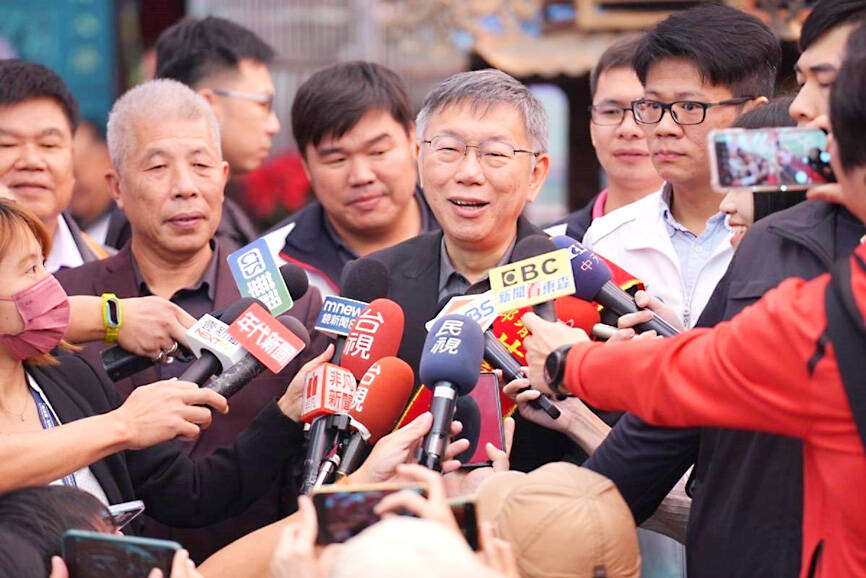
Photo courtesy of the Taiwan People’s Party
Of the DPP leaders, Tsai leans most toward the middle of the political spectrum and has even been challenged by the party’s pro-independence groups as “not being pro-independence enough,” with one of the challengers being Lai, who competed with her in the party primary in 2019, he said.
Tsai has been devoted to improving relationships with allies and bolstering Taiwan’s military self-reliance, which he recognizes and would continue to seek, but the deadlock in cross-strait relations should be re-examined, he said.
“The leader elected in 2024 should follow the middle path to maintain Taiwan’s autonomy and should also be able to communicate with China and the US,” he wrote, adding that Tsai carries the DPP’s burdens and could not achieve what she wanted, so he questions whether Lai could.
Ko said if Lai is no longer a pragmatic political worker for Taiwanese independence due to pressure from the US, then he thinks that Lai is essentially a “Taiwanese independence liar” that has used the claim to deceive supporters and garner votes.
Ko said he would reference Tsai’s US and national defense policies, heading toward Taiwan’s autonomy, but seek a moderate and rational path for internal affairs and cross-strait relations, resuming communication with the other side of the Taiwan Strait and establishing a trustworthy dialogue system between the two countries if elected.

NATIONAL SECURITY: Authorities are working to confirm the identities of the military personnel involved and investigating possible illegal conduct and regulatory violations Authorities are probing possible national security implications after Kinmen police and immigration officers on Sunday found a Chinese woman allegedly posing as a tourist while engaging in prostitution involving more than 10 military personnel. The woman, surnamed Chen (陳), has since been deported, authorities said, adding that investigators are still working to confirm the identities of those implicated, as the records only listed code names and aliases. The case stemmed from a report received by the Kinmen District Prosecutors’ Office on Friday last week from the Jinhu Precinct of the Kinmen County Police Bureau. On Sunday, police, along with the National Immigration

REASONS FOR TRAVEL: An assistant professor said that proposed amendments to penalize drivers if they used drugs overseas would not deter people from traveling People who operate a motor vehicle under the influence of marijuana would have their driver’s license revoked, even if they used the substance while overseas, the Ministry of Transportation and Communications said yesterday, citing proposed amendments to the Road Traffic Management and Penalty Act (道路交通管理處罰條例). The amendments would also authorize the government to revoke the licenses of people determined to have used Category 1 or Category 2 narcotics, even if they were not operating a vehicle while under the influence of drugs, as well as ban them from taking the license test for three years, the ministry said. People aged 18 or

GLOBALGIVING: ‘ Caving to external pressure is not acceptable for an organization that has cultivated justice reform and human rights for 30 years,’ one NGO said A slew of non-government organizations (NGOs) have withdrawn from the GlobalGiving fundraising platform after it announced it would use “Chinese Taipei” instead of “Taiwan” from next month. The Taiwan Good Rice Association wrote on Facebook on Friday that it was informed on April 28 via a teleconference call of the change, which was made because the platform wanted to operate in China. Taiwan Good Rice is to terminate all cooperative relationships with GlobalGiving in response to the platform’s “unilateral and non-negotiable” decision to remove references to Taiwan, the NGO said. “Taiwan is in the official name of Taiwan Good Rice Association and the

HEAVY WEATHER: Typhoon Jangmi is due to crash straight into the Ryukyus as airlines look to shift flights to larger aircraft or cancel flights to Okinawa entirely Taiwan’s international air carriers announced flight adjustments over the weekend as Typhoon Jangmi is forecast to hit the Ryukyu Islands today and tomorrow. The Central Weather Administration (CWA) upgraded Jangmi from a tropical storm to a typhoon at 8am yesterday, with the eye located 580km south of Naha city. It was moving north at 19kph. Today, China Airlines’ CI-120, CI-121, CI-122 and CI-123 flights between Taoyuan and Naha, Okinawa, have been canceled as well as CI-132 and CI-133 between Kaohsiung and Naha. EVA Air’s BR-112, BR-113, BR-186 and BR-185 flights between Taoyuan and Naha are also canceled. Low-cost carrier Tigerair Taiwan canceled IT-230,


 RSS
RSS