


Minister of Environment Shieu Fuh-sheng (薛富盛) has arrived in Dubai for the 28th meeting of the Conference of the Parties (COP28), the Ministry of Environment announced on Wednesday.
The minister and other government officials arrived in Dubai for the two-week COP28 meeting that began last week, the ministry said in a news release, adding that although Taiwan is not a UN member, it has participated in meetings through non-governmental organizations and research institutions.
On Saturday last week, the Industrial Technology Research Institute cohosted a side event titled, “Enhancing Ambitions with international cooperation towards a successful 2050 net zero transformation” with the Marshall Islands; on Monday, the Taiwan Research Institute (TRI) co-organized another side event, “Cross-level governance and solutions for global net zero transition,” with Belize; and “Building climate-resilient agri-food systems in vulnerable countries with indigenous knowledge” was held on Wednesday by Palau and Taiwan’s Mom Loves Taiwan Association.
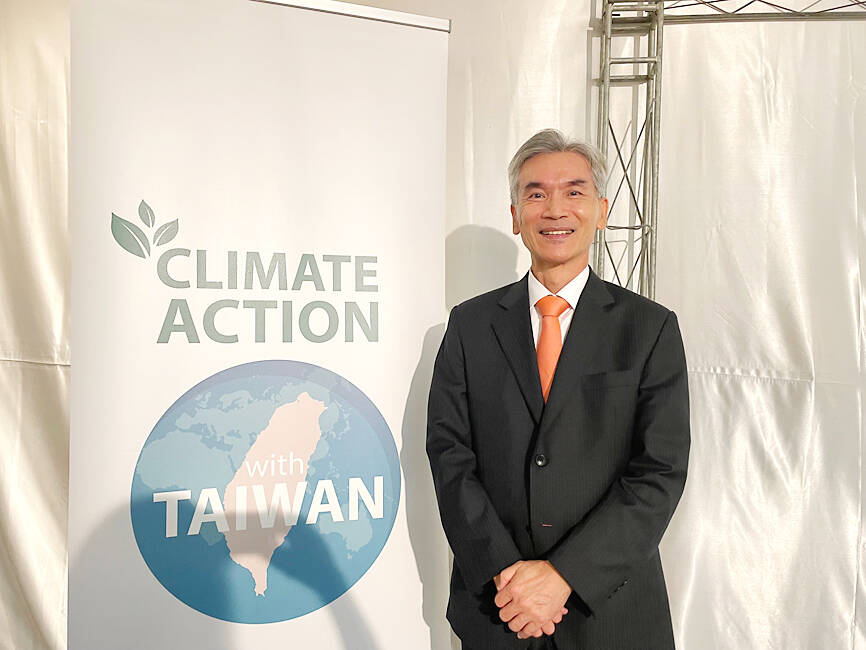
Photo: CNA
Taiwan would show to international partners “our promise to reach climate goals with meaningful contributions and showcase our resolution to pursue efforts to limit the average global temperature rise [from pre-industrial levels] to 1.5°C,” the ministry cited the minister as saying.
Shieu told reporters in Dubai that Taiwan has recently made several achievements to meet climate change challenges, including the nation’s net zero emissions goal in the Climate Change Response Act (氣候變遷因應法) passed earlier this year, which shows “Taiwan’s determination to reach net zero.”
Asked whether Taiwan should set more ambitious targets after this year’s COP began with calls for accelerated action to combat the escalating climate crisis, Shieu said considering that nearly 120 countries had announced a commitment to work together to triple the world’s installed renewable energy generation capacity at COP28, “Taiwan’s roadmap for 2050 net zero goal is on track.”
“Taiwan’s renewable energy capacity has hit 10 percent of its total this year, and the goal for 2050 is 30 percent,” which aligns with COP28 targets, Shieu said.
In March last year, the administration published “Taiwan’s pathway to net zero emissions in 2050,” providing the action pathway to achieve net zero emissions by 2050 by promoting technology R&D and innovation to help industry undergo a green transition, the National Development Council said.
Regarding Taiwan’s decarbonization effort, the minister said he is optimistic because “technologies will continue advancing,” and because the government’s plan employs a wide range of renewable energy, such as geothermal energy, biomass, marine energy and hydrogen.
Academia Sinica and Taiwan Power Co have also recently developed a new technological option that can remove the carbon in natural gas and only burn the hydrogen to create zero-carbon electricity, he added.
The minister also brought up a declaration made by more than 20 countries to triple nuclear energy capacity by 2050.
Taiwan would have to overcome three challenges before it continues developing nuclear energy, which are safety issues, the handling of the nuclear waste and how to reach a consensus on where to store it, Shieu said.
“When you can’t solve the problem [of where to place the waste], nuclear power is a pseudo-issue,” he added.

NATIONAL SECURITY: Authorities are working to confirm the identities of the military personnel involved and investigating possible illegal conduct and regulatory violations Authorities are probing possible national security implications after Kinmen police and immigration officers on Sunday found a Chinese woman allegedly posing as a tourist while engaging in prostitution involving more than 10 military personnel. The woman, surnamed Chen (陳), has since been deported, authorities said, adding that investigators are still working to confirm the identities of those implicated, as the records only listed code names and aliases. The case stemmed from a report received by the Kinmen District Prosecutors’ Office on Friday last week from the Jinhu Precinct of the Kinmen County Police Bureau. On Sunday, police, along with the National Immigration

GLOBALGIVING: ‘ Caving to external pressure is not acceptable for an organization that has cultivated justice reform and human rights for 30 years,’ one NGO said A slew of non-government organizations (NGOs) have withdrawn from the GlobalGiving fundraising platform after it announced it would use “Chinese Taipei” instead of “Taiwan” from next month. The Taiwan Good Rice Association wrote on Facebook on Friday that it was informed on April 28 via a teleconference call of the change, which was made because the platform wanted to operate in China. Taiwan Good Rice is to terminate all cooperative relationships with GlobalGiving in response to the platform’s “unilateral and non-negotiable” decision to remove references to Taiwan, the NGO said. “Taiwan is in the official name of Taiwan Good Rice Association and the

HEAVY WEATHER: Typhoon Jangmi is due to crash straight into the Ryukyus as airlines look to shift flights to larger aircraft or cancel flights to Okinawa entirely Taiwan’s international air carriers announced flight adjustments over the weekend as Typhoon Jangmi is forecast to hit the Ryukyu Islands today and tomorrow. The Central Weather Administration (CWA) upgraded Jangmi from a tropical storm to a typhoon at 8am yesterday, with the eye located 580km south of Naha city. It was moving north at 19kph. Today, China Airlines’ CI-120, CI-121, CI-122 and CI-123 flights between Taoyuan and Naha, Okinawa, have been canceled as well as CI-132 and CI-133 between Kaohsiung and Naha. EVA Air’s BR-112, BR-113, BR-186 and BR-185 flights between Taoyuan and Naha are also canceled. Low-cost carrier Tigerair Taiwan canceled IT-230,
MULTIPRONGED APPROACH: China has sought to pressure Palau across a number of fronts, but the island nation has staunchly resisted overtures to ditch Taiwan Palau has been firm in backing Taiwan despite Chinese pressure that uses tourism economics, cyberattacks and criminal infiltration as tools to threaten the Pacific ally into renouncing its recognition of Taiwan as a sovereign state. The Presidential Office yesterday announced that Vice President Hsiao Bi-khim (蕭美琴) would visit Palau from Saturday to Wednesday next week at the invitation of Palauan President Surangel Whipps Jr. Whipps in April said in an interview that China had outspokenly asked Palau to “denounce Taiwan.” “And we have said: ‘We have no enemies, but nobody tells us who our friends are,’” he said. Whipps has told reporters multiple times


 RSS
RSS