


More than 60 countries support Taiwan’s inclusion in Interpol, the Ministry of Foreign Affairs said in a statement on Monday.
Support for the nation’s bid to join Interpol has been rising, the ministry said, although Taiwan was not invited to its general assembly from Tuesday to Friday last week in Vienna.
The ministry thanked administrative and legislative branches of governments, international parliamentary groups and officials from more than 60 countries that voiced support for Taiwan at the event.
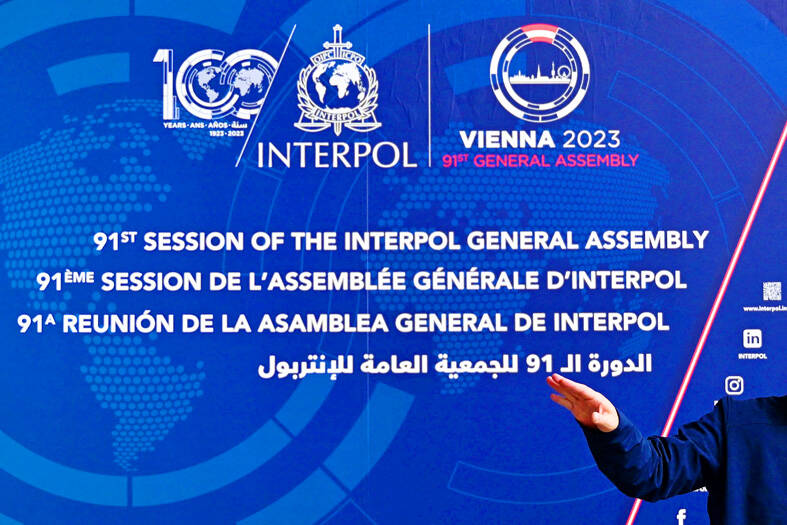
Photo: AFP
More countries have come to recognize the need to include Taiwan in the global system to combat transnational crime, it said.
Taiwan’s diplomatic allies supported its bid by sending letters, issuing news releases and releasing videos, it said.
Seven among them — Eswatini, Palau, Paraguay, Belize, Saint Vincent and the Grenadines, the Marshall Islands, and Saint Kitts and Nevis — spoke up for Taiwan during the assembly, bringing the bid to the attention of representatives from all participating countries, the ministry said.
Many national leaders — including from France, Australia, the UK, the US, Japan and Lithuania — have called for the inclusion of Taiwan in international organizations, including Interpol, in joint statements, it said.
US senators introduced the Taiwan Relations Reinforcement Act, while 32 US states, the Czech Republic, Poland, Brazil, Guatemala, and Saint Kitts and Nevis passed pro-Taiwan resolutions, it said.
Opinion pieces written by Ministry of Justice Criminal Investigation Bureau Director-General Chou Yu-wei (周幼偉) and Taiwan’s representative offices abroad, as well as interviews with Taiwanese diplomats and reports supporting Taiwan, were published in international media, including the Washington Times, National Review, Voice of America, the Diplomat, and in Japan, South Korea, New Zealand, Denmark, Spain, Poland and Latvia, it said, adding that 162 reports have been published.
A promotional video made by the Criminal Investigation Bureau had been viewed 870,000 times on the ministry’s Facebook and X accounts and its YouTube channel, the ministry said.
An advertisement advocating the message that “Taiwan can help” was displayed at the Vienna International Airport and the event venue, it said.
The ministry called on Interpol to uphold the principles of professionalism and neutrality, and to include Taiwan in the global law enforcement network as soon as possible.
Combating transnational crime requires global cooperation, it said, adding that Taiwan should not be excluded because of political considerations.
Taiwan joined Interpol in 1961, but was forced to withdraw in 1984 after the organization switched recognition to Beijing.
Its participation has been blocked since then under a resolution passed at Interpol’s 53rd General Assembly the same year.

Yangmingshan National Park authorities yesterday urged visitors to respect public spaces and obey the law after a couple was caught on a camera livestream having sex at the park’s Qingtiangang (擎天崗) earlier in the day. The Shilin Police Precinct in Taipei said it has identified a suspect and his vehicle registration number, and would summon him for questioning. The case would be handled in accordance with public indecency charges, it added. The couple entered the park at about 11pm on Thursday and began fooling around by 1am yesterday, the police said, adding that the two were unaware of the park’s all-day live

Fast food chain McDonald's is to raise prices by up to NT$5 on some products at its restaurants across Taiwan, starting on Wednesday next week, the company announced today. The prices of all extra value meals and sharing boxes are to increase by NT$5, while breakfast combos and creamy corn soup would go up by NT$3, the company said in a statement. The price of the main items of those meals, if ordered individually, would remain the same. Meanwhile, the price of a medium-sized lemon iced tea and hot cappuccino would rise by NT$3, extra dipping sauces for chicken nuggets would go up

Yangmingshan National Park’s Qingtiangang (擎天崗) nature area has gone viral after a park livestream camera observed a couple in the throes of intimate congress, which was broadcast live on YouTube, drawing large late-night crowds and sparking a backlash over noise, bright lights and disruption to wildlife habitat. The area’s livestream footage appeared to show a couple engaging in sexual activity on a picnic table in the park on Friday last week, with the uncensored footage streamed publicly online. The footage quickly spread across social media, prompting a tide of visitors to travel to the site to “check in” and recreate the

Minister of Digital Affairs Lin Yi-ching (林宜敬) yesterday cited regulatory issues and national security concerns as an expert said that Taiwan is among the few Asian regions without Starlink. Lin made the remarks on Facebook after funP Innovation Group chief executive officer Nathan Chiu (邱繼弘) on Friday said Taiwan and four other countries in Asia — China, North Korea, Afghanistan and Syria — have no access to Starlink. Starlink has become available in 166 countries worldwide, including Ukraine, Malaysia, the Philippines and Vietnam, in the six years since it became commercial, he said. While China and North Korea block Starlink, Syria is not


 RSS
RSS