


The trial of Hong Kong media tycoon Jimmy Lai (黎智英), who has been jailed for national security crimes, would serve as a “litmus test” for how China views the territory’s freedoms, his son said in an interview in Taipei.
The 75-year-old British citizen and founder of the now-shuttered Apple Daily has been behind bars in Hong Kong since 2020, awaiting trial for alleged “collusion with foreign forces.”
Initially scheduled to start a year earlier, Jimmy Lai’s trial has been postponed twice and is now slated for Dec.18. He was also denied his choice of legal representation, London-based lawyer Tim Owen.
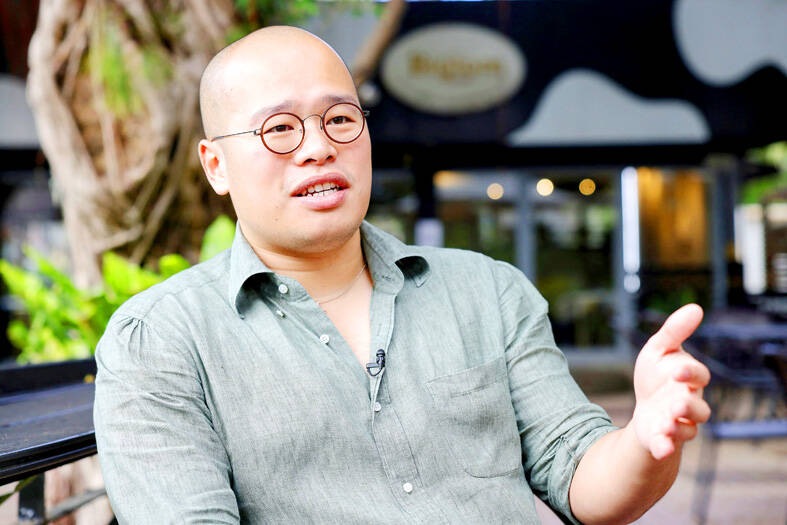
Photo: Cheng I-Hwa, AFP
His son Sebastien Lai (黎崇恩) said the postponements and other legal obstacles made it clear that “it’s a kangaroo court.”
“My father’s case is ... an opportunity for Hong Kong to show whether they are actually rule-of-law compliant; whether they respect all the values they say they respect,” the 29-year-old said.
The world “should be paying attention to my father’s case, to the case of Hong Kong,” he said.
“Hong Kong has always been a litmus test for how China views the world and how they view the liberties that we have in the free world. Now, my father stood really at the front of that,” Sebastien Lai said. “He’s a man who decided to sacrifice everything that he has for these ideals of freedom ... so how the Hong Kong government treats my father is how the whole government views these freedoms.”
While awaiting trial for collusion, Jimmy Lai has been sentenced for attending four pro-democracy protests and for an additional charge of “fraud” — convictions that together came with sentences of more than seven years.
The Hong Kong government in March hit out at Sebastien Lai for bringing his father’s case to the UN, calling it “foreign interference” with the territory’s judicial proceedings.
If convicted, Jimmy Lai faces up to life in prison under the National Security Law Beijing imposed on Hong Kong in 2020. The law’s aim was to quash dissent following massive, and at times violent, pro-democracy demonstrations in 2019, which brought hundreds of thousands to the streets to demand greater freedoms for the territory.
In the three years since the law’s passage, prominent opposition lawmakers and democracy activists have either been jailed or fled abroad, and Hong Kong’s once-vibrant civil society is now a shadow of its former self.
“I think he’d be very heartbroken [by the current state of Hong Kong], but dad always looks forward,” Sebastien Lai said.
Born in China, Jimmy Lai was smuggled into Hong Kong at the age of 12 and worked in sweatshops before he founded a hugely successful clothing empire. He started Apple Daily in 1995, a tabloid that mixed heady sensationalism with hard-hitting political reportage.
An early advertisement for Apple Daily — of many yellowed clippings Sebastien Lai has saved in his Taipei home — shows Jimmy Lai perched on a motorcycle and beaming as he holds up a crimson apple.
The paper openly backed Hong Kong’s pro-democracy movement in 2019, and Jimmy Lai was labeled a “traitor” by China’s state media. Six staff members were also detained and pleaded guilty to collusion. They face possible life imprisonment under the security law.
Today, Jimmy Lai is “the oldest political prisoner in Hong Kong,” said Sebastien Lai, adding that the UK has yet to call for his father’s release.
“It’s so important that they do that, because my father is a British citizen... He has fought to uphold the promise that the UK and China made to the people of Hong Kong during the handover,” he said.
Showing an old photograph enclosed in a faded Disney frame of his father looking at him, Sebastien Lai said his father “always let us pursue whatever we wanted to pursue.”
“I have to be optimistic” about the upcoming trial, he said. “This is a long fight, but it’s not one that I would shy away from.”

Considering that most countries issue more than five denominations of banknotes, the central bank has decided to redesign all five denominations, the bank said as it prepares for the first major overhaul of the banknotes in more than 24 years. Central bank Governor Yang Chin-lung (楊金龍) is expected to report to the Legislative Yuan today on the bank’s operations and the redesign’s progress. The bank in a report sent to the legislature ahead of today’s meeting said it had commissioned a survey on the public’s preferences. Survey results showed that NT$100 and NT$1,000 banknotes are the most commonly used, while NT$200 and NT$2,000

The Centers for Disease Control (CDC) yesterday reported the first case of a new COVID-19 subvariant — BA.3.2 — in a 10-year-old Singaporean girl who had a fever upon arrival in Taiwan and tested positive for the disease. The girl left Taiwan on March 20 and the case did not have a direct impact on the local community, it said. The WHO added the BA.3.2 strain to its list of Variants Under Monitoring in December last year, but this was the first imported case of the COVID-19 variant in Taiwan, CDC Deputy Director-General Lin Ming-cheng (林明誠) said. The girl arrived in Taiwan on

South Korea is planning to revise its controversial electronic arrival card, a step Taiwanese officials said prompted them to hold off on planned retaliatory measures, a South Korean media report said yesterday. A Yonhap News Agency report said that the South Korean Ministry of Foreign Affairs is planning to remove the “previous departure place” and “next destination” fields from its e-arrival card system. The plan, reached after interagency consultations, is under review and aims to simplify entry procedures and align the electronic form with the paper version, a South Korean ministry official said. The fields — which appeared only on the electronic form

The Ministry of Foreign Affairs (MOFA) is suspending retaliation measures against South Korea that were set to take effect tomorrow, after Seoul said it is updating its e-arrival system, MOFA said today. The measures were to be a new round of retaliation after Taiwan on March 1 changed South Korea's designation on government-issued alien resident certificates held by South Korean nationals to "South Korea” from the "Republic of Korea," the country’s official name. The move came after months of protests to Seoul over its listing of Taiwan as "China (Taiwan)" in dropdown menus on its new online immigration entry system. MOFA last week


 RSS
RSS