


Citizen Congress Watch yesterday called on all 335 legislative candidates to back reform proposals and pledge to refuse to abuse government funds to benefit assistants or their office.
All parties attended an event hosted by the legislative watchdog except the Chinese Nationalist Party (KMT).
The group said it would announce who signed the pledges by the middle of next month.
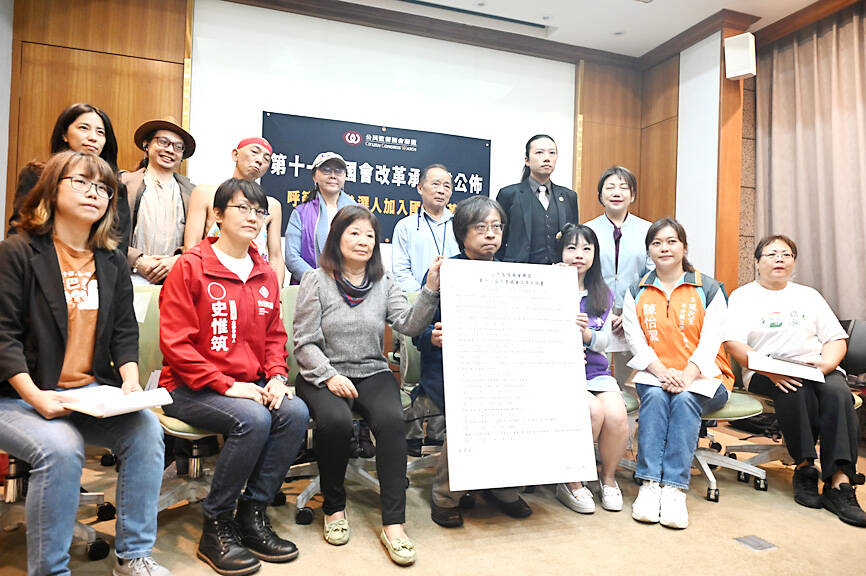
Photo: Wang Yi-sung, Taipei Times
Citizen Congress Watch chairman Tseng Chien-yuan (曾建元) told a news conference that there has been a spike in legislators failing to recuse themselves from conflicts of interests.
Group executive director Leo Chang (張宏林) said that incidents involving conflicts of interest have greatly affected the public’s confidence in the legislature, adding that Citizen Congress Watch hopes candidates would sign the pledge and uphold it if elected.
Democratic Progressive Party (DPP) Legislator Fan Yun (范雲), seeking to secure another term as a legislator-at-large, said the legislature always has room for improvement, even though Citizen Congress Watch considers DPP lawmakers to have excellent performance records, while the Legislative Yuan has earned international approval for transparency.
New Power Party (NPP) legislator-at-large candidate Wang Pao-hsuan (王寶萱) said that NPP legislators have all been considered “excellent” by the group and would continue to promote a more transparent legislature.
The party would continue to watch for issues that could pose conflicts of interest for its legislators, Wang added.
Taiwan Statebuilding Party legislator-at-large candidate Shih Wei-chu (史惟筑) said her party was glad to see Citizen Congress Watch’s proposed list of pledges, but added that more emphasis should be given to addressing Chinese infiltration efforts.
The party proposed two additional pledges: that candidates with significant investments in China be considered ineligible to run and that candidates be screened for national security reasons, Shih said.
Her comments referred to the KMT and the DPP nominating Chinese immigrants for their legislator-at-large lists.
Former People First Party legislator Chen Yi-chieh (陳怡潔) said the party had worked on legislative reform efforts before, and if it wins enough seats to form a caucus, it would work closely with Citizen Congress Watch.
While the People First Party agreed with most of the political watchdog’s pledges, legislators are elected representatives of the public, Chen said, adding that the group’s call for regulating the “commitment” of legislators should be further discussed.
Citizen Congress Watch called for legislative candidates to promise to not abuse their office, sign a nondisclosure agreement to not reveal national security secrets discussed during hearings, and draft laws that would ensure their full-time commitment as legislators — preventing them from holding positions at for-profit businesses during their time in office — and to be transparent about their positions.
It also called on candidates to be disciplined, uphold legislative transparency, publicize reports on foreign inspections, observe due process in the confirmations of officials, be timely on national spending reviews, and draft legislation granting the legislature powers of investigation and to hold hearings.

FUKUOKA SITUATION: Japanese media reported that the pathogen is expected to be identified by the summer, while the CDC downplayed the idea that it was hMPV A “mysterious cold-like illness” reported in Japan’s Fukuoka Prefecture does not seem to be a new disease, but Japanese authorities have been asked about the situation, the Centers for Disease Control (CDC) said yesterday. The Fukuoka Prefectural Medical Association on Wednesday told a news conference that a “mystery cold” that has become a hot topic on social media is “highly likely to be caused by some kind of viral infection,” Japan’s KBC News reported. “Many people are experiencing symptoms starting with a sore throat, followed by a runny nose, phlegm and a severe cough,” KBC News reported, citing association officials. Health authorities are

Nvidia Corp CEO Jensen Huang (黃仁勳) arrived in Taiwan yesterday ahead of upcoming AI and technology events, saying he plans to meet with clients and Taiwan Semiconductor Manufacturing Co Chairman C.C. Wei (魏哲家) during his visit. After landing at Taipei Songshan Airport, Huang posed for photos with fans and handed out Yakult drinks to reporters and supporters waiting at the scene, saying he has “a lot to do” during the trip. Asked about reports that Nvidia’s planned headquarters site in Taipei’s Beitou Shilin Technology Park could break ground on May 27, Huang said that if the company holds an event, he would

Carrefour Taiwan is to begin using a new name from the start of July, but it cannot divulge the name until then, the chairman of the supermarket chain's parent company said today. President Chain Store Co chairman Lo Chih-hsien (羅智先) was asked by reporters after a shareholders' meeting to confirm whether the company has settled on a new name for the supermarket brand. In March, the government-registered name of two Carrefour Taiwan branches was quietly changed to "Le Chia Kang" (樂家康) in Chinese, raising speculation that has been selected as the name. Lo said that because of local regulations and contractual obligations, the

The Philippines would likely be involved in any conflict over Taiwan due to its proximity to the democracy claimed by China, President Ferdinand Marcos Jr said, reiterating a stance that risks angering Beijing. “In the Philippines, we do not have a choice because Taiwan is so close to the Philippines and we have almost 200,000 Filipino nationals living and working in Taiwan,” Marcos said in an interview with Japanese media in Manila on Monday. The Philippine leader’s comments come ahead of a state visit to Japan next week, where he is to meet with Japanese Prime Minister Sanae Takaichi to discuss security


 RSS
RSS