


Kaohsiung has the highest rate of obesity among junior-high and high-school students in the nation, the most recent Ministry of Health and Welfare statistics showed.
The latest annual report of nationwide obesity statistics showed that at the elementary school level an average of 30.2 percent of male students and 22.7 percent of female students are obese. At the junior-high school level, 36.4 percent of male students and 25.6 percent of female students are obese.
However, statistics released earlier this year by the Kaohsiung Education Bureau showed that 32.68 percent of male students and 23.76 percent of female students at elementary school are obese. At the junior-high school level, 39.19 percent of males and 27.47 percent of females in the city are obese.
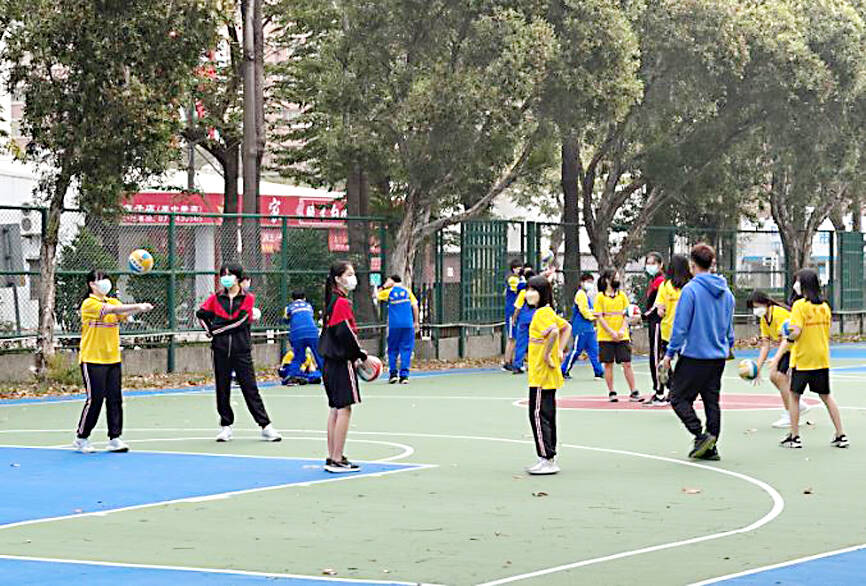
Photo: Hsu Li-chuan, Taipei Times
Grades one and two have the lowest rates of obesity, while 20 percent of students at the grade-five level and above are obese and 14 percent are overweight, the statistics for the city showed.
The high rate might be due to the hot weather in Kaohsiung, which might be encouraging children to drink more sweet and iced beverages, the Kaohsiung Education Bureau said, adding that the heat also causes children to spend less time exercising outdoors.
The average body mass index (BMI) of students in districts closer to the mountains and of indigenous children is higher, and that of students from near the city center including Gushan (鼓山), Sinsing (新興), Lingya (苓雅) and Cianjin (前金) districts is lower, the data showed.
The bureau recorded a decrease in the average BMI of the city’s students from each grade compared with the year before. The highest decrease was recorded among sixth graders whose average BMI decreased by 0.17, while the second-biggest decrease was among ninth graders, with an average BMI decrease of 0.13.
The year-on-year decrease showed that efforts by the city to promote a healthier lifestyle were promising, the bureau said, adding that students reported higher levels of exercise and better sleep patterns.
However, more effort was needed to encourage more water intake and consumption of vegetables, it said.
Schools with a higher proportion of overweight students would be provided with greater funds and resources to promote healthy habits, it said.

Considering that most countries issue more than five denominations of banknotes, the central bank has decided to redesign all five denominations, the bank said as it prepares for the first major overhaul of the banknotes in more than 24 years. Central bank Governor Yang Chin-lung (楊金龍) is expected to report to the Legislative Yuan today on the bank’s operations and the redesign’s progress. The bank in a report sent to the legislature ahead of today’s meeting said it had commissioned a survey on the public’s preferences. Survey results showed that NT$100 and NT$1,000 banknotes are the most commonly used, while NT$200 and NT$2,000

The Centers for Disease Control (CDC) yesterday reported the first case of a new COVID-19 subvariant — BA.3.2 — in a 10-year-old Singaporean girl who had a fever upon arrival in Taiwan and tested positive for the disease. The girl left Taiwan on March 20 and the case did not have a direct impact on the local community, it said. The WHO added the BA.3.2 strain to its list of Variants Under Monitoring in December last year, but this was the first imported case of the COVID-19 variant in Taiwan, CDC Deputy Director-General Lin Ming-cheng (林明誠) said. The girl arrived in Taiwan on

South Korea is planning to revise its controversial electronic arrival card, a step Taiwanese officials said prompted them to hold off on planned retaliatory measures, a South Korean media report said yesterday. A Yonhap News Agency report said that the South Korean Ministry of Foreign Affairs is planning to remove the “previous departure place” and “next destination” fields from its e-arrival card system. The plan, reached after interagency consultations, is under review and aims to simplify entry procedures and align the electronic form with the paper version, a South Korean ministry official said. The fields — which appeared only on the electronic form

The Ministry of Foreign Affairs (MOFA) is suspending retaliation measures against South Korea that were set to take effect tomorrow, after Seoul said it is updating its e-arrival system, MOFA said today. The measures were to be a new round of retaliation after Taiwan on March 1 changed South Korea's designation on government-issued alien resident certificates held by South Korean nationals to "South Korea” from the "Republic of Korea," the country’s official name. The move came after months of protests to Seoul over its listing of Taiwan as "China (Taiwan)" in dropdown menus on its new online immigration entry system. MOFA last week


 RSS
RSS