


The Democratic Progressive Party (DPP) yesterday unveiled its legislator-at-large nominees for next year’s election, with Kuma Academy cofounder Puma Shen (沈伯洋) joining party stalwarts Legislative Speaker You Si-kun (游錫堃) and party caucus whip Ker Chien-ming (柯建銘) at the top of the list.
The DPP Central Standing Committee finalized and approved the nominees at its regular midweek meeting.
Six men and six women make up the first 12 nominees, considered “safe positions” in winning enough votes to serve as legislators next year.

Photo: Wu Po-hsuan, Taipei Times
Legislators-at-large are elected through political party ballots. The New Power Party, the Taiwan Statebuilding Party and the Green Party Taiwan have already decided their nominees, while the Chinese Nationalist Party (KMT) has delayed its announcement to Sunday.
First on the DPP list is Jing Chuan Child Safety Foundation director Lin Yue-chin (林月琴), followed by Shen, a criminology professor at National Taipei University and chairman of Doublethink Lab.
He is also cofounder of the Kuma Academy, a nonprofit civil defense organization that trains people in first aid and media literacy to combat Chinese disinformation.
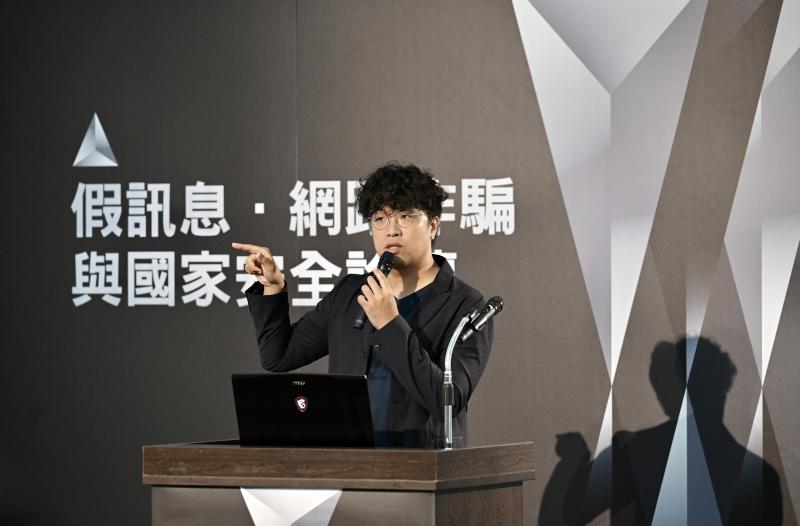
Photo: Lo Pei-der, Taipei Times
“We are facing ever-changing situations in cyberattacks and infiltration from an enemy state, and it is not just the civilians who should prepare to defend Taiwan, but our government must also establish systems to safeguard our nation,” Shen said yesterday.
As a legislator-at-large, he would seek to set up defense networks to combat the cognitive warfare Taiwanese need to guard against, he said.
Third on the list is Taiwan Parks and Playgrounds for Children by Children chairwoman Ariel Chang (張雅琳), followed by Legislator Hung Sun-han (洪申翰), an environmentalist and advocate for renewable energy.
At No. 5 is Malaysia-born Legislator Lo Mei-ling (羅美玲), who represents “new Taiwanese citizen groups,” such as foreigners married to Taiwanese. Lo previously served as a Nantou County councilor before becoming a legislator in 2020.
You is listed at No. 6, followed by Legislator Fan Yun (范雲), a women’s rights advocate, professor of sociology and founder of the Social Democratic Party.
At No. 8 is Ker, who represents Hsinchu City and has served in the legislature for nine consecutive terms over two decades.
Ker is followed by current legislators who represent powerful groups within the DPP: Shen Fa-hui (沈發惠) of the New Tide faction, Chuang Jui-hsiung (莊瑞雄) of a faction close to President Tsai Ing-wen (蔡英文) and DPP spokeswoman Michelle Lin (林楚茵) of the Taiwan Forward Foundation, founded by media tycoon Lin Kun-hai (林崑海), who died last year.
Listed at No. 12 is entertainer and TV show host Jean Kuo (郭昱晴), who is also an artist and author, followed by Hope Foundation for Cancer Care chairman Wang Cheng-hsu (王正旭), who represents medical professionals, and civil engineering professor Wang Yi-chuan (王義川), a popular pundit on TV news and chief strategist at the Taiwan Thinktank.
Notably absent from the list is former minister of health and welfare Chen Shih-chung (陳時中), who gained wide appeal for his efforts during the COVID-19 pandemic, but lost as the DPP’s candidate in Taipei’s mayoral election last year.

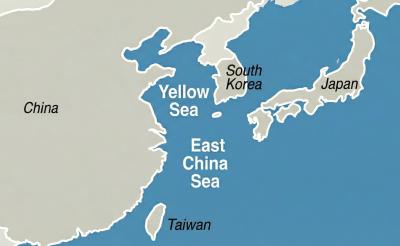
China has reserved offshore airspace in the Yellow Sea and East China Sea from March 27 to May 6, issuing alerts usually used to warn of military exercises, although no such exercises have been announced, the Wall Street Journal (WSJ) reported yesterday. Reserving such a large area for 40 days without explanation is an “unusual step,” as military exercises normally only last a few days, the paper said. These alerts, known as Notice to Air Missions (Notams), “are intended to inform pilots and aviation authorities of temporary airspace hazards or restrictions,” the article said. The airspace reserved in the alert is
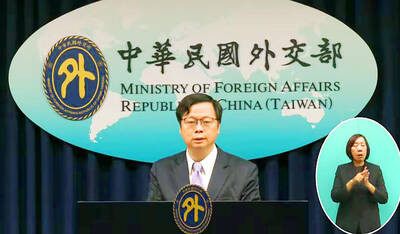
NAMING SPAT: The foreign ministry called on Denmark to propose an acceptable solution to the erroneous nationality used for Taiwanese on residence permits Taiwan has revoked some privileges for Danish diplomatic staff over a Danish permit that lists “Taiwan” as “China,” Eric Huang (黃鈞耀), head of the Ministry of Foreign Affairs’ Department of European Affairs, told a news conference in Taipei yesterday. Reporters asked Huang whether the Danish government had responded to the ministry’s request that it correct the nationality on Danish residence permits of Taiwanese, which has been listed as “China” since 2024. Taiwan’s representative office in Denmark continues to communicate with the Danish government, and the ministry has revoked some privileges previously granted to Danish representatives in Taiwan and would continue to review

More than 6,000 Taiwanese students have participated in exchange programs in China over the past two years, despite the Mainland Affairs Council’s (MAC) “orange light” travel advisory, government records showed. The MAC’s publicly available registry showed that Taiwanese college and university students who went on exchange programs across the Strait numbered 3,592 and 2,966 people respectively. The National Immigration Agency data revealed that 2,296 and 2,551 Chinese students visited Taiwan for study in the same two years. A review of the Web sites of publicly-run universities and colleges showed that Taiwanese higher education institutions continued to recruit students for Chinese educational programs without
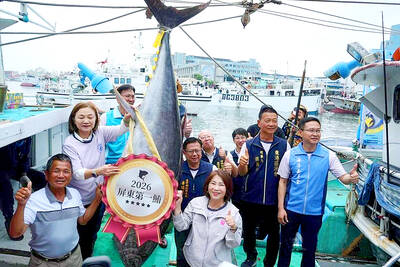
The first bluefin tuna of the season, brought to shore in Pingtung County and weighing 190kg, was yesterday auctioned for NT$10,600 (US$333.5) per kilogram, setting a record high for the local market. The auction was held at the fish market in Donggang Fishing Harbor, where the Siaoliouciou Island-registered fishing vessel Fu Yu Ching No. 2 delivered the “Pingtung First Tuna” it had caught for bidding. Bidding was intense, and the tuna was ultimately jointly purchased by a local restaurant and a local company for NT$10,600 per kilogram — NT$300 ,more than last year — for a total of NT$2.014 million. The 67-year-old skipper


 RSS
RSS