


Taiwan’s top intelligence agency yesterday said that it has completed the training of about 220 special agents, who would be assigned in four teams to presidential candidates ahead of January’s election.
Speaking at a graduation ceremony after months of training at the National Security Bureau in Taipei, bureau Director-General Tsai Ming-yen (蔡明彥) said that the job of the special agents is to protect the candidates for president and vice president, regardless of the party they represent.
It is the duty and responsibility of the bureau to protect Taiwan’s potential future leaders in accordance with the law and failure to do so would not be tolerated, Tsai said.
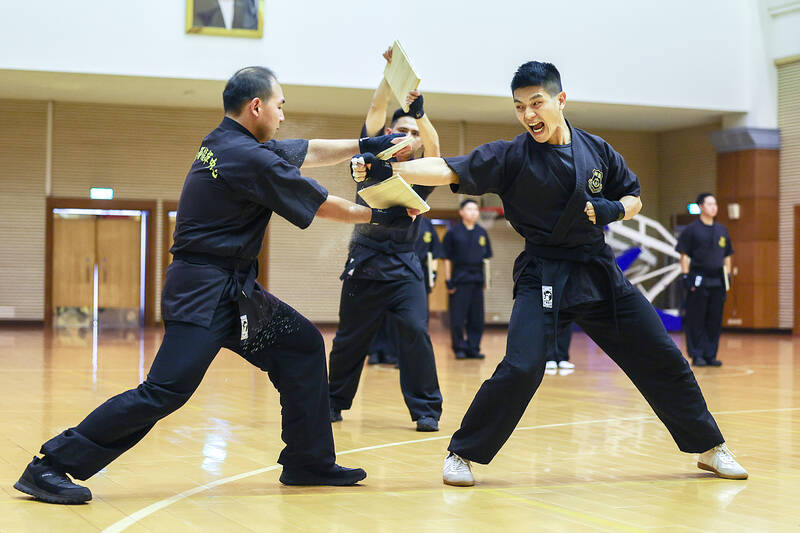
Photo: CNA
In a democratic country, it is quite common to see political figures in close proximity to members of the public, which could present a challenge for security agents, he said.
However, the security details must remain professional and find a balance between protecting a candidate’s safety and allowing access to voters, Tsai said.
At the ceremony, the bureau also staged a demonstration of some newly purchased security vehicles that would be used during the campaigns in the run-up to the Jan. 13 election.
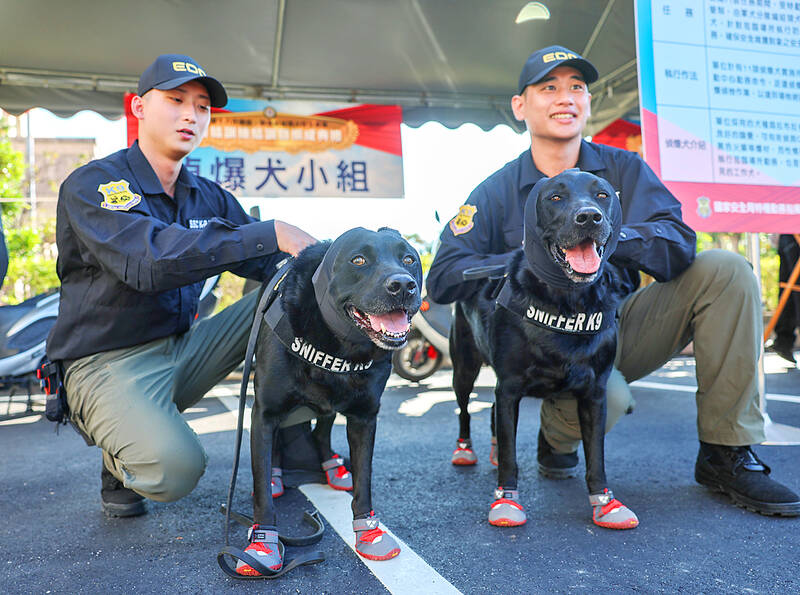
Photo: CNA
These included Ford Ranger modified double-cabin bulletproof patrol and Land Rover guard vehicles.
During the event on a bureau compound, the abilities of two black Labrador retriever sniffer dogs were also demonstrated.
They are to be part of a team of 11 detection dogs deployed during the election campaign period, the bureau said.
In addition, it plans to deploy Barrett MRAD rifles and NVLS thermal imagery systems from the US, as well as a new gunshot detector capable of quickly locating and countering hostile threats.
The ceremony marked the conclusion of five months of training, which included preparations for handling attacks involving drones and explosives.
The 220 agents would be assigned to the four expected presidential candidates and their running mates, who are required to formally register their candidacy by Nov. 24, the bureau said.
Vice President William Lai (賴清德) has been named as the Democratic Progressive Party’s candidate, New Taipei City Mayor Hou You-yi (侯友宜) for the Chinese Nationalist Party (KMT) and former Taipei mayor Ko Wen-je (柯文哲) for the Taiwan People’s Party.
They have not yet announced their running mates.
Hon Hai Precision Industry Co founder Terry Gou (郭台銘), who is seeking to run on an independent ticket, has submitted more than the required 289,667 petition signatures, which have to be certified by the Central Election Commission before Gou and his running mate, Tammy Lai (賴佩霞), could be included on the ballot.
Against that backdrop, the bureau is also prepared to assign a security detail to the candidates on a potential fourth ticket, it said.
The commission is to complete its review of the independent candidate’s petition by Tuesday next week, and registration of all presidential candidates and running mates would be from Nov. 20 to 24.

Considering that most countries issue more than five denominations of banknotes, the central bank has decided to redesign all five denominations, the bank said as it prepares for the first major overhaul of the banknotes in more than 24 years. Central bank Governor Yang Chin-lung (楊金龍) is expected to report to the Legislative Yuan today on the bank’s operations and the redesign’s progress. The bank in a report sent to the legislature ahead of today’s meeting said it had commissioned a survey on the public’s preferences. Survey results showed that NT$100 and NT$1,000 banknotes are the most commonly used, while NT$200 and NT$2,000

The Centers for Disease Control (CDC) yesterday reported the first case of a new COVID-19 subvariant — BA.3.2 — in a 10-year-old Singaporean girl who had a fever upon arrival in Taiwan and tested positive for the disease. The girl left Taiwan on March 20 and the case did not have a direct impact on the local community, it said. The WHO added the BA.3.2 strain to its list of Variants Under Monitoring in December last year, but this was the first imported case of the COVID-19 variant in Taiwan, CDC Deputy Director-General Lin Ming-cheng (林明誠) said. The girl arrived in Taiwan on

South Korea is planning to revise its controversial electronic arrival card, a step Taiwanese officials said prompted them to hold off on planned retaliatory measures, a South Korean media report said yesterday. A Yonhap News Agency report said that the South Korean Ministry of Foreign Affairs is planning to remove the “previous departure place” and “next destination” fields from its e-arrival card system. The plan, reached after interagency consultations, is under review and aims to simplify entry procedures and align the electronic form with the paper version, a South Korean ministry official said. The fields — which appeared only on the electronic form

The Ministry of Foreign Affairs (MOFA) is suspending retaliation measures against South Korea that were set to take effect tomorrow, after Seoul said it is updating its e-arrival system, MOFA said today. The measures were to be a new round of retaliation after Taiwan on March 1 changed South Korea's designation on government-issued alien resident certificates held by South Korean nationals to "South Korea” from the "Republic of Korea," the country’s official name. The move came after months of protests to Seoul over its listing of Taiwan as "China (Taiwan)" in dropdown menus on its new online immigration entry system. MOFA last week


 RSS
RSS