


A Chinese attack on Taiwan is the greatest peril to the global system since the 1930s, Atlantic Council CEO Frederick Kempe told the US-based cable news channel CNBC on Thursday.
The US is facing the fourth inflection point in its history that could result in an outcome similar to World War II should leaders mishandle the moment, he said at the channel’s virtual Evolve Global Summit, adding that China is the biggest risk factor.
The first three inflection points in US history were the two world wars and the Cold War, he added.
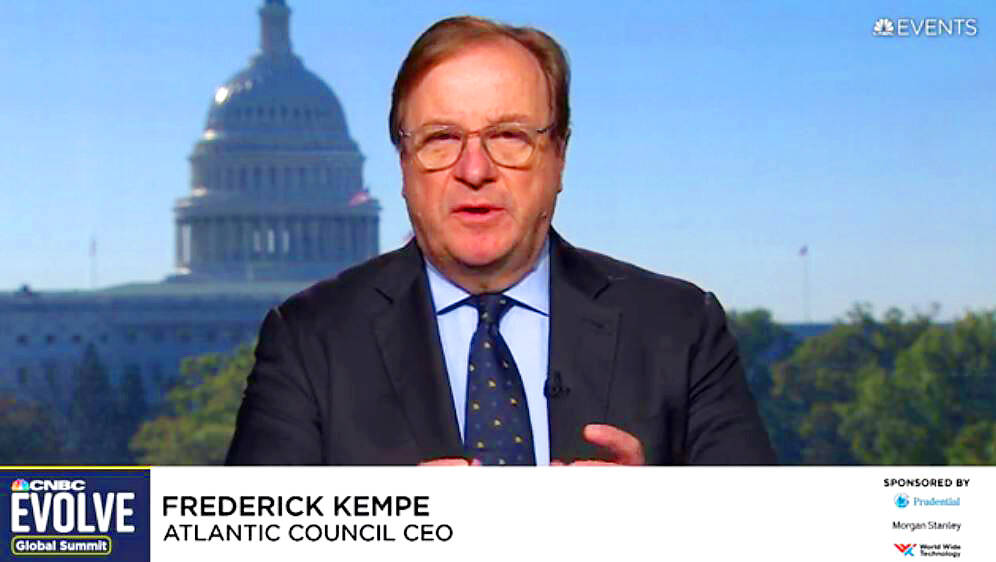
Photo: Screen grab from CNBC’s YouTube channel
When asked about US House of Representatives Speaker Mike Johnson’s attempt to separately fund aid packages to Israel and Ukraine while tying the latter to domestic issues, Kempe said the US should keep the latter as its top priority.
China might see a wavering in US support of Ukraine as an opportunity to invade Taiwan, he said.
Autocratic regimes around the world are collaborating more than ever before, and although they are not plotting together against the US, those regimes share a desire to not have the US “run the global system any longer,” he said.
Meanwhile, the US and its allies are not sufficiently united to effectively counter collaboration between China, Russia, Iran and North Korea, Kempe said.
When asked about JPMorgan Chase & Co chief executive Jamie Dimon’s remark that the world might be “facing its most dangerous time in decades,” Kempe responded in the affirmative, saying: “Geopolitics is coming into boardrooms in a way it has not in my lifetime.”
The shift has been building over the past five years with the outbreak of the COVID-19 pandemic, a chaotic US withdrawal from Afghanistan, Russian President Putin’s subsequent invasion of Ukraine and the Israel-Hamas conflict, Kempe said.
Corporate executives are right in fearing global instability worsening, he said, adding that companies should reduce supply chain dependency on China and bolster their resilience.

Considering that most countries issue more than five denominations of banknotes, the central bank has decided to redesign all five denominations, the bank said as it prepares for the first major overhaul of the banknotes in more than 24 years. Central bank Governor Yang Chin-lung (楊金龍) is expected to report to the Legislative Yuan today on the bank’s operations and the redesign’s progress. The bank in a report sent to the legislature ahead of today’s meeting said it had commissioned a survey on the public’s preferences. Survey results showed that NT$100 and NT$1,000 banknotes are the most commonly used, while NT$200 and NT$2,000

The Centers for Disease Control (CDC) yesterday reported the first case of a new COVID-19 subvariant — BA.3.2 — in a 10-year-old Singaporean girl who had a fever upon arrival in Taiwan and tested positive for the disease. The girl left Taiwan on March 20 and the case did not have a direct impact on the local community, it said. The WHO added the BA.3.2 strain to its list of Variants Under Monitoring in December last year, but this was the first imported case of the COVID-19 variant in Taiwan, CDC Deputy Director-General Lin Ming-cheng (林明誠) said. The girl arrived in Taiwan on

South Korea is planning to revise its controversial electronic arrival card, a step Taiwanese officials said prompted them to hold off on planned retaliatory measures, a South Korean media report said yesterday. A Yonhap News Agency report said that the South Korean Ministry of Foreign Affairs is planning to remove the “previous departure place” and “next destination” fields from its e-arrival card system. The plan, reached after interagency consultations, is under review and aims to simplify entry procedures and align the electronic form with the paper version, a South Korean ministry official said. The fields — which appeared only on the electronic form

The Ministry of Foreign Affairs (MOFA) is suspending retaliation measures against South Korea that were set to take effect tomorrow, after Seoul said it is updating its e-arrival system, MOFA said today. The measures were to be a new round of retaliation after Taiwan on March 1 changed South Korea's designation on government-issued alien resident certificates held by South Korean nationals to "South Korea” from the "Republic of Korea," the country’s official name. The move came after months of protests to Seoul over its listing of Taiwan as "China (Taiwan)" in dropdown menus on its new online immigration entry system. MOFA last week


 RSS
RSS