


Premier Chen Chien-jen (陳建仁) has reiterated the government’s goal to have up to 47,000 overseas compatriot students stay on in Taiwan after graduation by 2030 in a bid to boost the nation’s workforce.
During a meeting with a visiting delegation from the World Federation of Taiwan Alumni Associations on Tuesday last week, Chen said that alumni from different school and university tiers in Taiwan, living or staying in Taiwan, play an important role in promoting exchanges between Taiwan and their home countries.
As such, the Cabinet last year approved a 2023-2026 plan formulated by the Overseas Community Affairs Council (OCAC) to enhance the cultivation and retention of overseas compatriot students, with the goal of retaining up to 47,000 individuals in Taiwan for employment by 2030, with the aim of maintaining Taiwan’s economic growth momentum, Chen said.
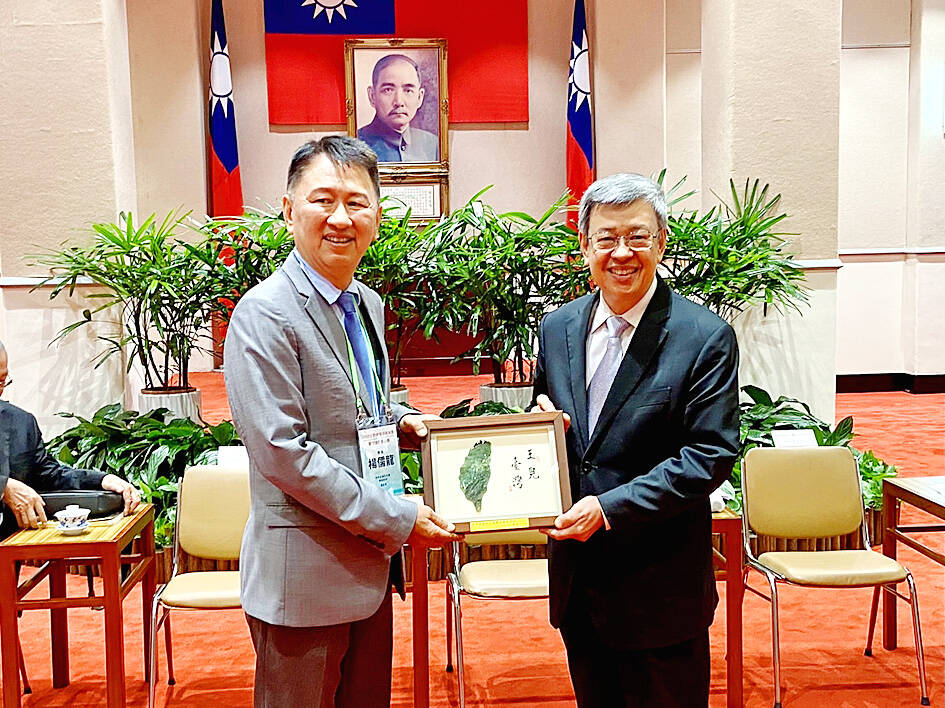
Photo: CNA
Under the policy, to maximize the development and retention of overseas compatriot students, the government has adopted new measures to make their enrollment more flexible, including encouraging schools to establish special study programs for international students.
Other measures include expanding industry-academia collaborative education programs for overseas compatriot students and transforming the Overseas Youth Vocational Training Program into two-year associate degree programs.
The government has also relaxed requirements to stay and work after graduation, including allowing overseas compatriot students who have obtained an associate degree or above in Taiwan to apply through their employers to become intermediate-skilled workers in Taiwan, which grants them exemption from certain requirements such as work experience.
Students on short-term study programs are also allowed to remain and work in Taiwan under certain conditions.
Chen said that since the government introduced its New Southbound Policy in 2016 to strengthen relations with its neighbors to the south, from South and Southeast Asia to Australia and New Zealand, many Taiwanese enterprises have pinned their hopes on overseas compatriot students remaining in Taiwan after graduation to help expand their international markets.
Since the implementation of the overseas compatriot education policy over 70 years ago, more than 170,000 overseas compatriot alumni have graduated from different school and university tiers in Taiwan, the council said.
The number of overseas compatriot students who remain in Taiwan after finishing their studies or programs in universities and colleges has increased from 2,000 in 2020, to 4,000 in 2021, 6,000 in 2022, and is expected to reach 8,000 this year, the council added.
The council on its Web site defines an “overseas compatriot student” as a person of Taiwanese or Chinese descent who “has come to Taiwan to study, who was born and lived overseas until the present time, or who has been living overseas for six or more consecutive years in the immediate past and obtained permanent or long-term residency status overseas.”
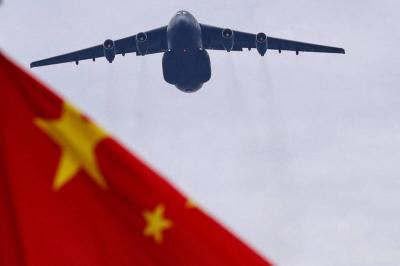
Beijing could eventually see a full amphibious invasion of Taiwan as the only "prudent" way to bring about unification, the US Department of Defense said in a newly released annual report to Congress. The Pentagon's "Annual Report to Congress: Military and Security Developments Involving the People's Republic of China 2025," was in many ways similar to last year’s report but reorganized the analysis of the options China has to take over Taiwan. Generally, according to the report, Chinese leaders view the People's Liberation Army's (PLA) capabilities for a Taiwan campaign as improving, but they remain uncertain about its readiness to successfully seize

Taiwan is getting a day off on Christmas for the first time in 25 years. The change comes after opposition parties passed a law earlier this year to add or restore five public holidays, including Constitution Day, which falls on today, Dec. 25. The day marks the 1947 adoption of the constitution of the Republic of China, as the government in Taipei is formally known. Back then the Chinese Nationalist Party (KMT) governed China from Nanjing. When the KMT, now an opposition party in Taiwan, passed the legislation on holidays, it said that they would help “commemorate the history of national development.” That

Taiwan has overtaken South Korea this year in per capita income for the first time in 23 years, IMF data showed. Per capita income is a nation’s GDP divided by the total population, used to compare average wealth levels across countries. Taiwan also beat Japan this year on per capita income, after surpassing it for the first time last year, US magazine Newsweek reported yesterday. Across Asia, Taiwan ranked fourth for per capita income at US$37,827 this year due to sustained economic growth, the report said. In the top three spots were Singapore, Macau and Hong Kong, it said. South
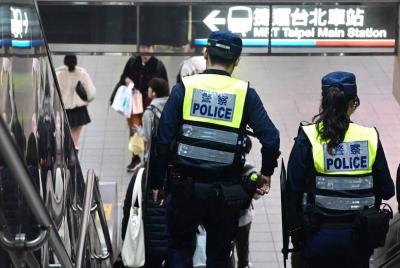
Police today said they are stepping up patrols throughout the Taipei MRT system, after a social media user threatened to detonate a bomb at an unspecified station this afternoon. Although they strongly believe the threat to be unsubstantiated, Taipei Metro police and the Railway Police Bureau still said that security and patrols would be heightened through the system. Many copycat messages have been posted since Friday’s stabbing attacks at Taipei Main Station and near Zhongshan MRT Station that left three dead and 11 injured, police said. Last night, a Threads user in a post said they would detonate a bomb on the Taipei


 RSS
RSS