


Beijing’s self-assessments of its military readiness “represent genuine anxieties” among its leadership about the Chinese People’s Liberation Army’s (PLA) readiness for real combat conditions, a US Department of Defense report said.
The Pentagon’s annual report to the US Congress, released on Thursday last week and titled Military and Security Developments Involving the People’s Republic of China, said that the military shortcomings the PLA has highlighted publicly are “likely to guide and accelerate force-wide modernization efforts.”
The PLA routinely highlights shortcomings using slogans or phrases to urge the military to carry out improvement campaigns, which this year include: the “five incapables,” the “two incompatibles,” the “two big gaps,” the “two inabilities” and the “three whethers,” the report said.
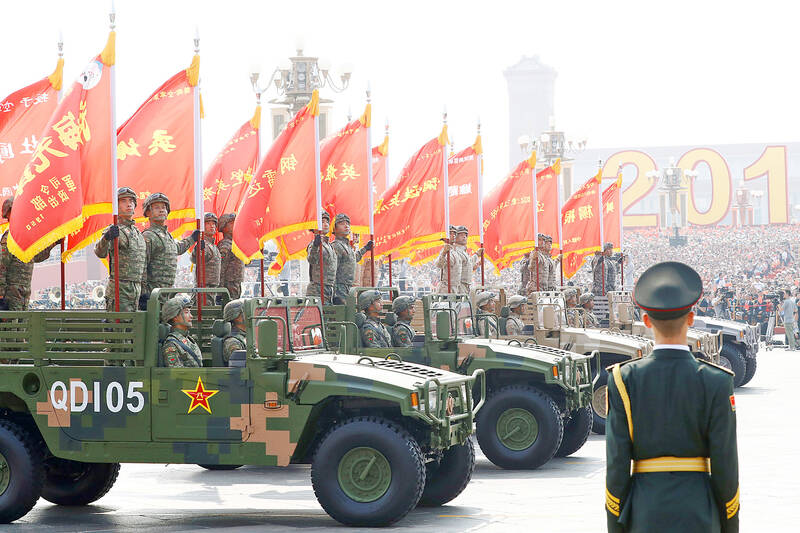
Photo: Reuters
The “five incapables” slogan highlights concerns over shortcomings in training and education “that reportedly left some commanders — particularly at the operational level — inadequately prepared for modern warfare,” it said.
Some commanders cannot judge situations, understand the intentions of higher authorities, make operational decisions, deploy forces and manage unexpected situations, it said.
The “two inabilities” slogan refers to the PLA’s inability to fight a modern war and the inability of its officers at all levels to command in a modern war, it said.
The “two incompatibles” refers to the PLA’s concerns that it “does not meet the requirements of winning local war under informatized conditions” and “does not meet the requirements of carrying out its historic missions at the new stage of the new century,” the report said.
The PLA uses the slogan “two big gaps” to highlight “enduring concerns” about its true fighting capabilities despite years of modernization efforts and its belief that it is “behind the world’s most capable militaries,” it said.
The second gap is that it does not meet national security requirements, it said.
As for the “three whethers,” the report said that the PLA is concerned about whether its armed forces can maintain the Chinese Communist Party’s (CCP) “absolute leadership” and can “fight victoriously when needed,” and whether “commanders at all levels are competent to lead forces and command in war.”
Institute for National Defense and Security Research analyst Shu Hsiao-huang (舒孝煌) said that the CCP is concerned about its capability to carry out joint operations, face new challenges and sustain itself in modern warfare following its 2015 military reforms.
It is unknown whether the PLA has come to a conclusion or decided on a strategy regarding US deployments in the Indo-Pacific region in the past few years, Shu said.
Taiwan’s military said that it is ever vigilant and has continued to train its forces, citing recent collaborations between the Republic of China Air Force and the French Air and Space Force as an example.
A team of French and Taiwanese pilots have been flying simulated combat exercises starting from the middle of this month through early December at an air base in Hualien County, it said.
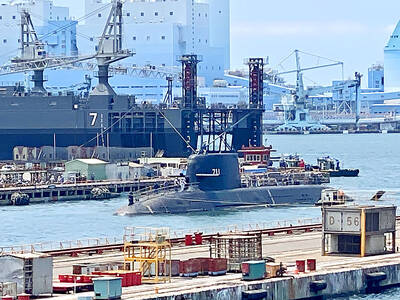
AGING: While Japan has 22 submarines, Taiwan only operates four, two of which were commissioned by the US in 1945 and 1946, and transferred to Taiwan in 1973 Taiwan would need at least 12 submarines to reach modern fleet capabilities, CSBC Corp, Taiwan chairman Chen Cheng-hung (陳政宏) said in an interview broadcast on Friday, citing a US assessment. CSBC is testing the nation’s first indigenous defense submarine, the Hai Kun (海鯤, Narwhal), which is scheduled to be delivered to the navy next month or in July. The Hai Kun has completed torpedo-firing tests and is scheduled to undergo overnight sea trials, Chen said on an SET TV military affairs program. Taiwan would require at least 12 submarines to establish a modern submarine force after assessing the nation’s operational environment and defense

A white king snake that frightened passengers and caused a stir on a Taipei MRT train on Friday evening has been claimed by its owner, who would be fined, Taipei Rapid Transit Corp (TRTC) said yesterday. A person on Threads posted that he thought he was lucky to find an empty row of seats on Friday after boarding a train on the Bannan (Blue) Line, only to spot a white snake with black stripes after sitting down. Startled, he jumped up, he wrote, describing the encounter as “terrifying.” “Taipei’s rat control plan: Release snakes on the metro,” one person wrote in reply, referring
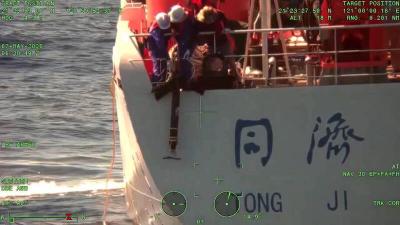
The coast guard today said that it had disrupted "illegal" operations by a Chinese research ship in waters close to the nation and driven it away, part of what Taipei sees a provocative pattern of China's stepped up maritime activities. The coast guard said that it on Thursday last week detected the Chinese ship Tongji (同濟號), which was commissioned only last year, 29 nautical miles (54km) southeast of the southern tip of Taiwan, although just outside restricted waters. The ship was observed lowering ropes into the water, suspected to be the deployment of scientific instruments for "illegal" survey operations, and the coast
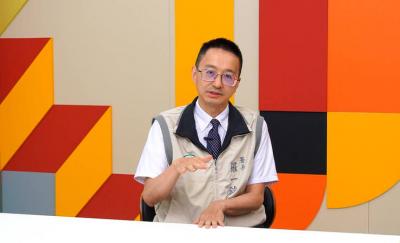
Taiwan’s two cases of hantavirus so far this year are on par with previous years’ case numbers, and the government is coordinating rat extermination work, so there should not be any outbreaks, Centers for Disease Control (CDC) Director-General Philip Lo (羅一鈞) said today in an interview with the Liberty Times (the Taipei Times’ sister newspaper). An increase in rat sightings in Taipei and New Taipei City has raised concerns about the spread of hantavirus, as rats can carry the disease. In January, a man in his 70s who lived in Taipei’s Daan District (大安) tested positive posthumously for hantavirus, Taiwan’s


 RSS
RSS