


Democratic Progressive Party (DPP) Legislator Chao Tian-lin (趙天麟) yesterday said he was willing to cooperate with any national security investigation into his affair with a Chinese woman, but added that Chinese Nationalist Party (KMT) Legislator Ma Wen-chun (馬文君) should also be investigated for allegedly leaking national security secrets, and she should also cooperate.
Taking questions from reporters at the legislature in Taipei yesterday, Chao denied he had leaked national secrets, while reiterating his decision to end his re-election bid, which he announced on Tuesday night, following media reports that he had an extramarital affair with a Chinese woman surnamed Zhang (張), and photos of the two kissing became public.
“I have apologized and admitted to wrongdoing in my personal life, but without any evidence, KMT lawmakers accused me — by exaggerating the matter to the highest level — of betraying the nation,” Chao said. “I shall cooperate with any judicial investigation into national security leaks, and I urge Ma to do the same.”
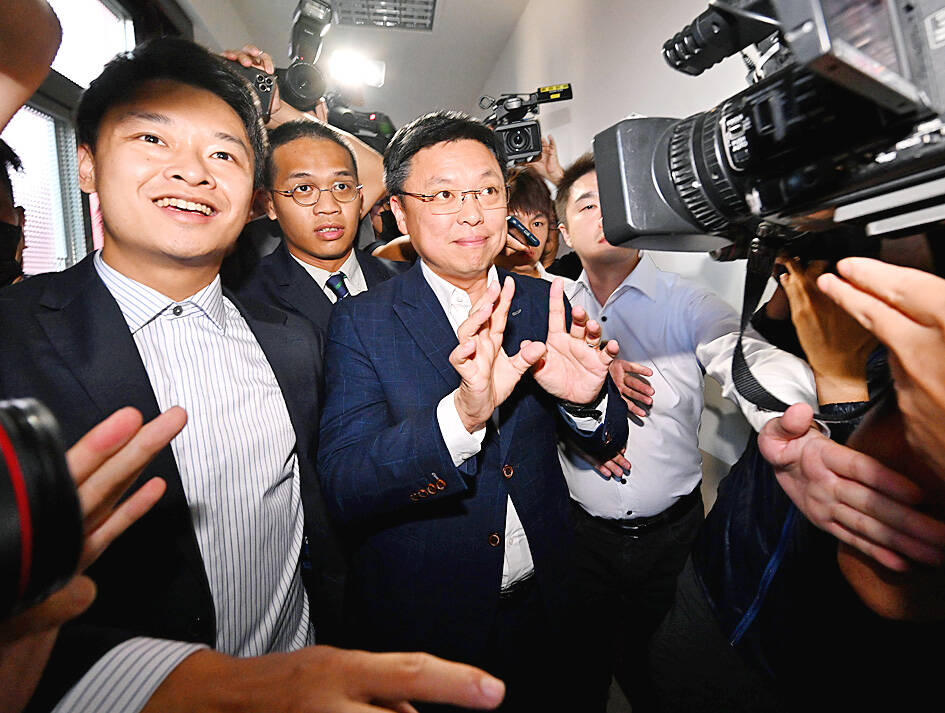
Photo: Tien Yu-hua, Taipei Times
Ma and other KMT lawmakers alleged that Chao passed classified materials from the legislature’s Foreign Affairs and National Defense Committee to China.
Separately, DPP caucus secretary-general Chuang Jui-hsiung (莊瑞雄) yesterday said that Ma had “betrayed the nation, seriously damaging national security,” and demanded that she not seek re-election.
Chuang said that Ma had interfered with the indigenous defense submarine project, by trying to prevent it from progressing by cutting its budget.
Ma had admitted that she had handed over classified materials related to the project to the South Korean representative office in Taiwan, which Chuang said resulted in the arrest and incarceration of several technicians working for South Korean contractor SI Innotec.
“During legislative sessions, Ma did not focus on scrutinizing the submarine construction or other military projects. Instead, she piled insults on military officials and defense experts, along with many staff members and technicians working to complete the first indigenous submarine,” DPP Legislator Lin Ching-yi (林靜儀) said.
Lin also said that videos of Ma speaking at the legislature are being used by China as propaganda to attack Taiwan’s government and military.
“Ma passed on classified project materials to South Korean officials to derail our submarines, which are to protect Taiwanese from a military invasion. Is this not treason?” Lin said. “During a classified legislative committee meeting to review the submarine blueprint and budget, Ma was talking on the phone. Is this not leaking national secrets? When someone does these things, they should be stripped of their rights and authority as a legislator right away.”
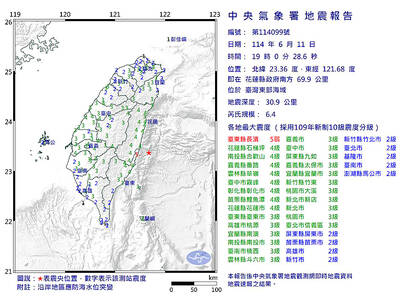
A magnitude 6.4 earthquake struck off the coast of Hualien County in eastern Taiwan at 7pm yesterday, the Central Weather Administration (CWA) said. The epicenter of the temblor was at sea, about 69.9km south of Hualien County Hall, at a depth of 30.9km, it said. There were no immediate reports of damage resulting from the quake. The earthquake’s intensity, which gauges the actual effect of a temblor, was highest in Taitung County’s Changbin Township (長濱), where it measured 5 on Taiwan’s seven-tier intensity scale. The quake also measured an intensity of 4 in Hualien, Nantou, Chiayi, Yunlin, Changhua and Miaoli counties, as well as
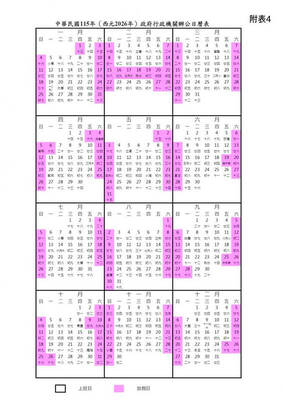
Taiwan is to have nine extended holidays next year, led by a nine-day Lunar New Year break, the Cabinet announced yesterday. The nine-day Lunar New Year holiday next year matches the length of this year’s holiday, which featured six extended holidays. The increase in extended holidays is due to the Act on the Implementation of Commemorative and Festival Holidays (紀念日及節日實施條例), which was passed early last month with support from the opposition Chinese Nationalist Party (KMT) and Taiwan People’s Party. Under the new act, the day before Lunar New Year’s Eve is also a national holiday, and Labor Day would no longer be limited

COMMITMENTS: The company had a relatively low renewable ratio at 56 percent and did not have any goal to achieve 100 percent renewable energy, the report said Pegatron Corp ranked the lowest among five major final assembly suppliers in progressing toward Apple Inc’s commitment to be 100 percent carbon neutral by 2030, a Greenpeace East Asia report said yesterday. While Apple has set the goal of using 100 percent renewable energy across its entire business, supply chain and product lifecycle by 2030, carbon emissions from electronics manufacturing are rising globally due to increased energy consumption, it said. Given that carbon emissions from its supply chain accounted for more than half of its total emissions last year, Greenpeace East Asia evaluated the green transition performance of Apple’s five largest final

Taiwan is to extend its visa-waiver program for Philippine passport holders for another year, starting on Aug. 1, Minister of Foreign Affairs Lin Chia-lung (林佳龍) said on Friday. Lin made the announcement during a reception in Taipei marking the 127th anniversary of Philippine independence and the 50th anniversary of the establishment of the Manila Economic and Cultural Office (MECO) in Taiwan, the Ministry of Foreign Affairs said. The decision reflected Taiwan’s commitment to deepening exchanges with the Philippines, the statement cited Lin as saying, adding that it was a key partner under the New Southbound Policy launched in 2016. Lin also expressed hope


 RSS
RSS