


POLITICS
Chang tapped for APEC
President Tsai Ing-wen (蔡英文) has appointed Taiwan Semiconductor Manufacturing Co (TSMC) founder Morris Chang (張忠謀) as her envoy to next month’s APEC summit, the Presidential Office said yesterday. Chang is to attend the APEC Economic Leaders’ Meeting, which is scheduled to be held from Nov. 15 to 17 in San Francisco, Presidential Office spokeswoman Lin Yu-chan (林聿禪) said in a press release. Under the Tsai administration, Chang has excelled in the role of the president’s envoy, successfully carrying out the duties assigned to him by Tsai at five previous APEC meetings, from 2018 to last year, Lin said. Those duties included engaging with other APEC leaders, enhancing Taiwan’s global visibility, and conveying the country’s willingness and ability to contribute to the international community, Lin said. Chang, 92, is the founder of TSMC, the world’s largest contract chipmaker, and he has served as the president’s envoy to APEC seven times. He first attended the annual APEC summit on behalf of Taiwan’s president in 2006, during the administration of then-president Chen Shui-bian (陳水扁). While the heads of government of all APEC members usually attend the annual Economic Leaders’ Meeting, Taiwan’s leaders have not been permitted to do so, due to China’s objection.
SOCIETY
Mahjong referendum denied
The Central Election Commission (CEC) on Friday rejected a proposed referendum on decriminalizing gambling on mahjong in public for elderly people with stakes of less than NT$1,000. The proposal, initiated by Kuo Hsi (郭璽), founder and chair of the Taiwan Mahjong Greatest Party, sought to allow people aged 65 or older to legally bet amounts lower than NT$1,000 on mahjong games in public. A hearing was held on July 17, after which Kuo was asked to submit a revised proposal. The CEC held a second meeting on Friday to examine the revised proposal, but it still turned it down, because it “did not meet the legal requirements,” the commission said in a press release, without providing any other details. In its current form, Article 266 of the Criminal Code makes gambling in public or via electronic or virtual means punishable by a fine of up to NT$50,000. While the law does contain an exception for gambling that is done “for temporary amusement,” it does not clearly define the term or set a ceiling on how much can be wagered.
CRIME
Three die in Taoyuan
Taoyuan prosecutors are investigating an alleged murder-suicide case in Taoyuan’s Yangmei District (楊梅), in which a suspect, surnamed Cheng (鄭), allegedly stabbed to death a couple, then jumped off a building to his death. Police first received a report of a man falling off a building on Tuesday night, then found a couple’s bodies at their home, apparently killed by knife wounds. Prosecutors identified the couple as a man surnamed Hung (洪), 54, and his wife, surnamed Hoang, 42, originally from Vietnam, who had reportedly been involved in romantic relations with Cheng, 48. Neighbors said the couple were married for more than 10 years, but were once divorced, then remarried. Neighbors said Hoang had a relationship with Cheng when the couple were divorced. Later, Cheng harassed Hoang over her returning to Hung. Due to constant harassment by Cheng, the couple in July applied for a “restraining order” mandating Cheng to stay away, according to Taoyuan prosecutors.
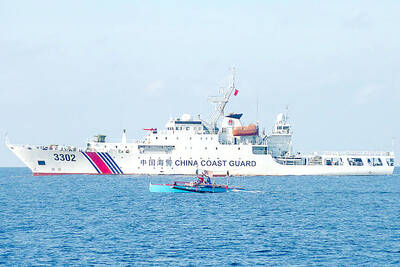
EXPANSIONIST: China deploys an average of 40 to 50 warships and coast guard vessels daily in the South China Sea, despite pledges not to militarize the region, an official said China is attempting to expand its influence across the First Island Chain and increase pressure on Japan by sending coast guard vessels into waters off of Taiwan under the pretext of maritime negotiations with Japan and the Philippines, a national security official said yesterday. China’s recent actions in the waters east of Taiwan and Japan and the Philippines’ exclusive economic zones (EEZ) are attempts to establish dominance in First Island Chain waters, said the official who declined to be named, adding that this is “expansion disguised as law enforcement.” Framing China’s actions solely as a cross-strait issue is a serious misjudgment that
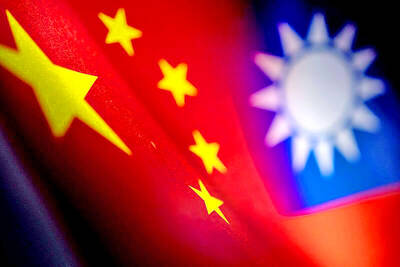
BAIT AND SWITCH: Allowing KMT-run counties to sell to China while the threat of abrupt cancelations hangs overhead is another form of coercion, officials said Beijing is using agricultural purchase offers announced during the Straits Forum to deepen Taiwan’s dependence on the Chinese market, a Taiwanese official said yesterday as they criticized the Taitung County commissioner’s participation in the initiative. During the Straits Forum held in Xiamen on Saturday, Chinese officials announced a sales and purchase agreement for agricultural products from some counties led by the Chinese Nationalist Party (KMT). Taitung County Commissioner Yao Ching-ling (饒慶鈴), who was barred from attending the event in person by the Mainland Affairs Council, participated via video. Under the agreement, China would purchase atemoyas, pomeloes, tea and grouper harvested in Taitung,
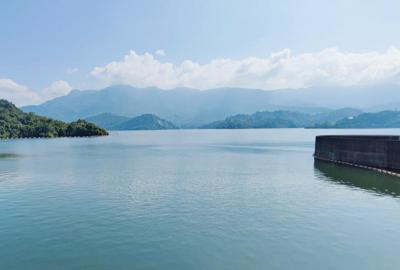
Several major reservoirs are estimated to have received 590 million tonnes of water inflow from June 4 to this morning, with storage levels at Wushantou Reservoir exceeding 50 percent and Zengwen Reservoir approaching 30 percent as of 9am today, data from the Water Resources Agency showed. Of the estimated 590 million tonnes, 450 million have already been stored in reservoirs, the data showed. As of 9am today, Baoshan Reservoir storage levels reached 100 percent, while Baoshan Second Reservoir, Yongheshan Reservoir and Techi Reservoir all exceeded 90 percent, data on the Water Resources Agency’s Web site showed. In addition, the Shimen Reservoir is at

SHIFTING FIRE: While the tempo of purely military exercises around Taiwan has gone down somewhat, Beijing is working to isolate Lai diplomatically from support abroad Chinese President Xi Jinping (習近平) is shifting tactics in his campaign to pressure Taiwan, ramping up diplomatic isolation of the nation while dialing down provocative displays of military aggression. Taiwan recorded a daily average of five Chinese military aircraft crossing the Taiwan Strait’s buffer line with China through May this year — half the number logged in the same period last year. In March, Beijing did not send a single fighter jet near Taiwan for seven days, the longest absence on record outside of typhoon season. In comparison, China sent 153 planes near Taiwan during one day at its peak in


 RSS
RSS