


Vice President William Lai (賴清德), the Democratic Progressive Party (DPP) presidential candidate, officially opened his national campaign headquarters in Taipei yesterday, with the participation of party leaders including President Tsai Ing-wen (蔡英文).
Lai and campaign staff gave a tour for Tsai and other party officials, and introduced the interior, visual displays and decorative items with the theme of baseball and “Team Taiwan,” a homonym in Mandarin also meaning “give strong support for Taiwan” (挺台灣).
“Lai can lead our nation to progress in technical innovation and new prosperity. Among all presidential candidates, William Lai is the most well-prepared and most suitable candidate having the leadership for Taiwan to stride forward,” Tsai said.
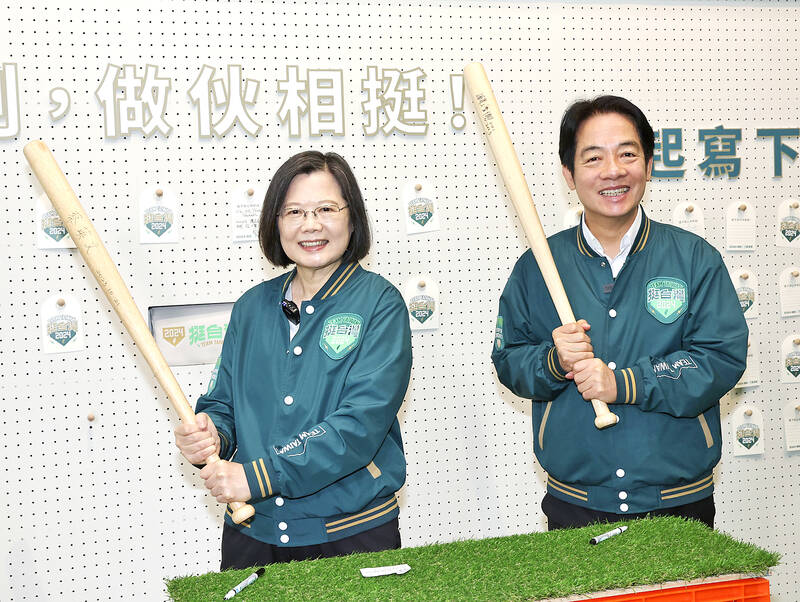
Photo courtesy of the Taipei Photojournalist Society
Tsai pointed out the interior decor and said: “Everyone knows that he [Lai] is a passionate baseball fan. Running an election campaign is much like playing baseball, where the on-field situation could change in an instant, and every inning has its unique circumstances.”
“When the game is on, a team must take up smart strategies and adapt to changing situations. It is vital to seize every scoring opportunity and to defend against each opponent’s turn,” she said. “A baseball game is not played by a single person, and all players matter; it is important to cooperate and execute the strategy to win.”
Lai said that the campaign headquarters is in the same place as Tsai’s campaign office during the 2016 and 2020 presidential elections.
“This place is blessed with good fortune, and it will carry us to victory,” Lai said. “Taiwan can be stronger on the path to democracy.”
Lai thanked the designers for the decor expressing his personal love of baseball, the most popular team sport in Taiwan.
Visitors upon entering are met with a visual that reads “Team Taiwan” over a graphic representation of Jade Mountain, the nation’s highest peak, along with the slogan “The MVP of Democracy” on the adjacent wall. There is a visual of rolling giant baseballs on a wall, while the floor of the office is green, representing the outfield of a ballpark.
Lai said members of the design team are young people, as he lauded them along with others working for his campaign, adding that they provided hope for Taiwan’s future.
“It is like President Tsai said in her address, running an election campaign is like playing baseball, which requires good teamwork. To build up our nation, we also need a good team — made of people from all occupations and all sectors — to unite in this effort, endeavoring to strengthen Taiwan and make a better future. In doing so, Taiwan can also make more concrete contributions to the world,” Lai said.

Considering that most countries issue more than five denominations of banknotes, the central bank has decided to redesign all five denominations, the bank said as it prepares for the first major overhaul of the banknotes in more than 24 years. Central bank Governor Yang Chin-lung (楊金龍) is expected to report to the Legislative Yuan today on the bank’s operations and the redesign’s progress. The bank in a report sent to the legislature ahead of today’s meeting said it had commissioned a survey on the public’s preferences. Survey results showed that NT$100 and NT$1,000 banknotes are the most commonly used, while NT$200 and NT$2,000

The Centers for Disease Control (CDC) yesterday reported the first case of a new COVID-19 subvariant — BA.3.2 — in a 10-year-old Singaporean girl who had a fever upon arrival in Taiwan and tested positive for the disease. The girl left Taiwan on March 20 and the case did not have a direct impact on the local community, it said. The WHO added the BA.3.2 strain to its list of Variants Under Monitoring in December last year, but this was the first imported case of the COVID-19 variant in Taiwan, CDC Deputy Director-General Lin Ming-cheng (林明誠) said. The girl arrived in Taiwan on

South Korea is planning to revise its controversial electronic arrival card, a step Taiwanese officials said prompted them to hold off on planned retaliatory measures, a South Korean media report said yesterday. A Yonhap News Agency report said that the South Korean Ministry of Foreign Affairs is planning to remove the “previous departure place” and “next destination” fields from its e-arrival card system. The plan, reached after interagency consultations, is under review and aims to simplify entry procedures and align the electronic form with the paper version, a South Korean ministry official said. The fields — which appeared only on the electronic form

The Ministry of Foreign Affairs (MOFA) is suspending retaliation measures against South Korea that were set to take effect tomorrow, after Seoul said it is updating its e-arrival system, MOFA said today. The measures were to be a new round of retaliation after Taiwan on March 1 changed South Korea's designation on government-issued alien resident certificates held by South Korean nationals to "South Korea” from the "Republic of Korea," the country’s official name. The move came after months of protests to Seoul over its listing of Taiwan as "China (Taiwan)" in dropdown menus on its new online immigration entry system. MOFA last week


 RSS
RSS