


In addition to providing farmers with banana seedlings, the Taiwan Banana Research Institute has also dedicated funding and time to research efforts that help develop different kinds of banana products, the most recent being its banana flower-based cosmetic products.
Institute director Chiu Chu-ying (邱祝櫻) said the institute, located in Pingtung County, had used banana flower extract to create an assortment of cosmetic products, including hydrolates, face-wash mousses, moisturizers and mosquito repellents.
Chiu said institute visitors were surprised that banana flowers could be used in such a fashion.
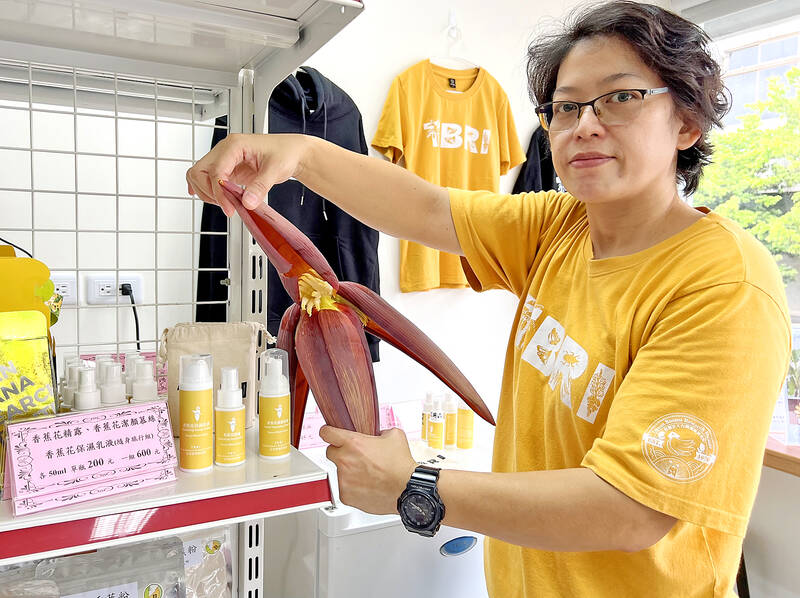
Photo: Lo Hsin-chen, Taipei Times
FLOWER EXTRACTS
Chiu said the institute is in talks with manufacturers on the development of even more diversified products using banana flower hydrolates and extracts.
Institute manager Pan Wei-hsin (潘唯心) said the institute saw a rise in visitor numbers during the post-COVID-19 pandemic period and, in order to provide visitors with more room, the institute is repurposing a workroom as an on-site store, selling the various products made by the institute.
The institute was founded with the goal of enhancing Taiwanese banana production and sales, with a large part of its research dedicated to the prevention of pests that would prey on banana crops, the conservation of banana species and research into new hybrid cultivars, as well as technology on propagating healthy banana seedlings.
The institute also conducts research into specific fertilizers for bananas, as well as improving banana harvesting and transportation.
The institute said that just this month, the CEO of the Vietnam-based Truong Hai Group, Tran Ba-duong (陳寶山), visited the institute and said that Taiwan’s precision agriculture was doing well for itself, as it could make many diverse products.
The institute said that developing alternative and diverse products utilizing bananas could increase the added value of processed banana goods and would alleviate the issue of banana overproduction.

Considering that most countries issue more than five denominations of banknotes, the central bank has decided to redesign all five denominations, the bank said as it prepares for the first major overhaul of the banknotes in more than 24 years. Central bank Governor Yang Chin-lung (楊金龍) is expected to report to the Legislative Yuan today on the bank’s operations and the redesign’s progress. The bank in a report sent to the legislature ahead of today’s meeting said it had commissioned a survey on the public’s preferences. Survey results showed that NT$100 and NT$1,000 banknotes are the most commonly used, while NT$200 and NT$2,000

The Centers for Disease Control (CDC) yesterday reported the first case of a new COVID-19 subvariant — BA.3.2 — in a 10-year-old Singaporean girl who had a fever upon arrival in Taiwan and tested positive for the disease. The girl left Taiwan on March 20 and the case did not have a direct impact on the local community, it said. The WHO added the BA.3.2 strain to its list of Variants Under Monitoring in December last year, but this was the first imported case of the COVID-19 variant in Taiwan, CDC Deputy Director-General Lin Ming-cheng (林明誠) said. The girl arrived in Taiwan on

South Korea is planning to revise its controversial electronic arrival card, a step Taiwanese officials said prompted them to hold off on planned retaliatory measures, a South Korean media report said yesterday. A Yonhap News Agency report said that the South Korean Ministry of Foreign Affairs is planning to remove the “previous departure place” and “next destination” fields from its e-arrival card system. The plan, reached after interagency consultations, is under review and aims to simplify entry procedures and align the electronic form with the paper version, a South Korean ministry official said. The fields — which appeared only on the electronic form

The Ministry of Foreign Affairs (MOFA) is suspending retaliation measures against South Korea that were set to take effect tomorrow, after Seoul said it is updating its e-arrival system, MOFA said today. The measures were to be a new round of retaliation after Taiwan on March 1 changed South Korea's designation on government-issued alien resident certificates held by South Korean nationals to "South Korea” from the "Republic of Korea," the country’s official name. The move came after months of protests to Seoul over its listing of Taiwan as "China (Taiwan)" in dropdown menus on its new online immigration entry system. MOFA last week


 RSS
RSS