


The Democratic Progressive Party (DPP) yesterday unveiled its first election campaign video in which it accused main opposition party members of “treason” and of trying to mislead the public.
DPP spokesman Chang Chih-hao (張志豪) said that Chinese Nationalist Party (KMT) Legislator Ma Wen-chun (馬文君) continues to receive complete support from KMT officials, following allegations of leaking national secrets by passing classified materials related to Taiwan’s indigenous submarine project to South Korean officials, and of attempting to derail it.
Speaking at the DPP headquarters, Chang introduced the party’s campaign video, opening with a photo of Ma accompanied by text that read: “Treason?” and “Leaking Secrets?”
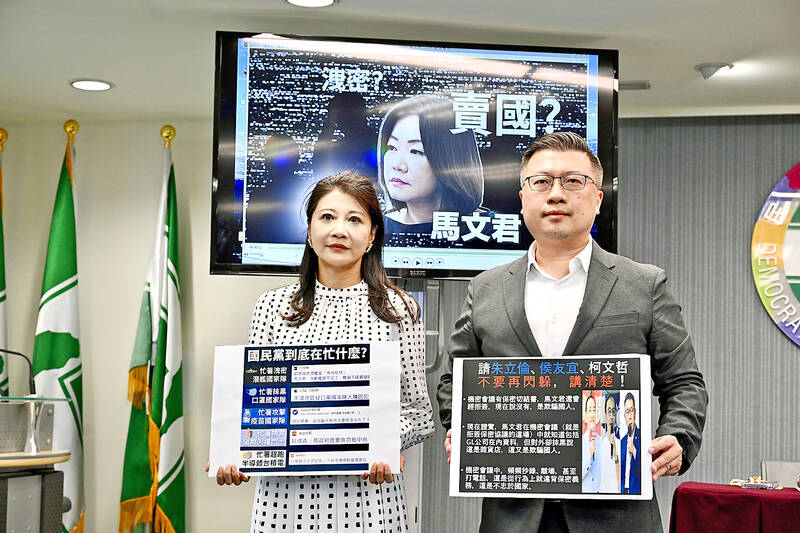
Photo: Lo Pei-de, Taipei Times
It asks three questions: “Why did you refuse to sign the confidentiality agreement?” “Who did you pass the materials to and what kinds of benefits did you gain from that?” and “What was your interest in selling out our nation?”
Chang said Ma should answer the questions and explain the situation clearly to the public.
He also urged Ma to show up at the legislature.
Ma has not attended any legislative sessions in the past two weeks.
Chang said people embroiled in the controversy have presented their accounts of what happened, and provided evidence and new material about Ma’s actions, but the KMT’s presidential candidate, New Taipei City Mayor Hou You-yi (侯友宜), and party chairman Eric Chu (朱立倫), along with many KMT legislators and party officials, have provided firm support for Ma.
Chang said evidence and witnesses’ accounts show that Ma copied classified materials by hand, made calls during a meeting and took a break to talk to someone outside.
“She has violated secrecy rules and leaked national secrets related to the classified submarine program, which were meant to be seen by legislators in closed-door meetings only and were not meant to be taken out. In doing so, she committed treason and betrayed our nation,” Chang added.
KMT members have always expressed strong loyalty to the Republic of China (ROC), but “do these KMT members really have ROC in their hearts?” Chang said.
“How many more Ma Wen-chu-type people are there in the KMT? Is the KMT forming an organization to commit treason and sell out this nation?” he added
“In this campaign video, we want to show the public Ma’s acts of treason, and that she has the solid support of KMT leaders and the party’s ‘fighting blue faction,’ as they are acting together to betray Taiwan in favor of the enemy,” DPP spokeswoman Michelle Lin (林楚茵) said.
Lin said voters should consider that if Ma and some other KMT members get elected in January elections, then Taiwan would have no future, with the KMT undermining national security.
“Ma at first claimed that she asked the Ministry of Foreign Affairs to pass the materials to the South Korean Mission in Taipei, and then she was told to send them herself by registered mail, but foreign affairs officials have refuted Ma’s version of the story,” Lin said, adding that Ma refuses to answer the DPP’s questions.
“Ma also claimed she did not make a call while reviewing classified submarine materials in a closed-door meeting, but one defense ministry official gave an eyewitness account saying that Ma used her phone and made calls... Then she also claimed that the deputy defense minister told her the materials were not classified, but this also was refuted,” Lin said.

Considering that most countries issue more than five denominations of banknotes, the central bank has decided to redesign all five denominations, the bank said as it prepares for the first major overhaul of the banknotes in more than 24 years. Central bank Governor Yang Chin-lung (楊金龍) is expected to report to the Legislative Yuan today on the bank’s operations and the redesign’s progress. The bank in a report sent to the legislature ahead of today’s meeting said it had commissioned a survey on the public’s preferences. Survey results showed that NT$100 and NT$1,000 banknotes are the most commonly used, while NT$200 and NT$2,000

The Centers for Disease Control (CDC) yesterday reported the first case of a new COVID-19 subvariant — BA.3.2 — in a 10-year-old Singaporean girl who had a fever upon arrival in Taiwan and tested positive for the disease. The girl left Taiwan on March 20 and the case did not have a direct impact on the local community, it said. The WHO added the BA.3.2 strain to its list of Variants Under Monitoring in December last year, but this was the first imported case of the COVID-19 variant in Taiwan, CDC Deputy Director-General Lin Ming-cheng (林明誠) said. The girl arrived in Taiwan on

South Korea is planning to revise its controversial electronic arrival card, a step Taiwanese officials said prompted them to hold off on planned retaliatory measures, a South Korean media report said yesterday. A Yonhap News Agency report said that the South Korean Ministry of Foreign Affairs is planning to remove the “previous departure place” and “next destination” fields from its e-arrival card system. The plan, reached after interagency consultations, is under review and aims to simplify entry procedures and align the electronic form with the paper version, a South Korean ministry official said. The fields — which appeared only on the electronic form

The Ministry of Foreign Affairs (MOFA) is suspending retaliation measures against South Korea that were set to take effect tomorrow, after Seoul said it is updating its e-arrival system, MOFA said today. The measures were to be a new round of retaliation after Taiwan on March 1 changed South Korea's designation on government-issued alien resident certificates held by South Korean nationals to "South Korea” from the "Republic of Korea," the country’s official name. The move came after months of protests to Seoul over its listing of Taiwan as "China (Taiwan)" in dropdown menus on its new online immigration entry system. MOFA last week


 RSS
RSS