


The Mainland Affairs Council (MAC) yesterday told legislators in a plenary session that it has asked temples and universities to be on alert for attempts by the Chinese Communist Party (CCP) to interfere in next year’s presidential and legislative elections.
With only 88 days left until the elections, legislators asked Premier Chen Chien-jen (陳建仁) and MAC Minister Chiu Tai-san (邱太三) whether the CCP had intensified campaigns to interfere in the elections.
Democratic Progressive Party Legislator Lai Jui-lung (賴瑞隆) said that some borough wardens and heads of temples in Taiwan were invited to visit China and encouraged to bring people with them.
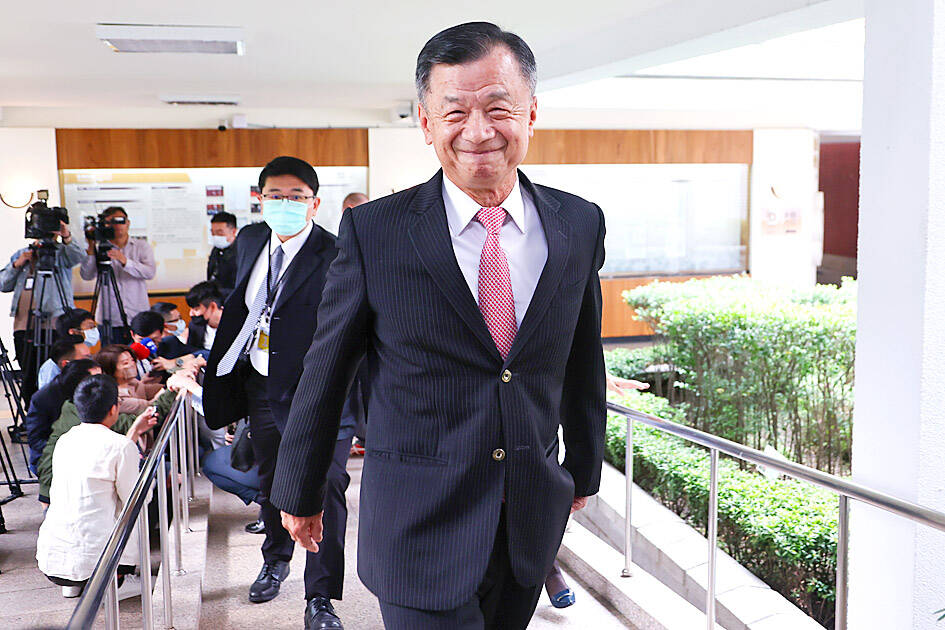
Photo: CNA
He said that he had received information that some university professors were organizing low-priced tours to China for students.
Lai urged the government to quickly respond to disinformation disseminated by the CCP, adding that it should consider responding to false information with videos instead of placards.
“We, as a democratic and free society, cannot afford to let the CCP regime interfere in our elections using disinformation. A false statement can become the truth when it is said multiple times, as people are utterly confused,” he said.
Beijing has tried to influence the outcomes of Taiwanese elections using numerous tactics, from organizing cultural and trade events to hosting Taiwanese politicians, Chiu said.
“The CCP’s Central Leading Group for Taiwan Affairs has since May tried to cover up manipulation tactics in the name of ‘expanded cross-strait exchange.’ However, they cannot accomplish much with these strategies because of restrictions on cross-strait exchanges imposed from both sides. As such, they have moved venues for ‘united front’ work from Taiwan to China,” he said.
“We have recently communicated the seriousness of this issue with the management of several important temples in Taiwan. The Ministry of Education has also reminded professors and students of the legal risks of traveling to China, and they are required to apply in advance and secure permission,” he said.
The Executive Yuan has formed a special task force to tackle disinformation and misinformation, which requires agencies to respond to reports of disinformation within a day under the principle of “speed, accuracy and precision,” Chen said.

Considering that most countries issue more than five denominations of banknotes, the central bank has decided to redesign all five denominations, the bank said as it prepares for the first major overhaul of the banknotes in more than 24 years. Central bank Governor Yang Chin-lung (楊金龍) is expected to report to the Legislative Yuan today on the bank’s operations and the redesign’s progress. The bank in a report sent to the legislature ahead of today’s meeting said it had commissioned a survey on the public’s preferences. Survey results showed that NT$100 and NT$1,000 banknotes are the most commonly used, while NT$200 and NT$2,000

The Centers for Disease Control (CDC) yesterday reported the first case of a new COVID-19 subvariant — BA.3.2 — in a 10-year-old Singaporean girl who had a fever upon arrival in Taiwan and tested positive for the disease. The girl left Taiwan on March 20 and the case did not have a direct impact on the local community, it said. The WHO added the BA.3.2 strain to its list of Variants Under Monitoring in December last year, but this was the first imported case of the COVID-19 variant in Taiwan, CDC Deputy Director-General Lin Ming-cheng (林明誠) said. The girl arrived in Taiwan on

South Korea is planning to revise its controversial electronic arrival card, a step Taiwanese officials said prompted them to hold off on planned retaliatory measures, a South Korean media report said yesterday. A Yonhap News Agency report said that the South Korean Ministry of Foreign Affairs is planning to remove the “previous departure place” and “next destination” fields from its e-arrival card system. The plan, reached after interagency consultations, is under review and aims to simplify entry procedures and align the electronic form with the paper version, a South Korean ministry official said. The fields — which appeared only on the electronic form

The Ministry of Foreign Affairs (MOFA) is suspending retaliation measures against South Korea that were set to take effect tomorrow, after Seoul said it is updating its e-arrival system, MOFA said today. The measures were to be a new round of retaliation after Taiwan on March 1 changed South Korea's designation on government-issued alien resident certificates held by South Korean nationals to "South Korea” from the "Republic of Korea," the country’s official name. The move came after months of protests to Seoul over its listing of Taiwan as "China (Taiwan)" in dropdown menus on its new online immigration entry system. MOFA last week


 RSS
RSS