


Taiwan People’s Party (TPP) chairman and presidential candidate Ko Wen-je’s (柯文哲) campaign office yesterday listed three issues with an open primary system proposed by Chinese Nationalist Party (KMT) presidential candidate Hou You-yi’s (侯友宜) office, saying it respects the suggestion but cannot accept it.
The KMT’s and the TPP’s representatives on Saturday held the first formal meeting in Taipei to form a “blue-white alliance” for next year’s presidential election, and Hou’s campaign office suggested they hold an open primary for deciding the strongest presidential candidate among the two parties, while Ko’s campaign office suggested that it should be decided based on the average result of opinion polls.
An open primary election would have three issues, namely under-representation, listing issues and limited preparation time, Ko’s office said.

Photo: George Tsorng, Taipei Times
As the KMT Chairman Eric Chu (朱立倫) stated that the minimum threshold for the primary to be valid should be at least 50 percent of the alliance’s voter base, then at least 5.5 million votes would be needed, it said.
Hou’s campaign office proposed to set up 73 voting stations for the primary, which means on average there should be about 80,000 votes cast at each station on a single day, it said, adding that otherwise public opinion would be misrepresented.
As for the listing issues, the office said the fairness of physical voting relies on avoidance of multiple voting and personation, but a primary held by opposition parties cannot have access to the government’s household registration system, and if voters are only required to sign a form saying they approve of opposition parties working together to remove the Democratic Progressive Party (DPP) from power, the votes might still cause misrepresentation.
It is also difficult for the two parties to create a primary election list with accreditation and sufficient security in such a short time, it added.
According to the KMT’s suggested timetable, the primary election should be completed by Nov. 10, which is 26 days away, it said, adding that the DPP adopted the same open primary system in 1995, and it took over six months to prepare to collect about 300,000 votes.
When the New Party held a primary election in 1998, it resulted in the controversy of members being taken to voting stations by chartered buses, it added.
When the KMT was preparing for the presidential election in 2019, Broadcasting Corp of China president Jaw Shaw-kong (趙少康) also proposed the primary system to then-KMT chairman Wu Den-yih (吳敦義), but it was not accepted.
The primary system has proven to be a failure by the two parties, so the KMT’s proposal to use the method only shows its intention to utilize the party’s voter mobilization capacity, but lacks sincerity to integrate with the TPP, Ko’s office said.
The open primary election proposed by the KMT is actually a closed primary, as voters need to sign a form to cast a vote, and the location where the voting stations are set up might also affect people’s willingness to vote, Ko’s office said.
The method of comparing polling results — conducted by five agencies, half via landline interviews and half via cellphone — proposed by Ko’s campaign office could reflects the real public opinion better, it said.
Earlier yesterday, Hou said the open primary election has been used in many democratic countries for many years, including the US, France and South Korea.
“I believe it is a scientific and democratic method to voice the public opinion,” he said.
The KMT would show its greatest tolerance, understanding and friendliness, in hope to form the “blue-white alliance,” he added.
Additional reporting by Lai Hsiao-tung

Chinese spouse and influencer Guan Guan’s (關關) residency permit has been revoked for repeatedly posting pro-China videos that threaten national security, the National Immigration Agency confirmed today. Guan Guan has said many controversial statements in her videos posted to Douyin (抖音), including “the red flag will soon be painted all over Taiwan” and “Taiwan is an inseparable part of China,” and expressing hope for expedited reunification. The agency last year received multiple reports alleging that Guan Guan had advocated for armed reunification. After verifying the reports, the agency last month issued a notice requiring her to appear and explain her actions. Guan

GIVE AND TAKE: Blood demand continues to rise each year, while fewer young donors are available due to the nation’s falling birthrate, a doctor said Blood donors can redeem points earned from donations to obtain limited edition Formosan black bear travel mugs, the Kaohsiung Blood Center said yesterday, as it announced a goal of stocking 20,000 units of blood prior to the Lunar New Year. The last month of the lunar year is National Blood Donation Month, when local centers seek to stockpile blood for use during the Lunar New Year holiday. The blood demand in southern Taiwan — including Tainan and Kaohsiung, as well as Chiayi, Pingtung, Penghu and Taitung counties — is about 2,000 units per day, the center said. The donation campaign aims to boost

The Kaohsiung Tourism Bureau audited six hotels in an effort to prevent price gouging ahead of Korean band BTS’ concert tour in the city scheduled for Nov. 19, 21 and 22 this year. The bureau on Friday said that the audits — conducted in response to allegations of unfair pricing posted on social media — found no wrongdoing. These establishments included the local branches of Chateau de Chine, Hotel Nikko, My Humble House, and Grand Hai Lai, it said, adding that the Consumer Protection Commission would have penalized price gougers had the accusations been substantiated. The bureau said the Tourism Development Act
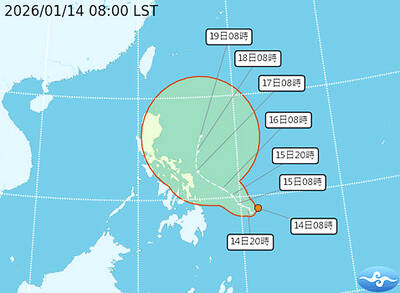
BACK TO WINTER: A strong continental cold air mass would move south on Tuesday next week, bringing colder temperatures to northern and central Taiwan A tropical depression east of the Philippines could soon be upgraded to be the first tropical storm of this year, the Central Weather Administration (CWA) said yesterday, adding that the next cold air mass is forecast to arrive on Monday next week. CWA forecaster Cheng Jie-ren (鄭傑仁) said the first tropical depression of this year is over waters east of the Philippines, about 1,867km southeast of Oluanpi (鵝鑾鼻), and could strengthen into Tropical Storm Nokaen by early today. The system is moving slowly from northwest to north, and is expected to remain east of the Philippines with little chance of affecting Taiwan,


 RSS
RSS