


Environmental advocacy groups on Thursday called on the government to finalize how much it would charge companies for carbon emissions.
The Green Citizens’ Action Alliance, together with the Environmental Rights Foundation and the Taiwan Climate Action Network, questioned the government’s resolve to reduce carbon emissions.
The Ministry of Environment is prioritizing the implementation of a carbon credit exchange system, which “has no real substantive effect on reducing carbon emissions,” Environmental Rights Foundation researcher Lin Yen-ting (林彥廷) said.
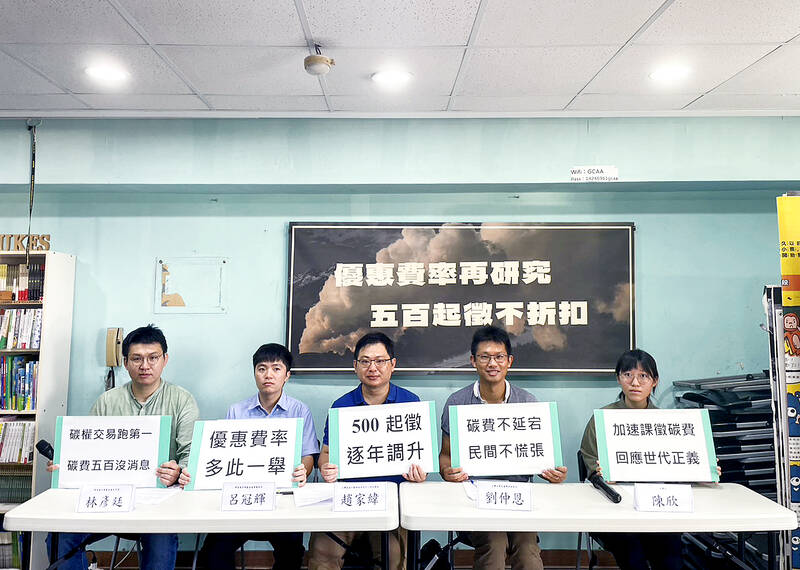
Photo courtesy of the Environmental Rights Foundation
The exchange is based on the premise that big emitters can fulfill their obligation to reduce carbon emissions simply by purchasing credits if they fall short of their commitments, Lin said.
In other words, the exchange system is a nonstarter for carbon emissions reduction in the absence of a carbon fee, Environmental Rights Foundation lawyer Lu Kuan-hui (呂冠輝) said.
“We have only three months left until we get to 2024,” which is supposed to be the baseline year of carbon emissions quantification for fee collection to happen in 2025, “but the rate has still not been decided,” Lu said.
Starting in 2025, carbon fees are to be collected annually from businesses that emit more than 25,000 tonnes of carbon dioxide the previous year, the ministry said.
As next year is to serve as the basis for the collection of carbon fees in 2025, the carbon fee rate should be finalized by the end of this year.
As for the actual carbon fee rate, the government has hinted that it might be NT$300 per tonne of carbon emissions, which is too low, Taiwan Climate Action Network chairman Chao Chia-wei (趙家緯) said.
The US Environmental Protection Agency has estimated that the cost of carbon emissions on society not reflected in market prices, known as the “externality” of carbon emissions, is about US$190 a tonne, Chao said.
“That would mean only 5 percent of the externality is reflected at the NT$300 rate,” he said.
Based on his group’s calculations, a rate of NT$500 per tonne would be the minimum necessary for Taiwan’s cement, steel and petrochemical industries, which account for one-quarter of the nation’s carbon emissions, to take the initiative to cut emissions.
The government has also proposed offering a preferential rate or a discount on carbon fees for companies in target industries that take initiatives to reduce emissions, an idea that the environmental groups did not support.
John Chung-en Liu (劉仲恩), an associate professor of sociology at National Taiwan University, said the preferential rate would defeat the purpose of charging carbon fees, which is that “polluters pay,” and would be more cumbersome to implement.
The ministry’s Climate Change Administration said that carbon fees would be charged if the companies that applied for the preferential rate failed to reach their proposed emission reduction goals.
It said the accusation that it was prioritizing a carbon credit exchange was “a misunderstanding,” as the carbon fee collection system was designed to be complemented by other measures aimed at pressuring companies to cut emissions.
It said the exchange has always been seen as “the last resort,” but did not explain why it has yet to set a carbon rate.
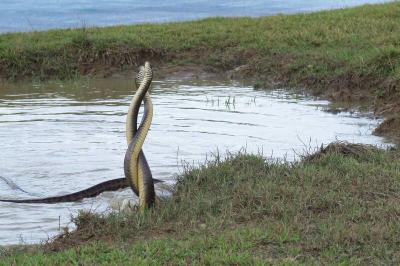
Kenting National Park service technician Yang Jien-fon (楊政峰) won a silver award in World Grand Prix Photography Awards Spring Season for his photograph of two male rat snakes intertwined in combat. Yang’s colleagues at Kenting National Park said he is a master of nature photography who has been held back by his job in civil service. The awards accept entries in all four seasons across six categories: architectural and urban photography, black-and-white and fine art photography, commercial and fashion photography, documentary and people photography, nature and experimental photography, and mobile photography. Awards are ranked according to scores and divided into platinum, gold and
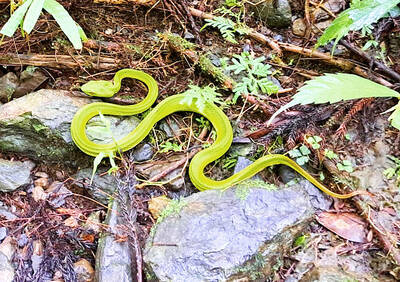
More than half of the bamboo vipers captured in Tainan in the past few years were found in the city’s Sinhua District (新化), while other districts had smaller catches or none at all. Every year, Tainan captures about 6,000 snakes which have made their way into people’s homes. Of the six major venomous snakes in Taiwan, the cobra, the many-banded krait, the brown-spotted pit viper and the bamboo viper are the most frequently captured. The high concentration of bamboo vipers captured in Sinhua District is puzzling. Tainan Agriculture Bureau Forestry and Nature Conservation Division head Chu Chien-ming (朱健明) earlier this week said that the
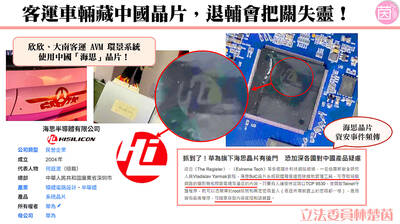
BREACH OF CONTRACT: The bus operators would seek compensation and have demanded that the manufacturer replace the chips with ones that meet regulations Two bus operators found to be using buses with China-made chips are to demand that the original manufacturers replace the systems and provide compensation for breach of contract, the Veterans Affairs Council said yesterday. Democratic Progressive Party Legislator Michelle Lin (林楚茵) yesterday said that Da Nan Bus Co and Shin-Shin Bus Co Ltd have fielded a total of 82 buses that are using Chinese chips. The bus models were made by Tron-E, while the systems provider was CYE Electronics, Lin said. Lin alleged that the buses were using chips manufactured by Huawei subsidiary HiSilicon Co, which presents a national security risk if the

The National Immigration Agency has banned two Chinese from returning to Taiwan, after they published social media content it described as disrespectful to national sovereignty. The agency imposed a two-month ban on a Chinese man surnamed Liang (梁) and a permanent ban on a woman surnamed Yang (楊), an influencer with 23 million followers, in October last year and last week respectively. Minister of the Interior Liu Shyh-fang (劉世芳) yesterday said on the sidelines of a legislative meeting that Chinese visitors to Taiwan are required to comply with the rules and regulations governing their entry permits. The government has handled the ban and


 RSS
RSS