


Independent presidential hopefuls who collect enough signatures to qualify for the Jan. 13 presidential election would not be in contravention of the law if they drop out as long as they have not registered their candidacy with the Central Election Commission (CEC) as a candidate, CEC Chairperson Lee Chin-yung (李進勇) said yesterday.
Independent presidential hopefuls and their running mates, who are required to pass a petition threshold to qualify, can register as petition initiators with the CEC from today until Sunday, and can submit signatures from Tuesday next week to Nov. 2, the CEC said.
The results of the petitions would be announced by Nov. 14, it added.
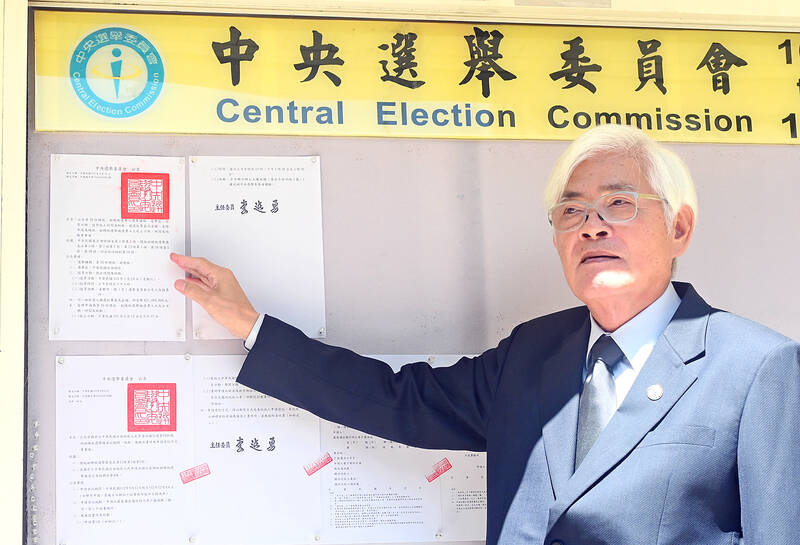
Photo: Wang Yi-sung, Taipei Times
On whether independent presidential hopefuls who have launched a petition for candidacy would be in contravention of Article 30 of the Presidential and Vice Presidential Election and Recall Act (總統副總統選舉罷免法) if they later decide to pull out of the race, Lee said: “If they do not register, withdrawal is not an issue. If they have registered, then withdrawal is out of the question.”
Hon Hai Precision Industry Co founder Terry Gou (郭台銘) last month announced his presidential bid, but has yet to announce his running mate.
Asked if independent presidential aspirants are legally liable if they abandon their campaign after submitting signatures to the commission, Lee said such an action would not be an infraction, as that would just mean they have forfeited the opportunity to register as presidential candidates.
“The decision of whether or not aspirants register as candidates falls within their civil right to participate in political affairs, and the CEC shall respect that decision,” CEC Vice Chairperson Chen Chao-chien (陳朝建) added.
“However, once they have registered as candidates under the act, they cannot withdraw their candidacy,” he said.
Candidates nominated by parties or independent candidates who collect enough signatures to qualify as candidates in the presidential election are required to register from Nov. 20 to 24.
Under the act, independent presidential hopefuls must obtain 289,667 signatures, or 1.5 percent of eligible voters in the previous presidential election, to qualify as candidates.
Those who attempt to “negotiate other candidates out” of the election by promising or giving them bribes or other undue benefits risk a prison term of three to 10 years and a fine of NT$2 million to NT$20 million (US$62,438 to US$624,376) under the act, Chen said.
Those who attempt to bribe eligible voters to petition for or against a presidential hopeful face a prison term of one to seven years and a fine of NT$1 million to NT$10 million, he said.

In a historic first, Taiwanese officials participated in this year’s Riga Strategic Communications Dialogue in Latvia from Wednesday to Friday last week, which debuted a breakout session focused on Taiwan The event organizer, the NATO Strategic Communications Center of Excellence, displayed Taiwan’s national flag and the officials’ formal titles on their Web site. Taiwanese attendees included National Security Council (NSC) Deputy Secretary-General Lin Fei-fan (林飛帆) and deputy head of the Taipei Representative Office in the UK, Chiang Ya-chi (江雅綺). In addition to the session discussing Taiwan titled “Taiwan: Navigating Strategic Communication in a Tense Environment,” the dialogue also included sessions
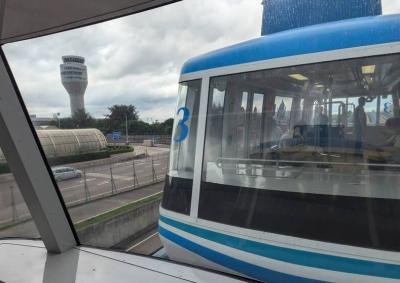
Taiwan Taoyuan International Airport is to suspend its automated Skytrain service connecting Terminal 1 and Terminal 2 starting on July 1 to facilitate connection works for the upcoming Terminal 3, the airport operator said today. Passengers and staff who need to travel between the two terminals after the suspension can instead use the Taoyuan MRT or the airport's 24-hour shuttle bus service, Taoyuan International Airport Corp said. The Taoyuan MRT Airport Line directly links the two terminals, while the shuttle buses are to operate around the clock, the company added. The Skytrain provides free transportation between the airport’s two terminals for travelers and
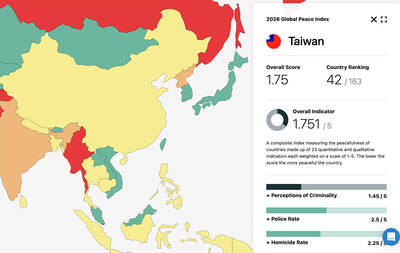
Taiwan ranked 42nd in terms of peacefulness among 163 countries, down five places from last year, according to this year’s Global Peace Index. With an overall score of 1.751, Taiwan dropped from 37th last year, the report published by the global Institute for Economics and Peace showed. The overall score measures a country’s level of peacefulness using 23 quantitative and qualitative indicators across three domains — ongoing domestic and international conflict, societal safety and security, and militarization. While Taiwan ranked 42nd worldwide, it was listed in ninth place among the 19 Asian-Pacific countries in the report, after New Zealand, Singapore, Japan, Malaysia,

TOKYO-MANILA DELIMITATION TALKS: Beijing is attempting to use this opportunity to normalize patrols and law enforcement in the waters east of Taiwan, MOFA said China has no law enforcement authority over the waters east of Taiwan, the Ministry of Foreign Affairs (MOFA) said yesterday, accusing China of undermining regional peace and stability. The Chinese Ministry of Transport on Saturday evening announced that it had launched a “special maritime law enforcement operation” in the waters east of Taiwan, dispatching coast guard vessels to engage in illegal enforcement activities, the ministry said. State-run Xinhua news agency said the operation was “a necessary action taken in response to Japan and the Philippines unilaterally announcing the initiation of maritime boundary delimitation negotiations in the waters east of China’s Taiwan island,


 RSS
RSS