


President Tsai Ing-wen (蔡英文) yesterday on Armed Forces Day urged Taiwanese to show support for the military and protect the nation together.
“Armed Forces Day is only one day, but our soldiers protect the country 365 days a year, day and night, without holidays,” Tsai wrote on Facebook, as she invited Taiwanese to express their gratitude to military personnel.
She said that the national defense budget for next year is more than NT$606.8 billion (US$19.05 billion), a historical high.
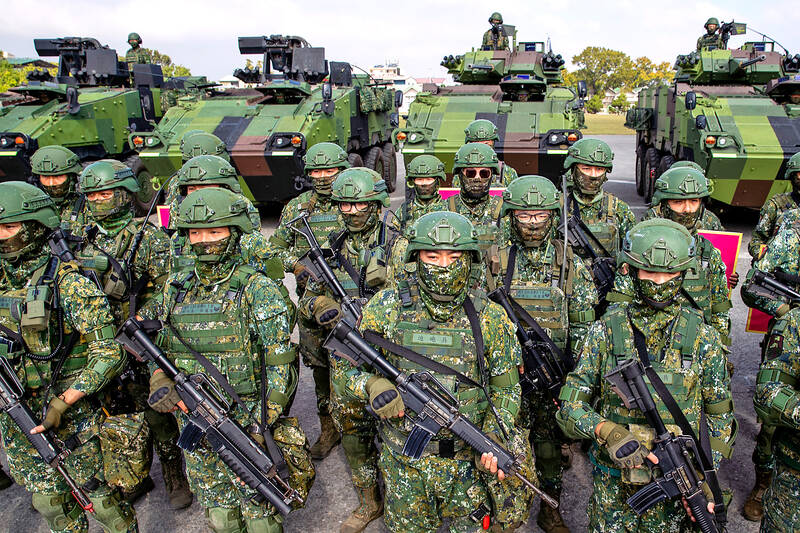
Photo: Ritchie B. Tongo, EPA-EFE
The environment on military bases is continuously improving, and more than 60,000 soldiers are expected to have more comfortable living quarters by the end of next year, she said.
Taiwan is enhancing military training and bolstering its reserve forces to achieve defense autonomy, to show the world the nation’s determination to protect democracy and freedom, she said.
“Our country is stronger because of the military’s devotion,” she wrote. “Let us thank the military for their efforts and be their backup, working together to protect our country.”
Vice President William Lai (賴清德), the Democratic Progressive Party’s (DPP) presidential candidate in next year’s election, also expressed his gratitude to the military in a Facebook post, writing that their sacrifice ensures Taiwanese can live in peace.
“The armed forces are the basis of national security, so giving the military our biggest support is the government’s responsibility,” he wrote.
“Taiwan is on the front line of democracy’s stand against authoritarianism, and the armed forces are at the front line of protecting peace in the Taiwan Strait,” he said. “As the world is closely watching the state of peace and stability in the Indo-Pacific region, we should stand in unity against external threats, and become a strong backup for our military.”
New Taipei City Mayor Hou You-yi (侯友宜), the Chinese Nationalist Party’s (KMT) presidential candidate, wrote on Facebook that he respects those who serve in the military and Taiwanese should support the armed forces.
“Maintaining cross-strait peace and stability, and avoiding war are the biggest hopes of Taiwanese and the armed forces, but under the administration of the DPP in the past few years, the scale between war and peace is tilting toward the risk of a fierce battle, which is a concern for Taiwanese and the armed forces, as well as the world,” he wrote.
While Taiwan must enhance its national defense capabilities, but as the government has emphasized purchasing new weapons and equipment, it has forgotten about those who serve in the military, as they determine the nation’s military strength.
He said that if elected president, he would raise military wages, and review the military pension and promotion mechanisms.
Taiwan People’s Party Chairman and presidential candidate Ko Wen-je (柯文哲) wrote on Facebook that the armed forces are Taiwan’s lifeline, adding that the national defense budget should be at least 3 percent of GDP.
He wrote that the military budget should be considered in three parts: personnel, operations and investment, adding that financial discipline should be accomplished through an item-by-item review of by the legislature.
As automated and “intelligent” weapon systems are an irreversible trend, the government should revise its labor-intensive strategies and add new technologies to training programs to build a modern military, Ko said.
Hon Hai Precision Industry Co founder Terry Gou (郭台銘), who has announced that he would run as an independent presidential candidate, wrote on Facebook that he served in the air force in Kinmen County when China would shell the county’s main island.
Although the Second Taiwan Strait Crisis, during which China fired more than 470,000 shells at Kinmen over 44 days, ended in 1958, China continued to intermittently shell Kinmen until 1979.
Gou said that people who lived through that period of time would not want the same experience for the next generation.
Taiwan must prepare for war, but not be afraid of it, and keep their faith as they pursue peace, he said.
Additional reporting by Lin Hsin-han

Yangmingshan National Park authorities yesterday urged visitors to respect public spaces and obey the law after a couple was caught on a camera livestream having sex at the park’s Qingtiangang (擎天崗) earlier in the day. The Shilin Police Precinct in Taipei said it has identified a suspect and his vehicle registration number, and would summon him for questioning. The case would be handled in accordance with public indecency charges, it added. The couple entered the park at about 11pm on Thursday and began fooling around by 1am yesterday, the police said, adding that the two were unaware of the park’s all-day live
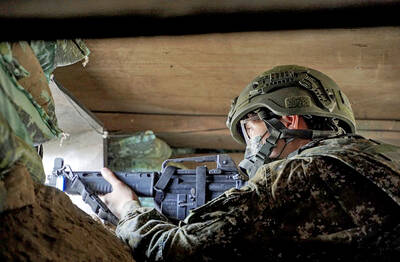
A former soldier and an active-duty army officer were yesterday indicted for allegedly selling classified military training materials to a Chinese intelligence operative for a total of NT$79,440. The Taipei District Prosecutors’ Office indicted Chen Tai-yin (陳泰尹) and Lee Chun-ta (李俊達) for contravening the National Security Act (國家安全法) and the Anti-Corruption Act (貪污治罪條例). Chen left the military in September 2013 after serving alongside then-staff sergeant Lee, now an army lieutenant, at the 21st Artillery Command of the army’s Sixth Corps from 2011 to 2013, according to the indictment. Chen met a Chinese intelligence operative identified as “Wang” (王) through a friend in November

Minister of Digital Affairs Lin Yi-ching (林宜敬) yesterday cited regulatory issues and national security concerns as an expert said that Taiwan is among the few Asian regions without Starlink. Lin made the remarks on Facebook after funP Innovation Group chief executive officer Nathan Chiu (邱繼弘) on Friday said Taiwan and four other countries in Asia — China, North Korea, Afghanistan and Syria — have no access to Starlink. Starlink has become available in 166 countries worldwide, including Ukraine, Malaysia, the Philippines and Vietnam, in the six years since it became commercial, he said. While China and North Korea block Starlink, Syria is not
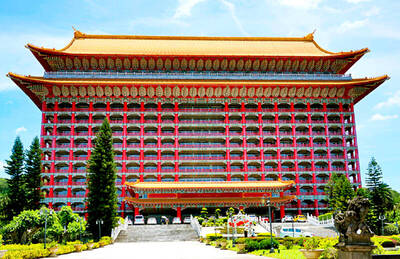
The Grand Hotel Taipei has rejected media reports claiming that the hotel had prevented CBS from broadcasting coverage of the Beijing summit between U.S. President Donald Trump and Chinese President Xi Jinping (習近平) on its premises. Media reports alleging that the hotel owner, dissatisfied with CBS’s coverage, prohibited the network from broadcasting political content on the hotel premises, are not true, the hotel said in a statement issued last night. The reports were “inconsistent with how the hotel actually handled the matter,” it said. The hotel said it received a refund request from a


 RSS
RSS